Renal-Relates to the Kidney
Kidney is part of the Urinary System
Two sets of organs
- Urine forming organs (1)
- Organs that store or carry urine out of the body (3)
- Kidneys
- Ureter, Bladder, Urethra
Outline of Topics
- Nephrons and steps in Urine Formation
- Glomerular Filtration - mechanism and _____
- Tubular Reabsorption - importance of ___ reabsorption
- Tubular Secretion - __, ___, role for ______, Organic ____
- Hydration State and varying the concentration of urine
- Medullary osmotic _____
- Anti____ Hormone
- Variable ___ reabsorption at the distal tubule and CD
- Long Term Control of Blood Pressure through the _____ System
- Nephrons and steps in urine formation
- control
- Na+ reabsorption
- H+, K+, Aldosterone, ions
- Hydration state and varying concentration of urine
- gradient
- ADH
- H20
- Long term B control - RAAS system
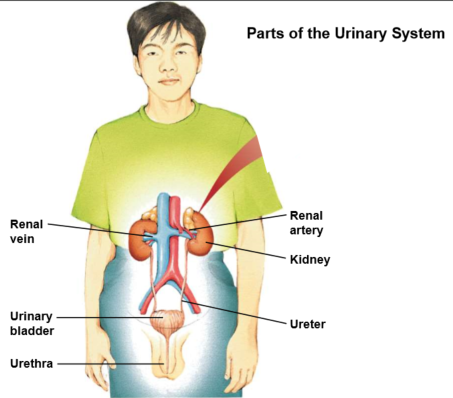
Parts of the Urinary System
Kidneys: major filtering organ of our body
- Filters _____ by taking blood and filter excess fluid, excess electrolytes to be removed from body
- D____ elimination
Renal Blood Flow: (1) branches off abdominal aorta and supplies blood to kidneys -> kidney filters that blood then leaves through (1) -> drains to (1) back into heart
- waste
- drugs
Renal Artery -> Renal Vein -> Abdominal Vena Cava -> heart
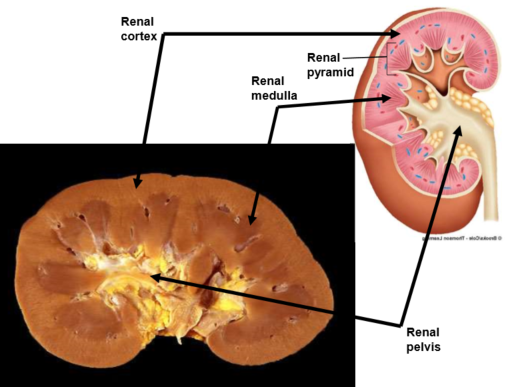
Parts of the Kidney
(1): outer, lighter region
(1): inner darker region
(1): set of tubules where urine collects and drains into renal pelvis
(1): center of kidneys where urine collects and exits through ureter
Renal Cortex
Renal Medulla
Renal Pyramid
Renal Pelvis
Urine is formed in cortex and medulla then drains into renal pelvis
Structure of the Kidneys
Kidneys function as (3) types of organs
Each kidney is composed of about 1 million microscopic functional units called ______:
(2) components
Filtering, Endocrine, Metabolic
Nephrons
Vascular, Tubular Component
Kidney Functions (notes)
We are going to focus on the kidneys filtering function however they also..
Kidneys as Endocrine organs: (1) hormone that acts on bone marrow to stimulate RBC production
Kidneys as Metabolic organs: (1) produces new glucose from substrates such as lactic acid and amino acids (is a main function of liver but kidneys contribute to this)
Erythropoietin (EPO)
Gluconeogenesis
Tubular Components
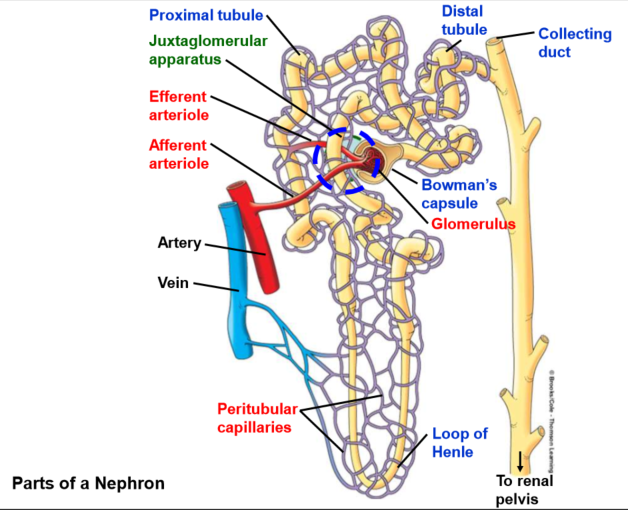
(1): yellow claw like structure that wraps around the Glomerulus
(1): tuft of capillairies where urine formation _____- plasma within capillaries filters across membrane into bowman’s capsule then down tubules
Flow of Urine
(1): first portion of tubule closest to glomerulus
(1): first down descending arm then up ascending arm
(1)
(1): physically attached to about 9-12 nephrons (located in renal pyramid) -> renal _____ -> _____
Bowman’s Capsule
Glomerulus
Proximal Tubule
Loop of Henle
Distal Tubule
Collecting Duct -> renal pelvis -> ureters
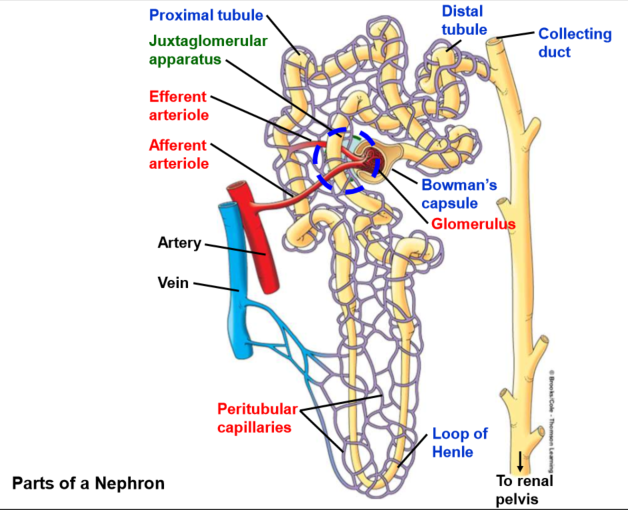
Vascular Components
Flow of Blood
- (1)
- (1): blood moving into Glomerulus
- (1): blood that doesn’t get filtered in glomerulus moves out through this
- (1): network of capillaries (purple net) that surrounds the nephron
- Exchange of substances back and forth between capillaries and tubules adjusts _____ of urine
- (1): then into vena cava
- Renal Artery
- Afferent Arteriole
- Efferent Arteriole
- Peritubular Capillaries
- composition
- Renal Vein
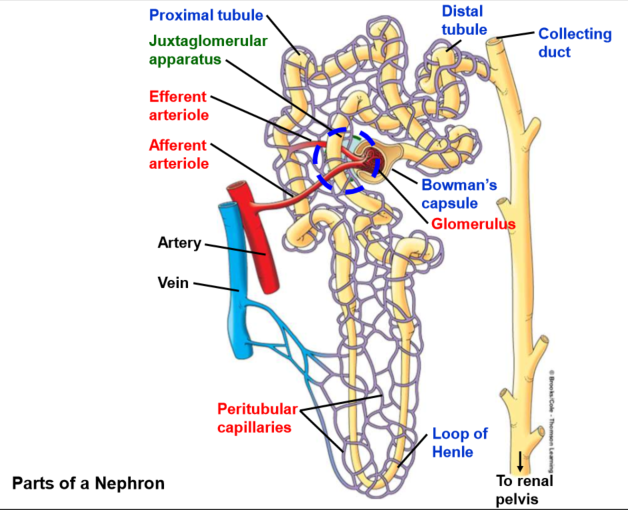
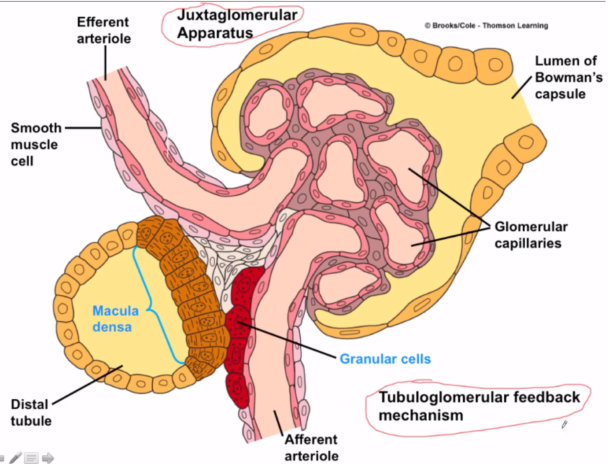
Juxtaglomerular Apparatus
**Importance** =
- juxta-glomerular = right ____ to glomerulus
- Portion of ____ tubule sits close and in between (2) -invaginate (form a V) -> regulates ____ of filtration
REGULATES KIDNEY FUNCTION
- next to glomerulus
- distal, sits between afferenta and efferent arteriole -> regulates rate of filtration
Regional Differences Among Nephrons
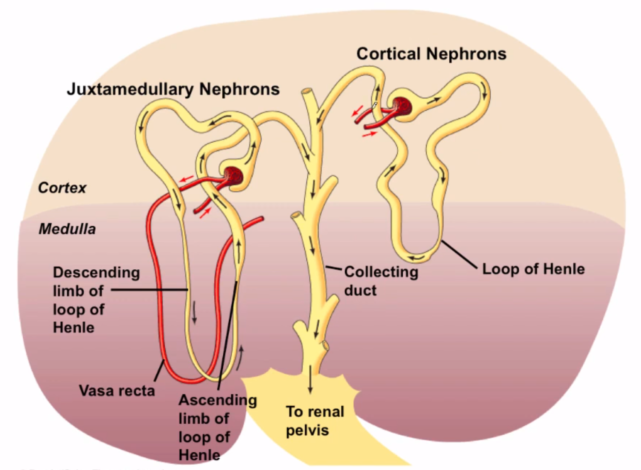
- All nephrons originate in the _____ of the Kidney
- Differ in location of _____ within cortex
- (1) nephrons: glomeruli where?
- (1) nephrons: glomeruli where?
- Differ in location of _____ within cortex
- cortex
- glomeruli
- (Superficial) Cortical Nephrons: outer cortex
- Juxtamedullary Nephrons: inner cortex
- glomeruli
3 Anatomical Differences of Nephrons
- ____ of glomeruli
- _____ of loop of henle
- Juxtamedullary has ___ ____
Juxtamedullary Nephron
- Glomeruli near ____
- ____ loops of henle
- (1): starts with single vessel that parallels the loop of henle and then exits medulla, peritubular capillaries only really wrap around tubular parts in the cortex
Cortical Nephron
- Glomeruli sit near ____ edge of cortex
- ____ loops of henle
- Peritubular capillaries wrap around _____ tubule
- Location
- Lengths
- Vasa Recta
Juxtamedullary Nephron
- medulla (outer cortex)
- Long
- Vasa Recta
Cortical Nephron
- outer
- Short
- entire
Functional Differences Between Nephrons
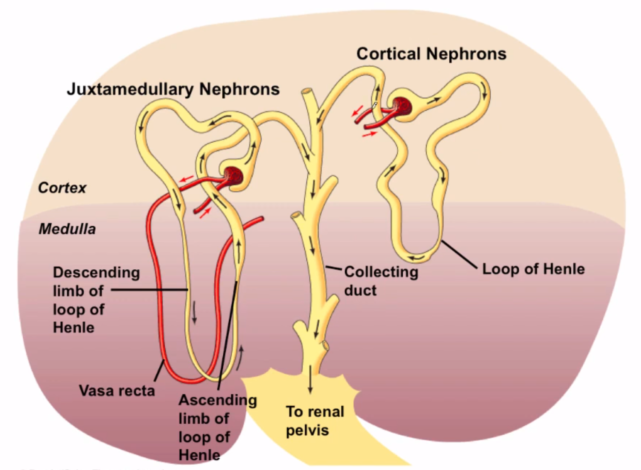
Juxtamedullary Nephrons important function =
- High proportion of juxtamedullary nephrons in what type of animals?
- High proportion of cortical nephrons in what type of animals?
Humans: ___% Juxtamedullary, __% Cortical
Important in kidney conservation of water by allowing kidneys at certain times produce very concentrated urine
- dry climates
- wet climates
20% juxta, 80% cortical
Basic Renal Processes
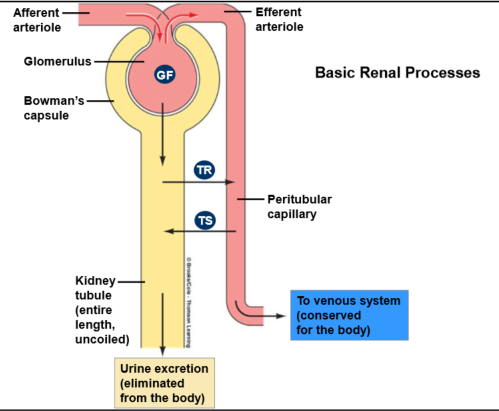
(3)
What percent of plasma that enters glomerulus gets filtered into bowman’s capsule?
Glomerular Filtration (first stage of urine production)
Tubular Reabsorption (tubule -> capillary)
Tubular Secretion (capillary -> tubule)
20%
Glomerular Filtration
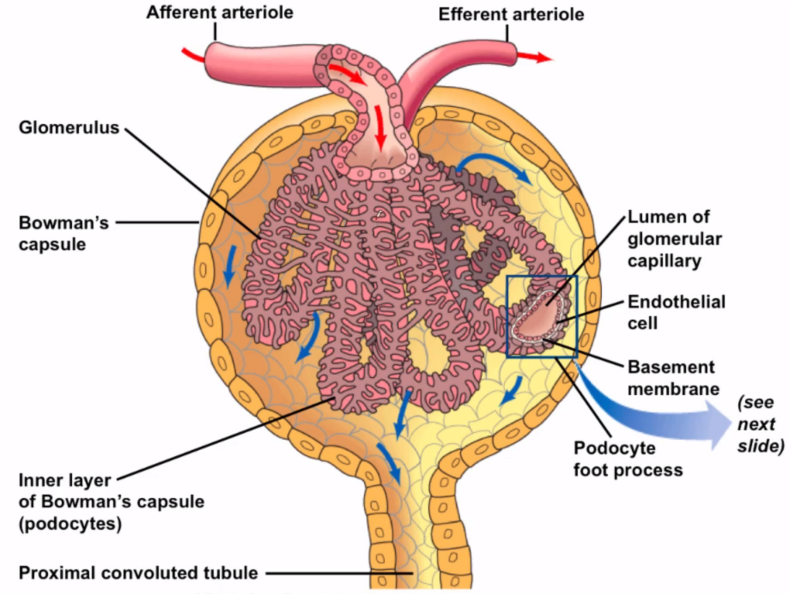
Renal Corpuscule =
(3) Layers of Glomerular Membrane
- GF is a completely ______** and nonselective process
Glomerulus + Bowman’s Capsule
- Wall of Glomerular Capillaries
- Basement Membrane
- Inner Layer of Bowman’s Capsule
- passive**
Glomerular Membrane (Notes)
- _____ cells compose the capillary wall
- White outline = ______ membrane
- (1) make up inner membrane of bowman’s capsule is the spaces in between these processes
Function of Glomerular membrane =
- Fluid that enters Bowman’s capsule (filtrate) _____ in composition of plasma minus (2)
- Endothelial cells
- Basement Membrane
- Podocytes: podo meaning feet, foot processes wrap around capillaries
Prevent plasma proteins and cells from getting out of capillaries
- filtrate identical to plasma minus protein and cells
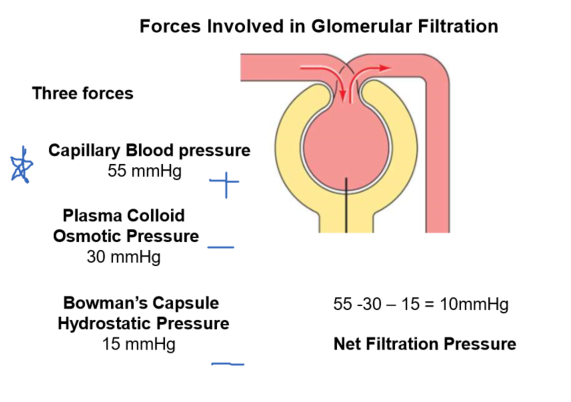
Forces Involved in Glomerular Filtration
(3)
Which forces OPPOSE glomerular filtration?
Net Filtration Pressure =
Capillary Blood Pressure (55) pushing pressure
Plasma Colloid Osmotic Pressure (30) pulling pressure
Bowman’s Capsule Hydrostatic Pressure (15) pushing pressure from bowman’s
Plasma Colloid + Bowman’s Hydrostatic pressures OPPOSE -> only Cap BP promotes GF
10
The Rate of Glomerular Filtration
Depends on (3)
Filtration Coefficient Kf = ___ x ___
GFR = ___ x ___
Net filtration pressure
Surface Area available
Permeability of Glomerular Membrane
SA x Permeability
Kf x net filtration pressure
Rate of Glomerular Filtration (Notes)
- GFR: volume of fluid filtered at glomerulus per ____, measure of renal ___ and ____ of kidneys
- SA = how many functional ____ you have
- Permeability - if membrane gets ____, perm will go down
- Filtration Coefficient Kf should be ____ in a normal healthy person -> if it is then GFR is entirely dependent on (1) AKA capillary blood pressure
- minute, function, health
- nephrons
- injured/scarred
- constant - net filtration pressure
Two Major Mechanisms Control GFR
(2)
Each with Different Goals/Priorities?
Autoregulation
Goal = maintain GFR in the face of normal fluctuations in BP ie. diff positions, stress (intrinsic control, prevents spontaneous changes in GFR whenever arterial BP changes)
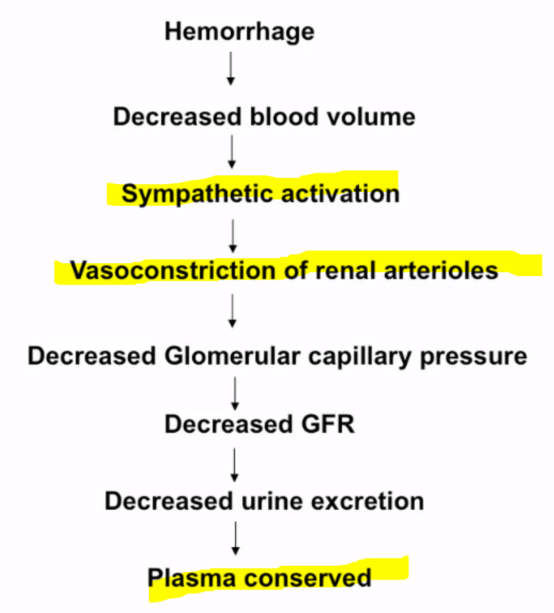
Extrinsic Sympathetic Control
Goal = alter GFR in an attempt to control blood volume and BP ie) if BP drops, GFR is going to drop to conserve fluid
Autoregulation
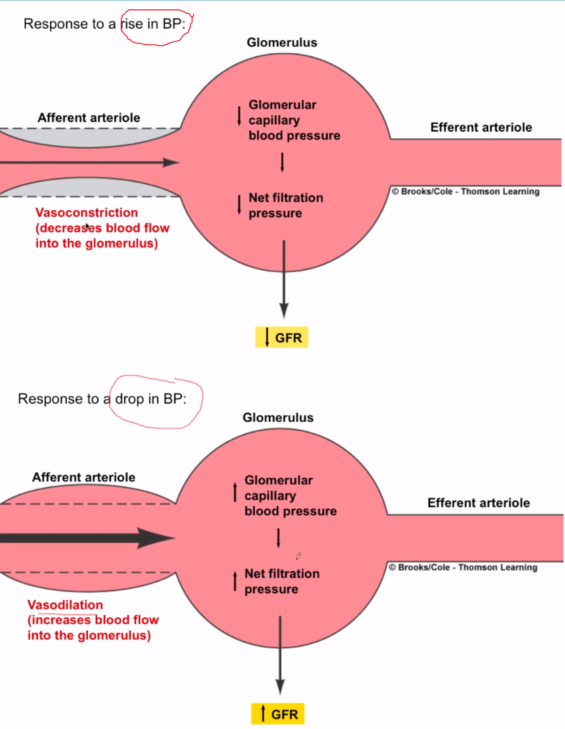
(Goal = maintain GFR in face of normal fluctuations in BP)
- Kidneys maintain steady Glomerular blood flow and a stable GFR by altering the _____ of the _____ _____ by constriction or dilation of ____ ____ lining of the vessels wall
What happens if arterial blood pressure increases?
What happens if arterial blood pressure decreases?
- diameter, afferent arteriole, smooth muscle
Vasoconstriction of Afferent Arteriole to decrease blood flow into glomerulus
Vasodilation of Afferent Arteriole to increase blood flow into glomerulus
What is the Mechanism for Autoregulation?
(1)
Tubuloglomerular Feedback Mechanism Involving the Juxtaglomerular Apparatus
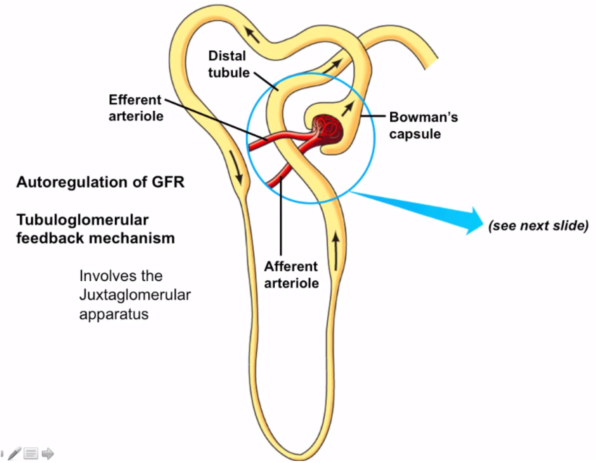
Cells Involved in Autoregulation
(1): located on afferent arteriole and constantly regulates ___
(1): located on distal tubule and constantly regulates ___
BOTH CELLS CAN RELEASE ______ and ______ ONTO AFFERENT ARTERIOLE
Granular Cells - BP
Macula Densa Cells - rate of fluid through distal tubule
VASOCONSTRICTORS, VASODILATORS
Extrinsic (Sympathetic) Control of GFR
(Goal = alter GFR in an attempt to control blood volume and BP)
Sympathetic input can ______ the autoregulatory responses
The smooth muscle cells of the afferent and efferent arterioles contain many (1) receptors that are sensitive to (2)
- Renal nerve releases norepinephrine - ______ arterioles
- Glomerular capillary BP and GFR then ______
Override
alpha adrenergic receptors -> Epinephrine and norepinephrine
- vasoconstricts
- GFR decreases
Through innervation of smooth muscle cells of afferent and efferent arterioles by sympathetic nerves -> releases epi onto alpha adrenergic receptors to cause vasoconstriction -> decrease GFR
Case of Hemorrhage
Example of where Extrinsic Control Kicks in


-
Cellular Basis Of Disease49
-
Cellular Basis of Disease Part 241
-
Normal Function of the Nervous System43
-
Normal Function of the Nervous System Part 257
-
Endocrine System51
-
Human Stress Response, Immune System Part 143
-
Immune System Part 263
-
Cardiovascular Normal Function Part 141
-
Cardiovascular Normal Function Part 249
-
Cardiovascular Patho Part 138
-
HTN/Cardiovascular Patho Pt 280
-
Respiratory System Normal Function60
-
Respiratory Pathophysiology37
-
Renal System Normal Function87
-
Renal Pathophysiology51


