Internal (Cellular Respiration)- The Whole Point
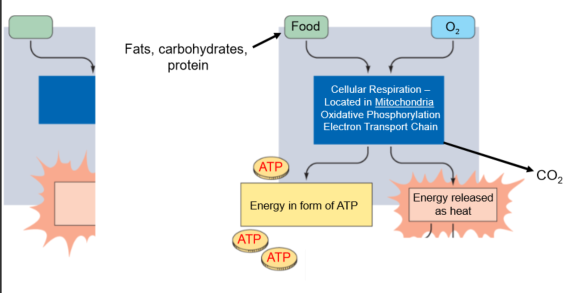
Intracellular Respiration: AKA _____ ______ refers to the utilization of ___ and energy substrates (____) to produce energy in the form of (2), (1) is a byproduct
IS THE PURPOSE OF _______ _______
Cellular Metabolism, O2 and Food -> energy in form of ATP and Heat, CO2 byproduct
EXTERNAL RESPIRATION
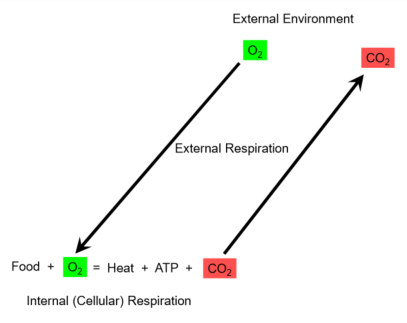
External Respiration
=
External Respiration is there to meet the needs of Internal Respiration
Delivery of O2 from external environment to the site of cellular respiration and the removal of CO2 from site of cellular respiration into external environment
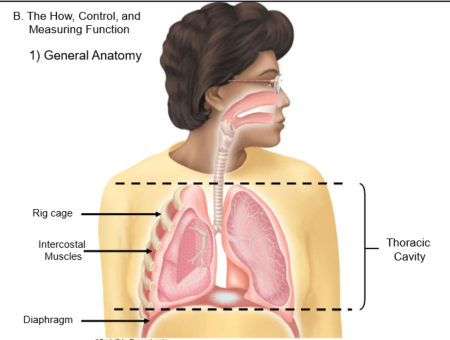
General Anatomy of Thoracic Cavity
Superior Margin:
Inferior Margin:
Encased by (2)
Clavicles
Diaphragm
Rib Cage and Diaphragm on bottom
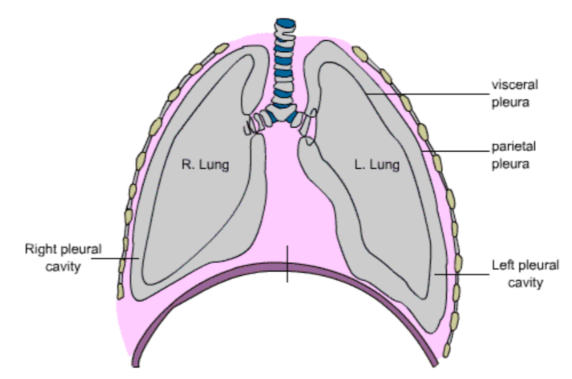
Air Tight Seal
Purpose:
- (1): lines cavity of each lung (sits against lung tissue)
- (1): Membrane that sits against thoracic cavity wall and diaphragm
- (1): Fluid that sits between these two membranes
To create a lower pressure than atomospheric and abdominal - critical in maintaining inflation of lungs and breathing
- Visceral Pleura
- Parietal Pleura
- Intrapleural Fluid
General Anatomy
- Airway Flow =
- (1): Largest main airway that’s supported by (1)
- (1): voice box
- (1): lose rings of cartilage and have smooth muscle surrounding walls
Mouth and Nose -> Pharynx -> Larynx -> Trachea -> bifurcates into right and left bronchus -> Bronchioles -> Terminal bronchiole -> Respiratory Bronchiole -> Alveoli
- Trachea, rings of cartilage
- Larynx
- Bronchioles
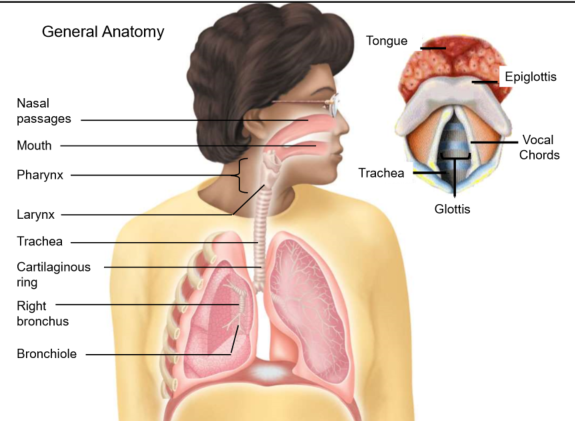
Bronchioles
- (1): last bronchiole before gas exchange
- (1): where gas exchange starts (have some alveoli coming out of it)
- Site of Gas Exchange:
- Terminal Bronchiole
- Respiratory Bronchiole
- Respiratory Bronchioles and Alveolar Sacs (specifically at pulmonary capillaries)
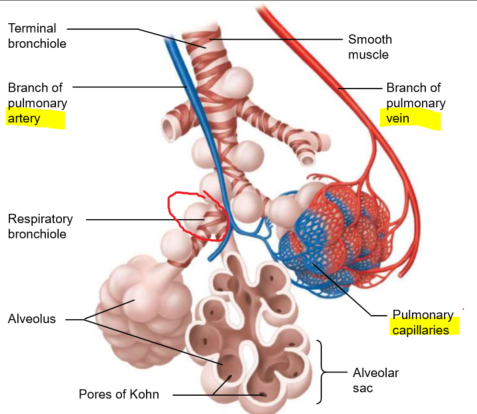
Alveolar Microanatomy
- (1): Composed of flat endothelial cells that form wall of capillary, contain ___ (around same diameter - keeping it close to cap wall to minimize ____ ____)
- Type I Alveolar Cell:
- Type II Alveolar Cell:
- Alveolar Macrophage:
- Pulmonary Capillary: RBCs - minimize diffusion distance
- Pink flat cells that form walls of alveolar sacs
- responsible for producing Pulmonary Surfactant (substance that acs as detergent: reduces surface tension of water vapor (that likes to stick together) in alveolar sacs - prevents collapse
- Phagocytizes any inhaled debris, dust, pathogenic organisms
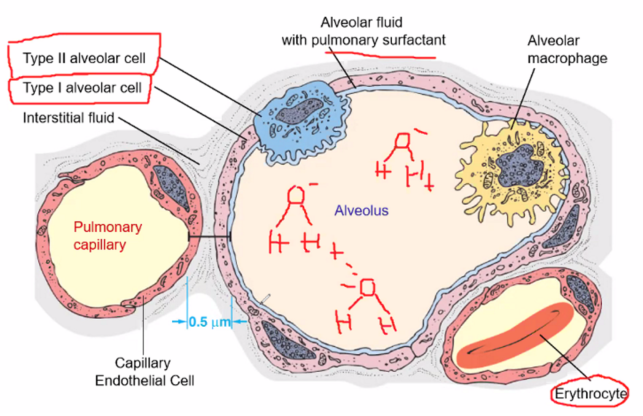
Gas Exchange
Movement of gases (O2 and CO2) across the alveolar and capillary walls
- Accomplished via?
- The direction of diffusion determined by?
- Passive Diffusion
- Partial Pressure Gradients: measure of concentration of gas
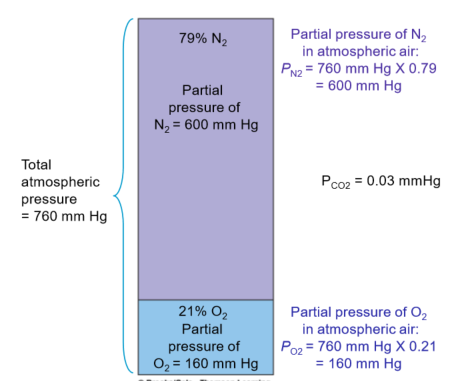
Mixture of Gases in Atmospheric Air
Atmospheric Pressure =
79% _____
21% _____
Trace amounts of __, __, and other ____
760mmHg (total pressure at sea lvl)
Nitrogen
Oxygen
CO2, H20, gases
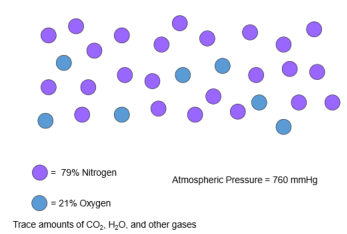
Partial Pressure of Gases That Make up Atmospheric Air
- Partial Pressure of N2 in Atmospheric air: PN2 = 760 x 0.79 = ____ mmHg
- Partial Pressure of O2 in Atmospheric air: PO2 = 760 x 0.21 = ____ mmHg
- PCO2 = ____ mmHg (so small bc like we said there are only trace amounts)
- 600
- 160
- 0.03
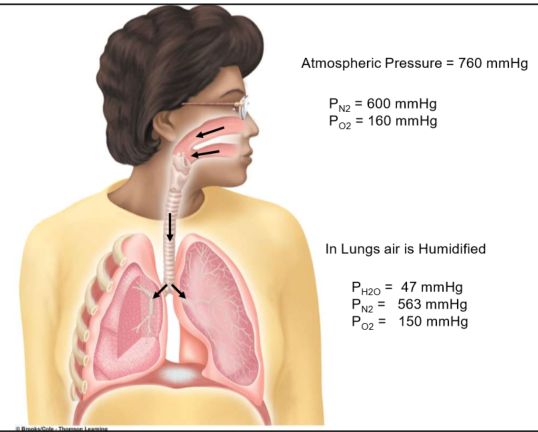
Air in Lungs is Humidified
PH2O =
PN2 =
PO2 =
- Since we are trying to get oxygen from alveolar space into the blood: partial pressure of O2 in alveolar space must be ____ than partial pressure of O2 in blood at site of gas exchange
- O2 mixes with ____ ____ after inhalation -> dilutes air that we take in -> ___ PN2 and PO2
47
563 (from 600)
150 (from 160)
- higher
- water vapor -> decreases PN2 and PO2
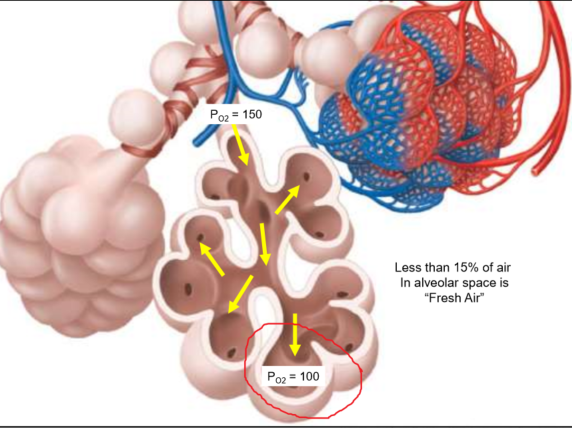
Partial Pressure of Air in Alveoli
PO2 in Alveoli =
Less than __% of air in alveolar space is fresh air
- Air that comes in gets ____ by air that was taken in by previous breaths -> and that air going to have higher __ concentration bc it moves from blood into alveolar space
- Advantage of 15% turnover is air in the alveoli remains at 100mmHg whether you are breathing restfully in or out so at all time periods oxygenation in alveolar sacs is ____ -> gas exchange can happening at all times
- If you hold your breath for long period of time PO2 can go ___ (won’t go down in a few secs)
- If your exercise PO2 in alveolar sacs can go __
100
15%
- diluted, high CO2
- stable
- down
- up
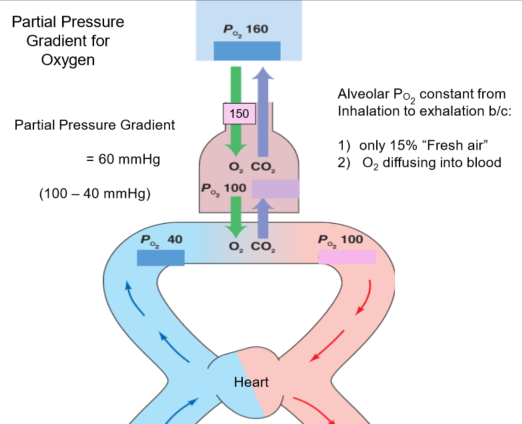
Partial Pressure Gradient for Oxygen
Alveolar PO2 constant from inhalation to exhalation bc (2)
Partial Pressure Gradient = __ mmHg
- PO2: ____ (outside) -> ____ (in airways) -> _____ (in alveoli)
- PO2 of deoxygenated blood in pulmonary capillary space = __
- PO2 of oxygenated blood going back to heart through pulmonary vein = __
- only 15% “Fresh air”
- O2 diffusing into blood
60 mmHg
- 160 -> 150 -> 100
- 40
- 100
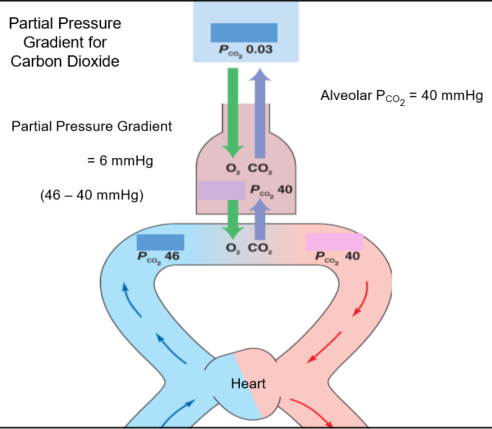
Partial Pressure Gradient for Carbon Dioxide
- PCO2 in deoxygenated blood = ___
- PCO2 in alveolar space = ___
- PCO2 of oxygenated blood going back to the heart = ___
- Partial Pressure Gradient = ___
So why does our body hold onto more CO2 then the amount in the environment?
- 46
- 40
- 40
- 6
To maintain healthy pH balance
Aspects of the Diffusion Barrier
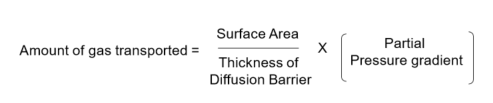
Diffusion during gas exchange is governed by the following relationship:
Amount of gas transported = _____/_____ x _____
- 3 aspects of ficks law
- increased SA -> _____ diffusion
- increased Partial Pressure -> _____ diffusion
- increased thickness of barrier -> _____ diffusion
- Lungs are highly _____ to maximize diffusion based on these factors
Surface Area/Thickness of Diffusion Barrier X (partial pressure gadient)
- Fick’s Law
- increased
- increased
- decreased
- adapted
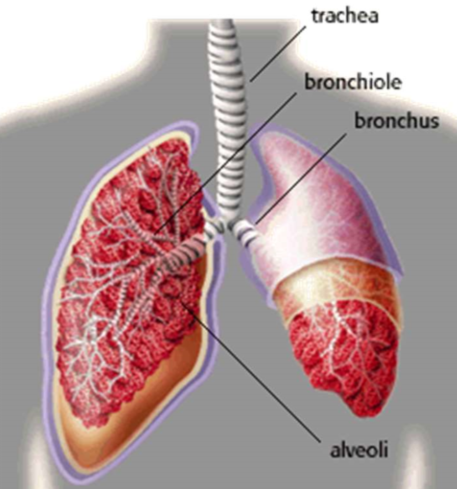
Surface Area Available for Gas Exchange
Total SA of lungs = ___ m2
Compared to SA of ___ m2 if lungs were just hollow sacs of air
- So big due to ______/anatomy of lungs: ____ pattern of airway branches into smaller and smaller branches then alveolar sacs
75m2 (size of tennis court)
- 01m2
* arrangement: branch pattern
Thickness of Diffusion Barrier
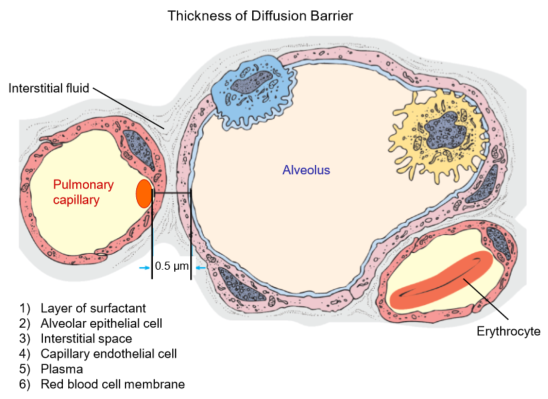
- Thickness of diffusion barrier is very ____ in pulmonary system
- Total thickness of this barrier = ___ micrometers (50x thinner than paper)
- List of everything that stands between blood and alveoli (6)
- small
- 0.5
- Layer of surfactant
- Alveolar epithelial cell
- Interstitial space
- Capillary endothelial cell
- Plasma
- RBC membrane
Alteration Diffusion
- Examples of Altered
- Surface Area (1)
- Thickness of Diffusion Barrier (1)
- Partial Pressure Gradient
- Decreased Atmospheric PO2 (_____)
- Decreased ____ of O2 to alveoli
- Reduced # of functional alveoli
- Thickening from Scar Tissue
- Altitude
- Delivery of O2
Oxygen Carriage by Blood - Gas Transport
Oxygen is carried by blood in one of two ways + what percentage?
(2)
- 1.5% Physically Dissolved in Plasma (O2 is very poorly soluble in plasma)
- 98% Chemically Bound to Hemoglobin
Hemoglobin
- Hemoglobin (Hb) is a large intracellular ____ - RBCs
- ____ subunits each with a ____ containing ____-group
- Each heme-group can _____ bind one O2 molecule
- One hemoglobin can carry up to ___ O2 molecules
- ______ = when unbound to oxygen
- _____ = when bound to oxygen
- protein
- 4 subunits, iron containing Heme-group
- reversibly
- 4
- Deoxyhemoglobin
- Oxyhemoglobin
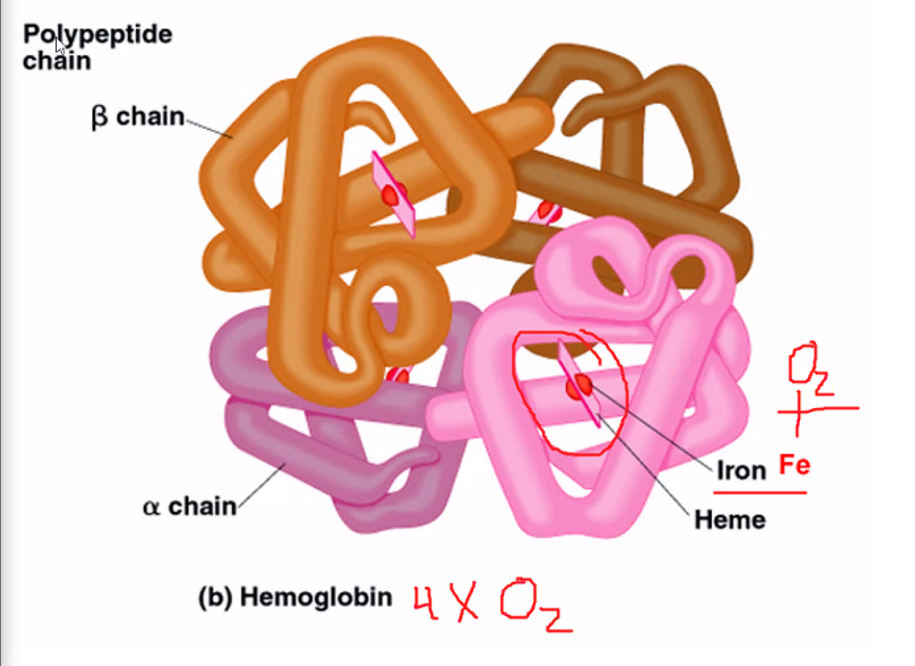
Structure of Hemoglobin Protein
- (1): Upper Chains
- (1): Lower Chains
- (1): that contains iron: in center of each unit that acts as ____ sites of oxygen
- 4xO2 = _____ Hgb
- And once one O2 binds to Hgb it alters the ____ of Hb to ____ bind to last 3 so you ____ find unsaturated Hb -> and vice versa if one comes off then the rest easily come off too
- Beta Chains
- Alpha Chains
- Heme Group - iron -> binding sites of oxygen
- Saturated Hb
- structure, easily, rarely find unsaturated
Hemoglobin Oxygen Binding
The main factor that determines the binding of O2 to Hb is the ___
- When all 4 O2 binding sites on Hb are occupied, Hb is ____ _____
The % of Hb saturation is determined by the ___ of blood
- This relationship is simply a matter of ___ ____
- Hb + O2 <-> HbO2
The relationship between PO2 and %Hb saturation is NOT _____
PO2
- fully saturated
PO2
- Mass Action
NOT LINEAR
PO2 (partial pressure of O2 in plasma) is the main factor that determines binding of O2 to hemoglobin - bc determines the amount of O2 actually available to actually bind to Hgb
Is a reversible reaction: when there is low O2, oxyhemoglobin tends to unbind from O2
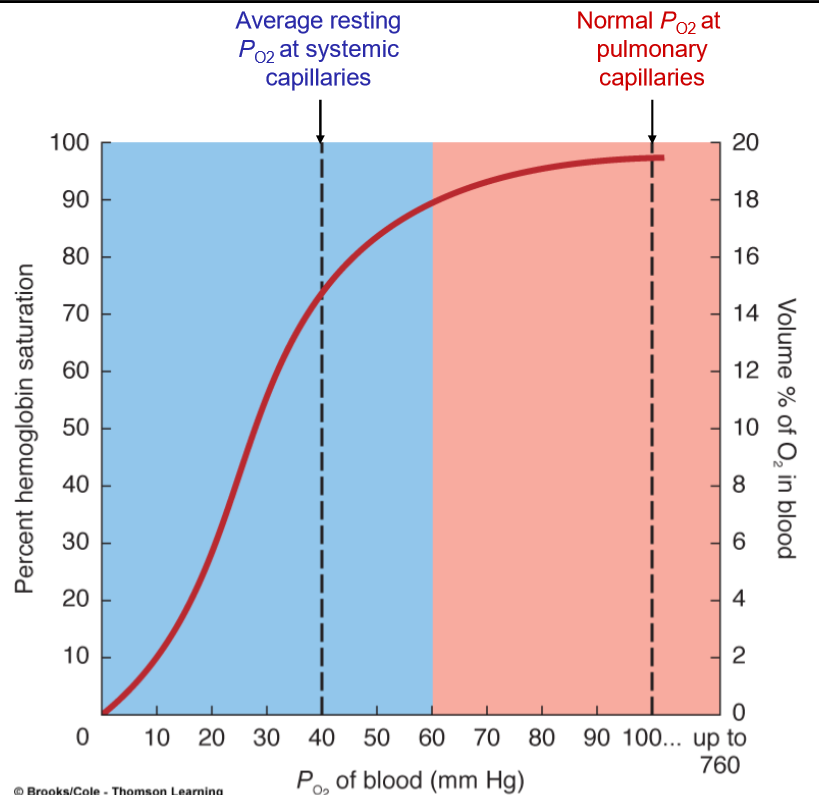
Hemoglobin Dissociation Curve
- At _____ levels of blood PO2, relationship is much more steep
- Upper levels of blood PO2, relationship is more ____
This difference is highly adapted for Hb’s Job
- Hb job in the lungs is to bind to O2, so under conditions of high PO2 in ____ capillaries it binds to O2 very tightly and doesn’t let go as it leaves the lungs, when it gets to tissues it readily ____ of O2
- Pulmonary Cap PO2 __-__
- Systemic Cap PO2 ~__
- lower
- flat
- pulm cap tightly, in tissues lets go
- 95-100
- ~40
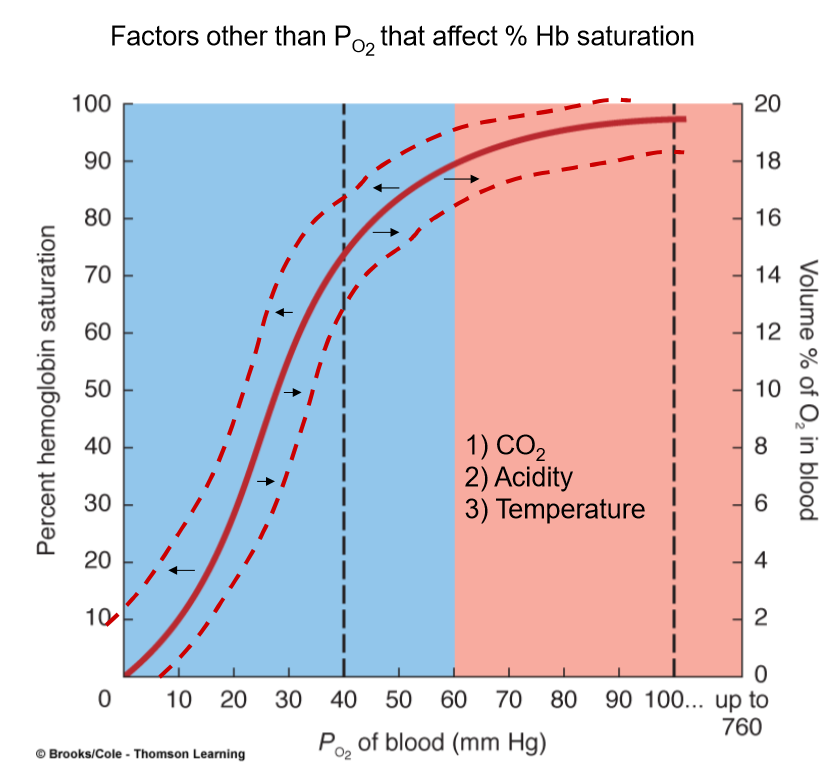
Local Metabolic Changes also affect %Hb Saturation
- Right Shift Curve when ____ Metabolic Activity
- CO2 =
- Acidity =
- Temperature =
- Result:
- Left Shift Curve when _____ Metabolic Activity
- CO2 =
- Acidity =
- Temperature
- Result:
- Conclusion:
- Higher Metabolic Activity
- Higher (more metabolically active tissue)
- Higher (production of lactic acid)
- Higher
- Lower Hgb saturation bc Hb lets go of even more O2 to metabolically active tissues
- Lower Metabolic Activity
- Lower
- Lower
- Cooler
- Higher Hgb saturation bc tissue doesn’t need it right now
- Hb delivers more O2 to tissues that need it the most and less O2 to tissues that need it the least


-
Cellular Basis Of Disease49
-
Cellular Basis of Disease Part 241
-
Normal Function of the Nervous System43
-
Normal Function of the Nervous System Part 257
-
Endocrine System51
-
Human Stress Response, Immune System Part 143
-
Immune System Part 263
-
Cardiovascular Normal Function Part 141
-
Cardiovascular Normal Function Part 249
-
Cardiovascular Patho Part 138
-
HTN/Cardiovascular Patho Pt 280
-
Respiratory System Normal Function60
-
Respiratory Pathophysiology37
-
Renal System Normal Function87
-
Renal Pathophysiology51


