What is laminar air-flow?
Smooth flow.
Flow rate is proportional to pressure difference.
Flow = ∆P/R, R = resistance to flow
What is turbulent air-flow?
“Rough” flow
Increased flow rate = increased turbulence
Flow is NOT proportional to the pressure difference
What type of flow takes place in the lungs?
Transitional flow.
Most air in the lungs is transitional - a midpoint between laminar and turbulent flow.
How are resistance to flow and radius of the airway related?
Resistance to flow, R, is inversely proportional to radius, r
R ∞ 1/r4
Small change in radius = large change in resistance!
What are the two main factors that can alter airway resistance?
Chemical factors
and
Mechanical factors
What are the 2 classifications of chemical factors that influence airway resistance?
Name examples for each.
ALL chemical factors act by affecting the smooth muscle tone of the bronchioles:
- Bronchoconstrictors - cause contraction of smooth muscle
Example: Parasympathetic nervous system uses ACh
Example: Histamine
- Bronchodilators - causes relaxation of smooth muscle
Example: Sympathetic nervous system releases Epinephrine/Norepinephrine via beta adrenergic receptors
What influence does epinephrine have on the smooth muscle tone of bronchioles?
Epinephrine is a bronchodilator - relaxes smooth muscle.
What are two drugs that are agonistic to beta adrenergic receptors?
Isoproterenol, albuterol.
These are the active ingredients in inhalers. Inhalers cause relaxation of smooth muscle of the bronchioles.
Note that agonistic is opposite of antagonistic. Therefore, these drugs stimulate the beta adrenergic receptors
Name 3 mechanical factors that may alter airway resistance:
- Mucous blockage (bronchitis)
- Lung volume - large lung volumes expand airways and decrease resistance
- Dynamic airway collapse (example: emphysema)
How are lung volume and airway resistance related?
Increase lung volume = decreased airway resistance
Patients with bronchitis “operate” at higher lung volumes in order to make it easier to breath and overcome the airway resistance
What pressure must be positive in order for an airway to remain open?
The trans pulmonary pressure (PTP) must be positive for the airway to remain open.
Recall that PTP = PAW - PIP
where AW = air way, IP = intrapleural space
If PAW > PIP, airway is open
If PIP > PAW, airway is closed
Is PIP always negative?
PIP, the intrapleural pressure, is generally negative.
A cough or forced exhalation can depress the chest cavity faster than the lung. This creates a positive PIP value, and the lung/airway can collapse.
Recall that a negative PIP creates a vacuum that “pulls” the airway open.
For which disease is dynamic airway collapse an important factor?
Emphysema!
The lungs have a reduced tendency to deflate AND a decreased lung recoil ability.
Emphysema patients use muscles during quiet breathing to drive forced expiration, which causes a positive PIP = airway collapse.
What is dead space, and how much of the lung does it affect?
Dead space = volume of the lung that does not engage in gas exchange.
Anatomical dead space = the air that remains in the trachea and never makes it to the alveoli.
Alveolar dead space = the unperfused (receives no blood supply) regions of the lung
Physiologic dead space = anatomical + alveolar dead space
About 30% of the lung is dead space.
What is the effect of dead space on breathing?
Dead space reduces the efficiency of breathing.
In a healthy person, the contribution of alveolar dead space is small.
A large alveolar dead space is indicative of respiratory disease.
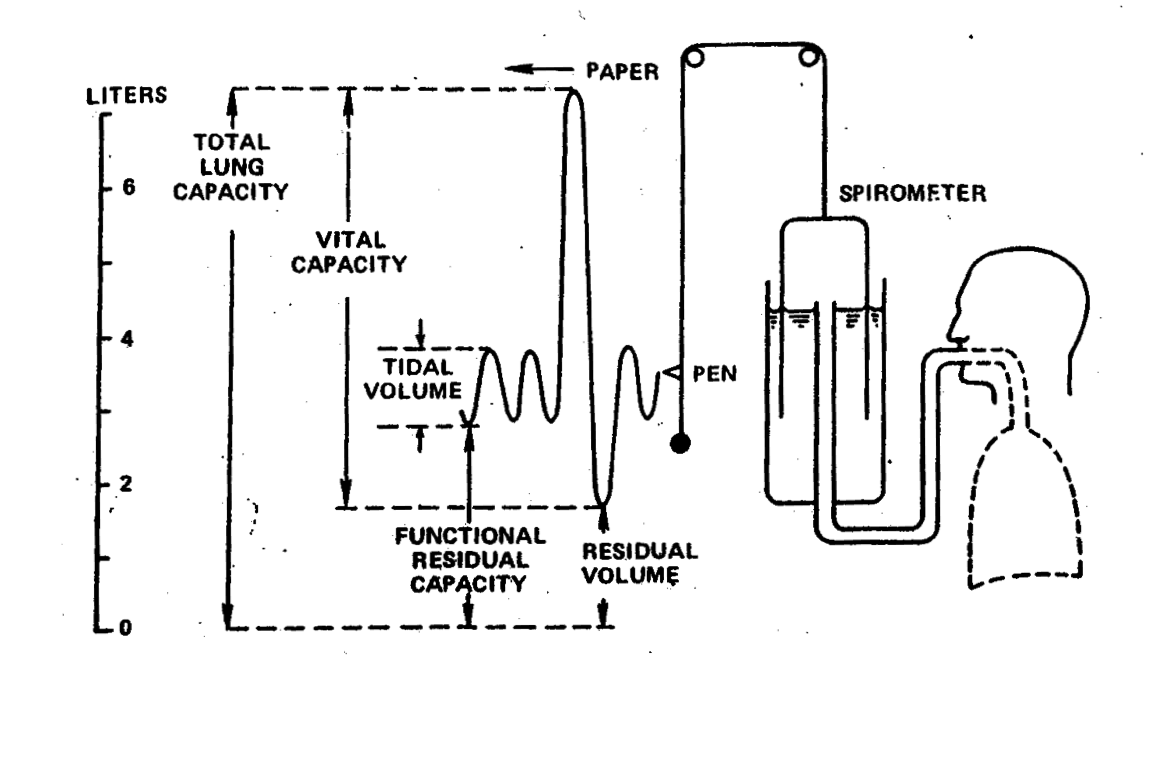
What is TLC?
Total Lung Capacity: how large the lung is at maximum capacity (~7 Liters)
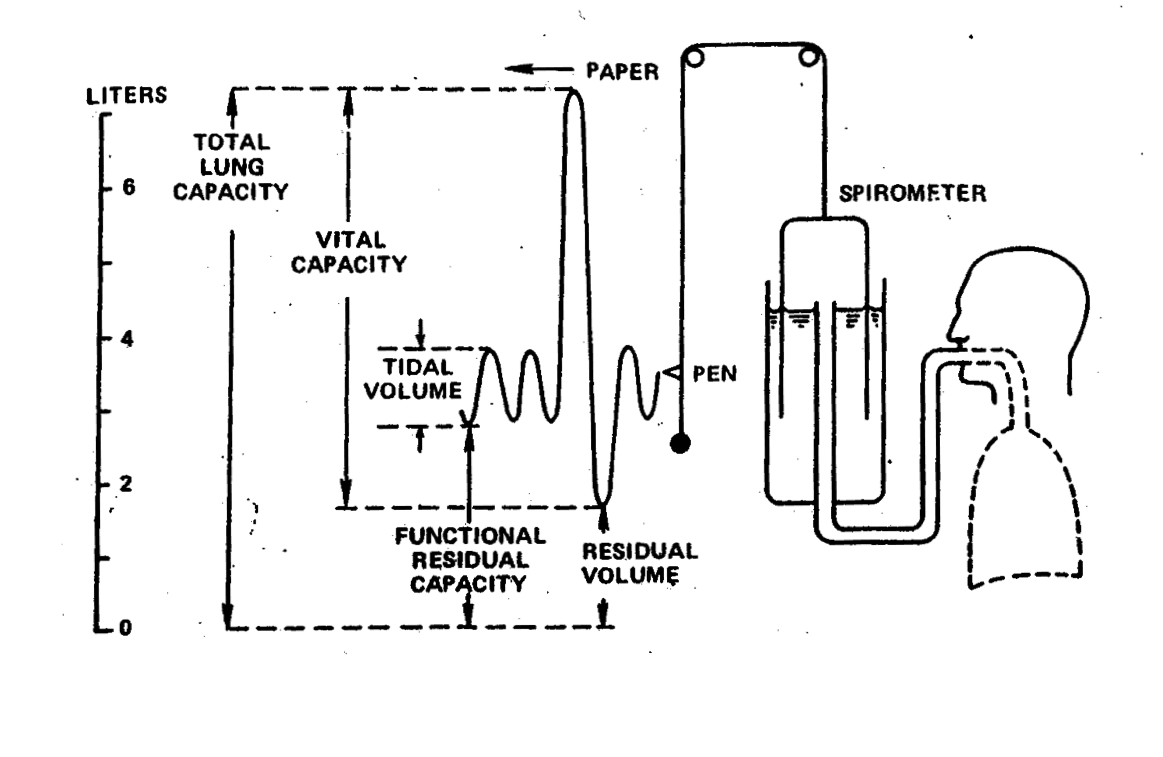
What RV?
Residual volume: how small the lung is at maximum expiration.
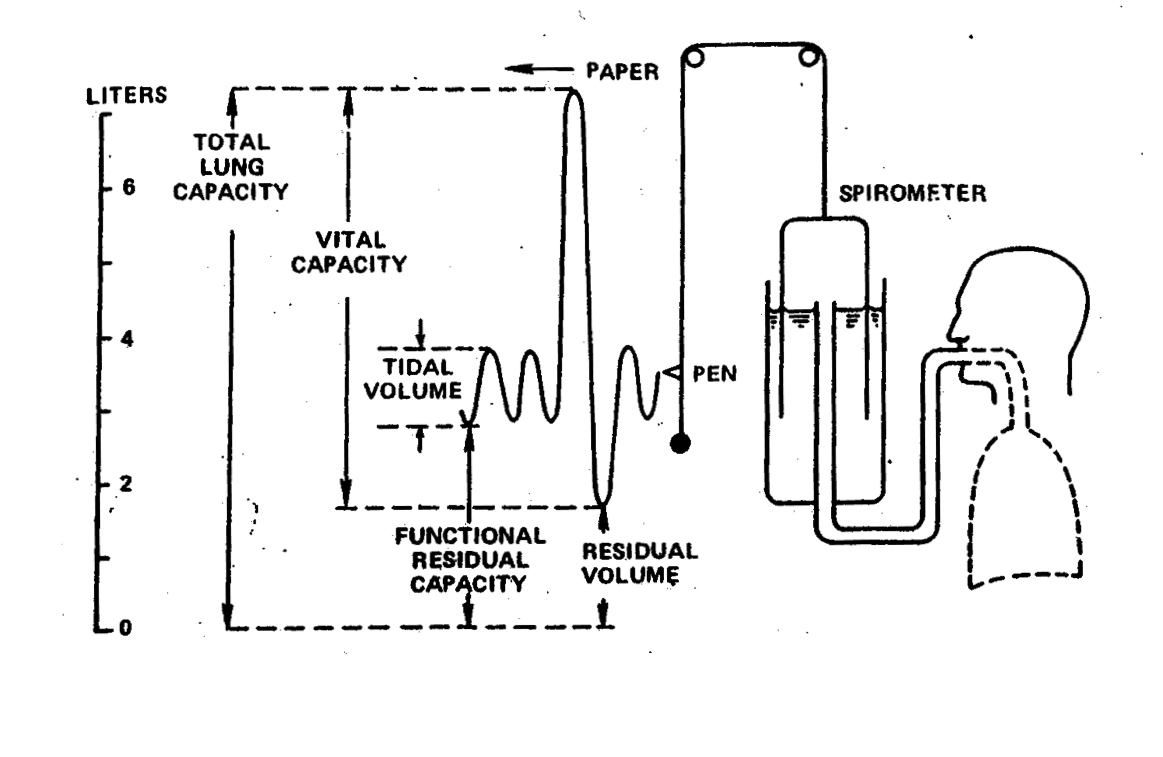
What is the VC?
Vital Capacity = Total Lung Capacity - Residual Capacity
Think: Vital = life = the working volume of air flowing in and out
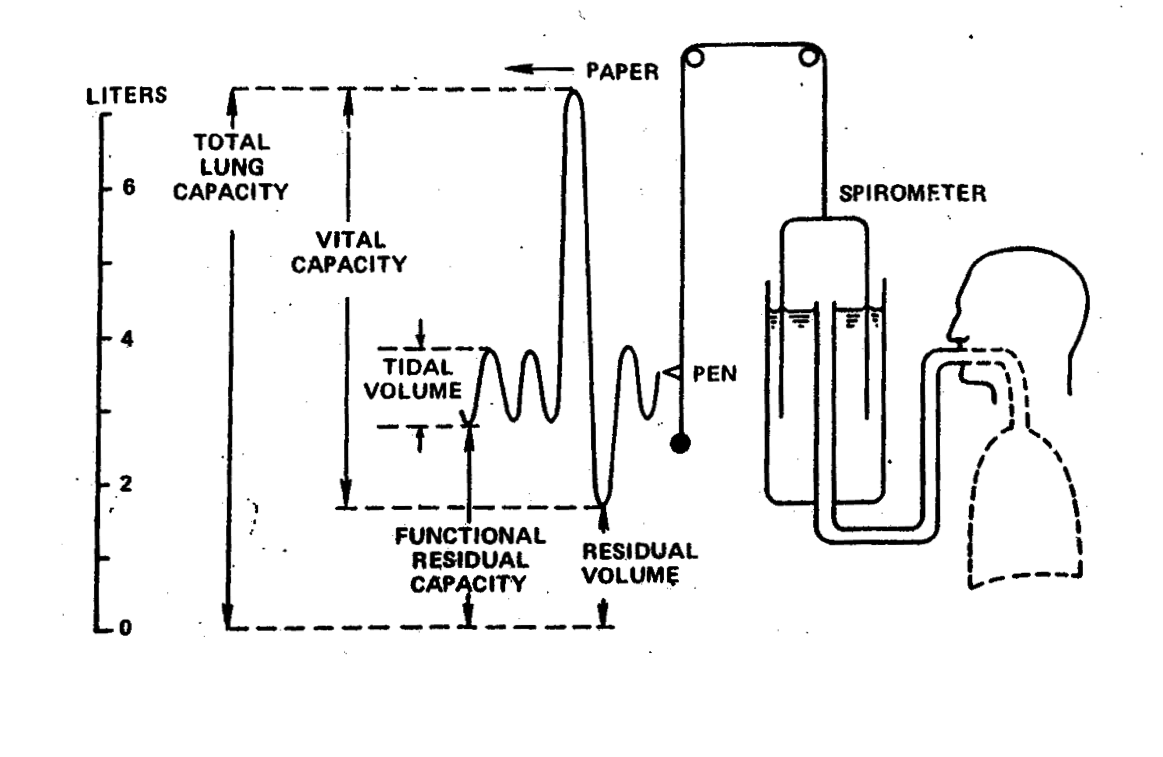
What is the FRC?
Functional Residual Capacity: The volume of the lung after quiet expiration…no muscles “squeezing” out the extra air
Think: during normal/functional breathing, you don’t exhale as much air as you can.
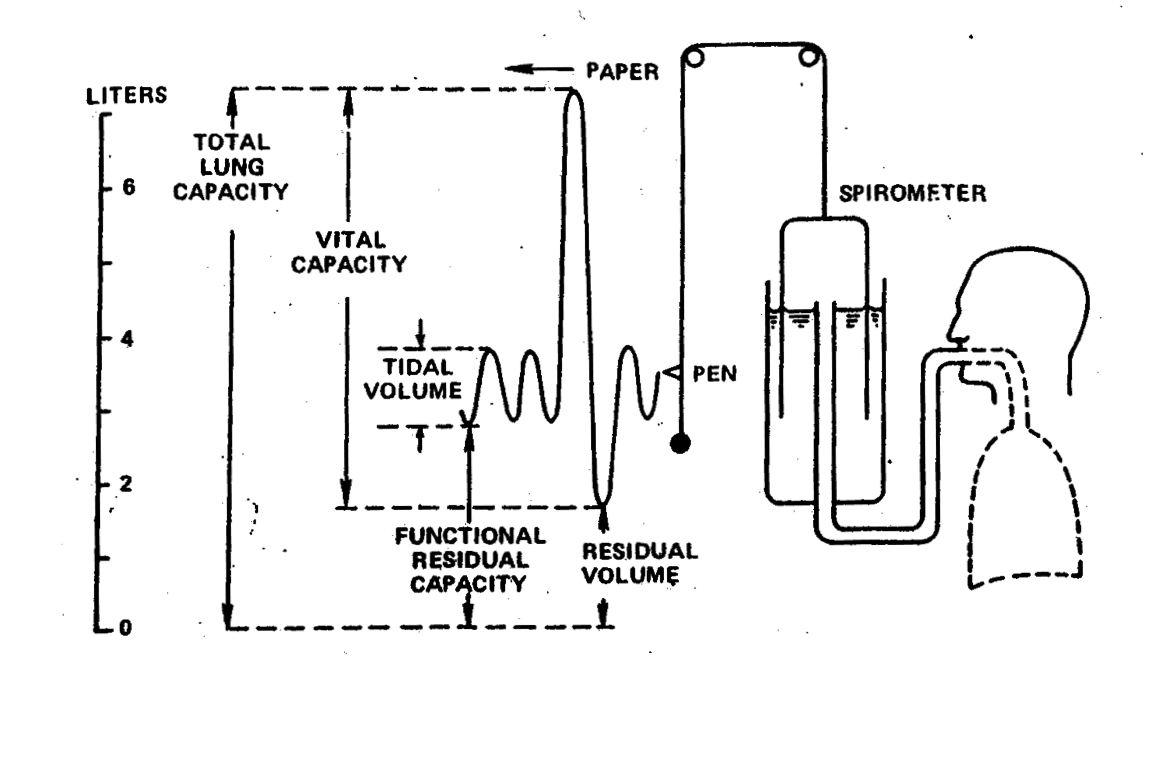
What is the tidal volume?
Tidal Volume = Small volume that represents the difference in size after quiet breathing expiration and before quiet preathing inspiration.
What is FEV and FVC?
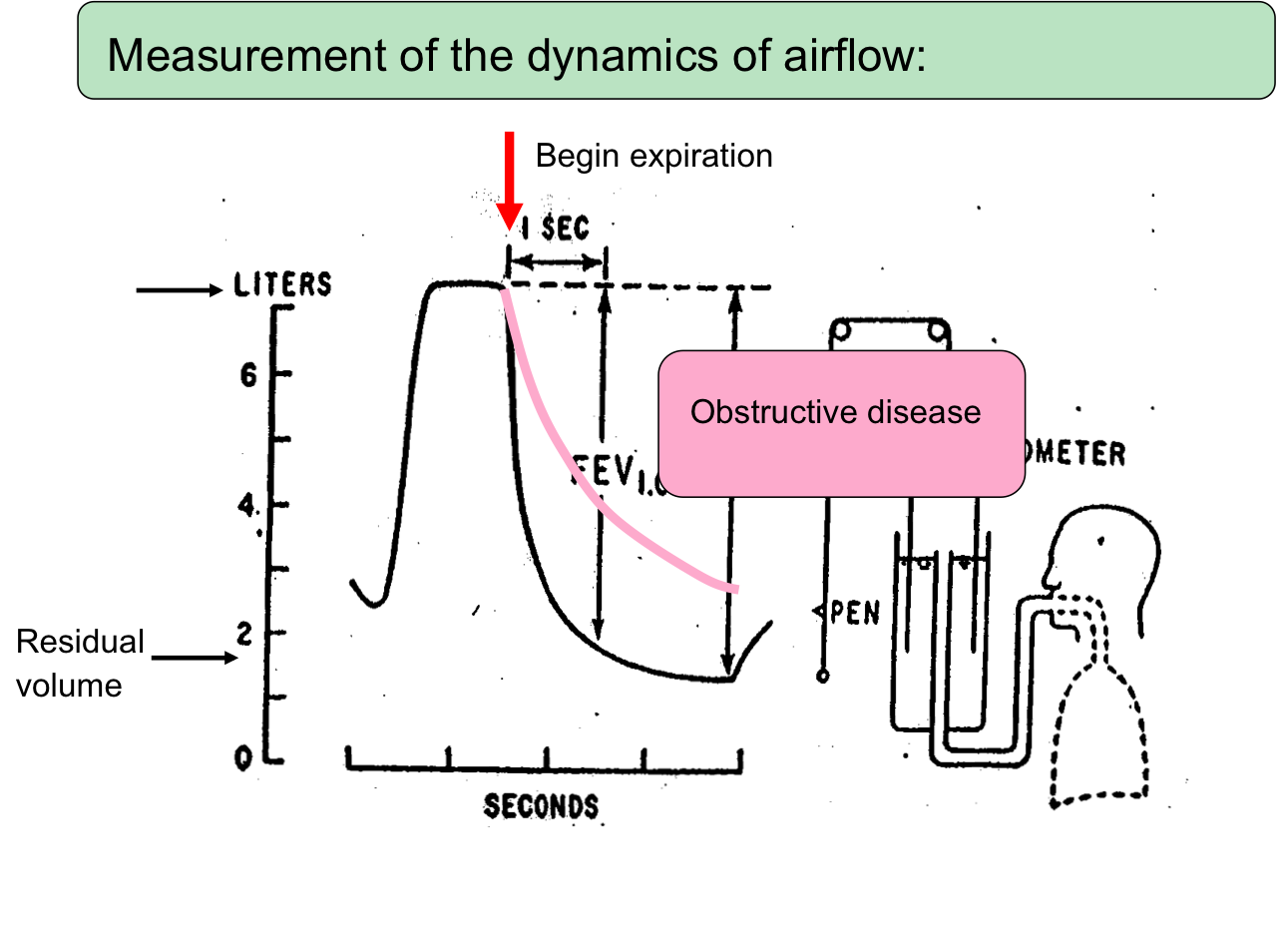
FEV = Forced Expiration Volume = amount of air during forced expiration
FVC = Forced Vital Capacity = TLC - RV = Amount you can force exhale after a maximum inhale.
What is (FEV1.0)/FVC?
The subset 1.0 = in one second.
This ratio reflects the rate of airflow during forced expiration.
Think: It represents the proportion of a person’s vital capacity that they are able to expire in the first second of expiration.
For a healthy person, this is 80% of the vital capacity, or
(FEV1.0)/FVC = 0.8
For an obstructive disease, how does the dynamics of airflow change? (visually, on a graph)
The curve downwards from the total lung capacity to residual volume = how fast the air was expired.
An obstructive disease will cause a less steep curve (expired more slowly) and will end at a greater residual volume (unable to expell that last bit of air due to resistance).
Why is laminar flow better than turbulent air flow in the lungs?
Laminar flow is proportional to the change in pressure, and therefore it is a more efficient delivery of air.


