What is O2 “off-loading”?
Not just simply sending O2 off into tissues from the arterial blood….
Oxygen off-loading is the degree in which O2 is unbound from hemoglobin to supply tissues. The oxyhemoglobin dissociation curve reflects the varying degree of off-loading.
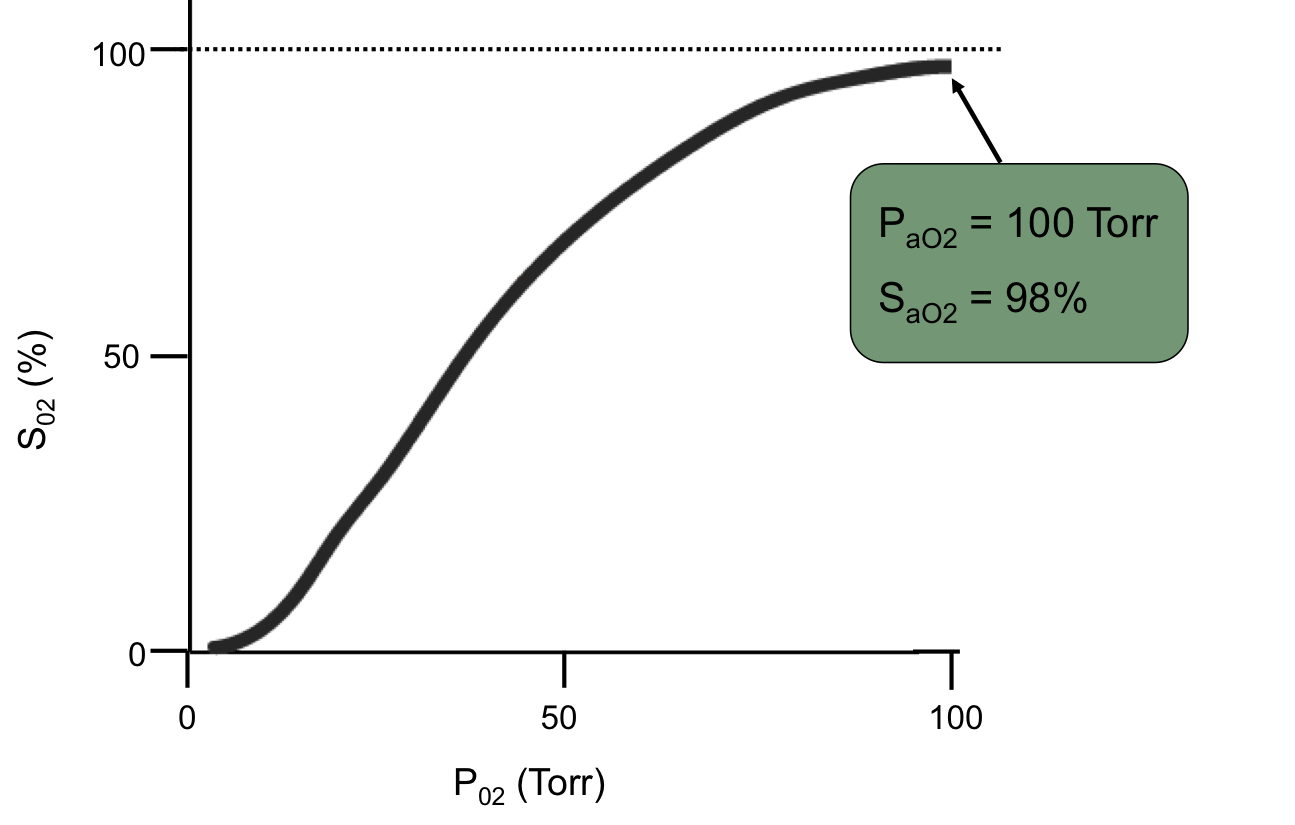
What increases the oxygen off-loading?
Anything that shifts the oxyhemoglobin dissociation curve to the right:
a decrease in pH,
an increase in PaCO2, or
an increase in temperature.
Example: exercise!
What decreases the oxygen off-loading?
Anything that shifts the oxyhemoglobin dissociation curve to the left:
an increase in pH.
Define hypoxia.
Inadequate delivery of O2 to tissues. Note that O2 delivery is dependent upon cardiac output (perfusion) and the concentration of O2 in the arterial blood.
D*O2 = Q* x CaO2
–>Low O2 delivery due to low perfusion, Q*, or low CaO2 from a low partial pressure arterial oxygen.
What are the different types of hypoxia?
- hypoxemia = reduced arterial free O2
- Ischemic hypoxia = decrease in blood flow
- Anemic hypoxia = decreased hemoglobin
What can cause hypoxemia?
Hypoxemia = low arterial blood O2.
Caused by:
Low PIO2 (altitude, fire, etc)
Low PAO2 (high CO2 levels in alveoli, etc)
Diffusion problem
A shunt (blocked ventilation to a region of the lung)
V/Q mismatch
What can cause delivery problems for delivering O2 to tissue?
Anemic hypoxia:
Low concentration of hemoglobin (anemia)
Carbon monoxide poisoning - CO binds to hemoglobin more favorably that O2
How is CO2 carried in the blood, and at what concentrations?
- CO2 can dissovle into blood at 1.2 mM when PaCO2 = 40 torr.
- Carbonic anhydrase catalyzes a reaction converting CO2 and water into carbonic acid, which dissociates into protons, and bicarbonate ions (HCO3-).
HCO3- is at a concentration of 24 mM when PaCO2 = 40 torr.
- CO2 can also bind to proteins such as hemoglobin (carbamino compound)
If CO2 is acidic and HCO3- (blood bicarbonate) is basic, then how is the pH calcuated for this acid-base balance?
Good ‘ol Henderson-Hasselbalch!
pH = 6.1 + log([HCO3-]/[CO2])
and [CO2] = (solubility constant aCO2 )x PCO2
aCO2 = 0.03 mM/Torr
What is a normal arterial blood pH?
Between 7.35 -7.45
What are the 4 acid-base distrubances and their general cause and effect?
- Respiratory acidosis: increase in PCO2 = decrease in pH
- Respiratory alkalosis: decrease in PCO2 = increase in pH
- Metabolic acidosis: addition of acid other than CO2
- Metabolic alkalosis: increase in bicarbonate OR decrease in an acid other than CO2
When does respiratory acidosis take place, and what happens to compensate?
Respiratory acidosis: increase in PCO2 = decrease in pH
PCO2 increases during low alveolar ventilation (such as severe obstructive disease or a drug overdose)
Compensate with renal reabsorption of bicarbonate HCO3- back into the blood and removal of H+ via urine. Slow, takes 1-3 days.
When does respiratory alkalosis take place and what is done to compensate?
Respiratory alkalosis: decrease in PCO2 = increase in pH
Occurs during high alveolar ventilation, such as at high altitude.
Renal compensation is to decrease the bicarbonate in the blood. Slow, takes 1-3 days.
The drug Diamox blocks the transport of bicarbonate back into the blood.
When does metabolic acidosis take place and what is done to compensate?
Metabolic acidosis: addition of acid other than CO2
Takes place when other acids are present at high levels in the blood, such as ketoacids, lactic acid, etc. Diarrhea causes a loss of bicarbonate which also can contribute to metabolic acidosis.
To compensate, ventilation increases. This happens quickly, within minutes.
When does metabolic alkalosis take place and what is done to compensate?
Metabolic alkalosis: increase in bicarbonate OR a decrease in an acid other than CO2
Takes place when vomiting (causes a large loss of gastric acid) or with antacid ingestion
To compensate, ventilation decreases.
During exercise, the affinity of O2 to hemoglobin changes significantly. Is there a decrease or an increase in affinity? What are the causes and the advantages?
The affinity for O2 DECREASES because you want to release O2 more readily (an advantage).
The affinity decreases because of the lowered pH, higher temperatures, and an increase in PCO2.
A patient has polycythemia (high RBC count). Is his arterial O2 content higher, lower, or normal?
He would have a higher O2 content.
In what form is most CO2 carried in the blood?
Bicarbonate, HCO3-
A patient has high arterial CO2 levels. Will his pH be higher, lower, or normal?
The pH will be lower (acidic)


