Somatosensory Flashcards

(85 cards)

1
Q

List the 5 types of somatic sensation

A

Descriminative touch Vibration sensitivity Pain Temperature Position Sense

2
Q

List the 3 elements of primary afferents in somatic sense

A

Peripheral receptors First order neurons Second order neurons

3
Q

Function of somatic sensory peripheral receptors?

A

Detection in skin, muscles, tendons, joints

4
Q

Function of somatic sensory first order neurons?

A

Dorsal root ganglia Trigeminal ganglion for face and head (a single process that bifurcates)

5
Q

Second order neurons of the somatic sensory?

A

Project to the thalamus

6
Q

What mediates touch?

A

Cutaneous and subcutaneous mechanoreceptors in the skin

7
Q

Hair receptor?

A

Deflection, directionally sensitive

8
Q

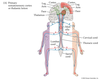
Deep touch receptors?

A

Raffini ending / Pacinian corpuscle

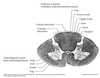
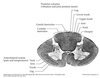
9
Q

Superficial touch receptors?

A

Meissner’s/Merkel’s receptor

10
Q

Vibration is mediated by what receptors?

A

Pacinian corpuscles Ruffini endings Hair receptors

11
Q

Vibration sense is transmitted via?

A

Exclusively by the dorsal column system

12
Q

Pain is mediated by?

A

Mechanoreceptors that are FREE NERVE ENDINGS in the skin

13
Q

Describe the 4 types of pain receptos

A

High threshold, responding to pinch or pressure High threshold, responding to high temperature Poly modal responding to all of the above as well as chemical byproducts of trauma (bradykinin, histamine, potassium)

14
Q

Temperature in somatosensory receptors?

A

Specialized thermoreceptors Bare nerve endings

15
Q

Two types of temperature receptors?

A

Warm and cold receptors Changes in temperature deferentially activate different classes

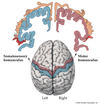
16
Q

Poistion sense is known as? What receptors?

A

Proprioception Tendon receptors = golgi tendon organs

17
Q

Muscle receptors of proprioception?

A

Muscle receptors are muscle spindles which are not consciously recognized but regulate muscle function

18
Q

Describe visceral sensation

A

Mediated by sensory nerve endings in viscera Maintain homeostasis Contribute to sensation of hunger/satiation Visceral pain is mediated by pain receptors that sense stretch or distention of the viscera

19
Q

Describe the speed of sensory impulse and the correlation with myelin

A

Conduction velocity reflects myelination Reflexes are fast Touch and vibration are moderately fast Pain and temperature are fast (sharp, pricking) or slow (burning)

20
Q

Diabetic neuropathy affects?

A

Selectively affects unmyelinated C fibers leading to loss of pain and temperature sensation

21
Q

Describe Type I (A-alpha) fibers

A

Largest (13-20 um) Myelinated Proprioception for muscle spindle/golgi organ

22
Q

Describe Type II (A-beta) fibers

A

Second largest (6-12 um) Myelinated Muscle spindle, meissner’s, merkel’s, pacinian, and ruffini endings Superficial/deep touch, vibration

23
Q

Describe Type III (A-delta) fibers

A

1-5 um Myelinated Bare nerve endings for pain and cool temperatue

24
Q

Describe Type IV fibers (C)

A

0.2-1.5 um Not myelinated Bare nerve endings for pain, warm temperature, and itch
25
Describe how spatial resolution in two point discrimination is acheived?
can only occur when nerve endings from two different first order neurons are activated (different branches of a single axons is one signal to the CNS)
26
Spatial resolution depends on?
receptor density which varies over the body
27
Describe the hierarchy of dermatomes and peripheral nerves
Axons from receptors collect into cutaneous nerves Cutaneous nerves collect into peripheral nerves (submodalities mingle) Peripheral nerves contain axons from several dorsal root ganglia
28
Cutaneous nerves contain axons from?
One area of skin
29
Damage to a single dorsal root does?
Does not lead to complete anesthesia of a dermatome (there is an overlap
30
A peripheral nerve contains axons from?
Several dorsal root ganglia
31
Dermatomes are defined by?
The dorsal root that supplies them
32
A disease affecting spinal cord or dorsal root will lead to?
sensory loss with a dermatomal distribution
33
A disease affecting the peripheral sensory nerve will lead to?
lead to sensory loss with a peripheral nerve distribution, otherwise called a stocking-glove distribution as distal aspects are most commonly affected
34
Damage to a peripheral nerve will lead to what corresponding affect in the innervated area?
Because peripheral nerves contain all axons from an area, damage leads to complete anesthesia in the area supplied by the nerve
35
How are different submodalities of nerve type identified?
Size and neurochemical transmitter
36
Describe cell body and axon diameter / myelination
Unmyelinated C fibers are thin and originate from small cell bodies Larger axons originate from larger cell bodies
37
Describe NT differentiation between different submodalities
Nociceptors contain substance P, CGRP, VIP, and somatostatin Play a role in neurotransmission centrally and receptor regulation peripherally
38
Once entered into the spinal cord, what do the submodalities do?
Diverge and take different central paths
39
Major ascending somatosensory pathways?
Dorsal column / Medial lemniscal pathway Spinothalamic (part of anterolateral) pathway
40
Minor ascending somatosensory pathways?
Spinocervicothalamic pathway Spinocerebellar pathway
41
Dorsal column detects?
Discriminative touch, vibration, and position
42
Axons of dorsal column pathway enter the spinal cord...
At the ipsilateral dorsal column directly Also give off collaterals to the dorsal horn
43
Describe the two parts of the dorsal column
Gracile fasciculi in SC are most medial, prominent in lumbar and low thoracic Cuneate fasciculi in SC are most lateral, prominent in high thoracic and cervical
44
First order axons of the dorsal column terminate at?
The cuneate and gracile nuclei (2nd order)
45
Leaving the cuneate and gracile nuclei, the fibers of the dorsal column do what?
Leave as the internal arcuate fibers Cross at the medial lemniscus (decussate)
46
After decussating, the dorsal column fibers do what?
Project from the medial lemniscus to the VPL nucleus of the thalamus
47
Dorsal column fibers from the VPL travel?
Through the internal capsule to the somatosensory cortex (3rd neuron)
48
Lesion below the spinomedullary junction of Dorsal column will lead to?
Lesion below level of spinomedullary junction will lead to loss of touch, vibration and position on the ipsilateral side (below the lesion)
49
Lesion above the spinomedullary junction of Dorsal column will lead to?
Lesion above the level of the spinomedullary junction will lead to a loss of touch, vibration and position on the contralateral side of the lesion
50
Where do fibers of the dorsal column decussate?
Cross and form the medial lemniscus Internal arcuate fibers form this At the caudal medulla
51
Describe the somatotopic organization of the dorsal column
As fibers join the tract, they layer onto the ascending fiber system For example, the cervical fibers (arm) layer on lateral to the thoracic fibers (leg) Somatotopy is maintained at higher levels I.e from medial to lateral: Leg, lower trunk, upper trunk, arm, neck, occiput
52
What happens if the dorsal column is destroyed with regards to touch?
Dorsal column lesions do not completely eliminate touch; crude touch is partially spared because some touch information is conveyed by spinothalamic tract
53
What happens if the dorsal column is destroyed with regards to position and vibration?
Dorsal column lesions do completely eliminate position and vibration sense; tests for these modalities can define a dorsal column lesion
54
A person with a dorsal column lesion will be deficient at?
Patient with DC lesion: deficient at localizing touch and stereognosis
55
Complete dorsal column lesion at low thoracic or lumber legs does what to position sense in legs?
Complete dorsal column lesion at low thoracic and lumbar levels do not completely eliminate position sense in legs
56
Function of segmental terminations of the dorsal column?
Axons that enter dorsal columns ascend to the brain, and also give rise to collaterals that terminate in the dorsal horn of the spinal cord These terminals modulate simple motor behaviors mediated by segmental circuitry (e.g. scratch reflex)
57
Spinothalamic pathway is responsible for what senses?
Pain and temperature, and a crude sense of touch
58
Path of spinothalamic axons from the receptor?
Axons either enter dorsal horn directly, or project up or down a few segments in the tract of Lissauer before entering the dorsal horn
59
Decussation of the spinothalamic tract?
After ascending on ipsilateral side, axons decussate in the anterior white commissure under the central canal (2nd order)
60
Path of spinothalamic after decussation?
Join the anterolateral column, and most ascend to thalamus (hence, spinothalamic)
61
Other two branches of anterolateral column other than spinothalamic?
Others branch to reticular formation and periaqueductal gray of midbrain Spinoreticular Spinomesencephalic
62
Unilateral lesion in spinothalamic pathway results in?
Unilateral lesion at a particular level of cord leads to loss of pain and temperature at levels beginning one or two segments below the injury This is in contrast to DC system, where deficit manifests at all levels below injury
63
Where does spinothalamic decussate?
At the level of receptor or few segments above receptor level
64
What is syringomyelia and how does it relate to spinothalamic pathway?
Syringomyelia is a condition of syrinx formation following injury/disorder, which interrupts crossing fibers (at the anterior white commissure)
65
Describe the somatotropic organization of the spinothalamic pathway
Fibers joining tract layer onto existing fibers Fibers layer onto medial aspect of tract Spinal cord: legs lateral, arms medial Intractable pain in legs can be treated by transection of lateral fibers of anterolateral pathway
66
Describe relative position of fibers of spinothalamic and dorsal columns in the medulla and pons?
As fibers ascend through medulla and pons, spinothalamic tract lies lateral to the dorsal column pathway
67
Trigeminal nerve is responsible for what? Where?
Touch Somatosensory information from face and oral and nasal cavities
68
Axons of the trigeminal nerve enter the brainstem and?
Axons enter brainstem and synapse in trigeminal nuclear complex (three nuclei)
69
What is analogous to the dorsal column system for the trigeminal nerve (touch)?
Principal nuclues Rostral part of the spinal trigeminal nucleus
70
From the trigeminal nuclei, where do touch fibers go from there?
Fibers then cross midline and collect in ventral trigeminothalamic tract, which terminates in VPM of thalamus
71
What is the gate control theory?
Sensory inputs from large diameter A-beta sensory fibers reduce pain transmission in dorsal horn
72
Descending input for pain?
Hypothalamus, amygdala and cortex project to periaqueductal gray, then to RVM (rostral ventral medulla), then to dorsal horn
73
Somatotropic organization of thalamus?
Info from legs terminate laterally in thalamus Info from arms terminate medially
74
Receptor segregation of the thalamus with regards to the cutaneous and deep somatosensory receptors
Receptor segregation is also noted, with cutaneous receptors terminating in the core of the thalamus, and deep receptors terminating in the shell
75
Different subdivisions of the thalamus project to different...
Different subdivisions of thalamus project to different subdivisions of somatosensory cortex
76
Axons from the thalamus project to?
Axons project from thalamus via internal capsule to somatosensory cortex, and terminate in a somatotopic fashion, primarily on the postcentral gyrus or primary somatosensory cortex
77
Describe the homunculus of the somatosensory cortex
Disproportionate representation of different parts of the body on the cortical surface
78
Primary somatosensory cortex lesion results in?
Deficit is contralateral to lesion Discriminative touch and joint position most severely affected Damage to adjacent cortical areas may include upper motor neuron-type weakness or visual field deficits
79
Lesion to thalamic VPL/VPM or radiations leads to?
Deficit is contralateral to lesion Deficit may be more noticeable in the face, hand and foot (more so than in trunk or proximal extremities) All sensory modalities are often involved, with or without motor deficit
80
Very large lesions to Thalamic VPL/VPM can also result in?
Larger lesions that involve the internal capsule, lateral geniculate or optic radiations may cause hemiparesis or hemianopia
81
Damage to thalamic radiations cause?
Damage to radiations cause contralateral hemisensory loss, and often hemiparesis due to associated damage to corticospinal fibers
82
Lesion to lateral pontine or medulla?
Lesion involves the anterolateral pathways on contralateral side and trigeminal nucleus on ipsilateral side Loss of pain and temp opposite the lesion, and loss of pain and temp in the face on same side of lesion Associated deficits due to damage to nearby pontine and medulla
83
Lesion to medial medullary lesion
Lesion involves the medial lemniscus Causes contralateral loss of discriminative touch, vibration and joint position sense
84
Damage to nerve roots or peripheral nerves leads to?
Known as distal symmetrical polyneuropathy Causes bilateral sensory loss in a ‘stocking glove’ distribution in all sub-modalities Specific nerve or nerve root lesions cause sensory loss in their associated territories
85
Describe reorganization following nerve injury
Damage to sensory systems leads to reorganization that facilitates compensation If a peripheral nerve is damaged, areas of cortex supplied by that nerve are no longer activated With time however, that area of cortex responds to stimulation of skin that retains intact innervation Mechanisms are not known May involve reorganization of the central projections of primary afferents Reorganization plays a role in functional recovery after peripheral nerve injury Regeneration of injured peripheral nerves is often disordered and incomplete Although somatotopic map is scrambled, reorganization leads to recovery