CNS innervation of voiding
Voluntary control over micturition
Inhibition of reflex detrusor contraction
Parasympathetic innervation of voiding
Facilitates macutrition
Direct motor activation of detrusor contraction
Indirect facilitation of detrusor contraction via stretch receptors
Sympathetic innervation of voiding
Facilitates storage
Inhibition of detrusor via direct (beta-3-adrenergics) and indirect (blocking PSNS) routes
Contraction of “internal sphincter”/bladder neck
What part of the urinary tract is under somatic control?
External sphincter
Describe the micturition reflex
- Autonomic reflex between bladder and spinal cord promoting bladder emptying
- Urine causes stretching of bladder wall, promotes detrusor contraction
- Further activation of stretch receptor with further promotion of detrusor contraction
CNS mediation of the micturition reflex
- Can inhibit it
- Decision to urinate is made, CNS removes the inhibitory signals and external sphincter relaxes to allow for micturition reflex to occur
How does the pontine micturition center coordinate voiding?
Detrusor contraction – PNS
Internal sphincter relaxation – inhibition of SNS
External sphincter relaxation
Damage to brainstem/pons or spinal cord lesion below have potential to cause discoordination
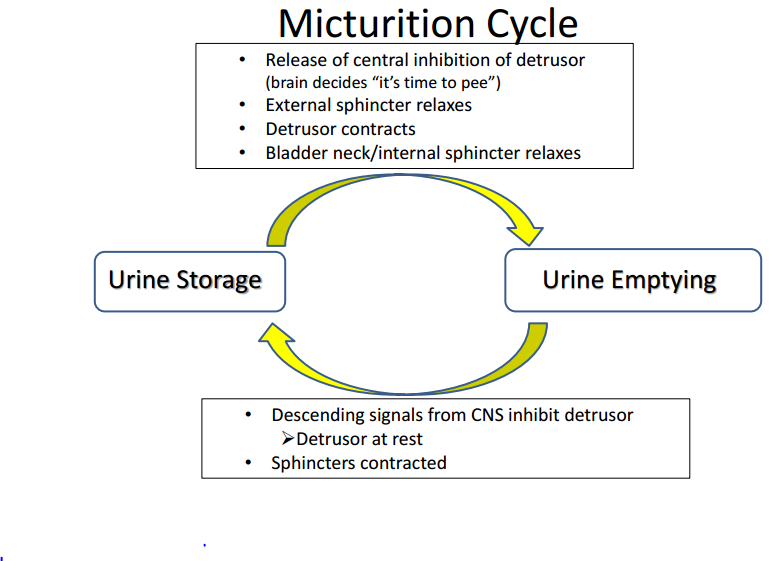
What is the micturition cycle?
Overactive bladder
What is the fundamental pathoglogy?
What are the sx?
Hyperactive/irritable detrusor – “Bladder spasms”
Urinary urgency, frequency, nocturia, urge incontinence
What are the causes of OAB?
- UTI
- Bladder irritants
- Neurologic conditions – Spinal cord injury, stroke, MS
- Metabolic conditions – Diabetes
- Urethral obstruction – Enlarged prostate, prior surgery for incontinence
- Other – Lack of estrogen, obesity, pelvic organ prolapse, pelvic floor dysfunction
What is the epidemiology of OAB?
Common
Rises with age
<70 yo:F
>70 yo: M=F
What is the tx for OAB?
Behavioral therapies – Fluid management, Kegel exercises
Medications – Anti-cholinergics (oxybutin, tolterodine), beta (III)-adrenergic agonist (myrbetriq)
Surgery
What kind of pathology does an underactive detrustor cause?
Chronic retention/overflow incontinence
What pathology voiding incontience is associated with the urethral sphincter?
What is the pathophysiology?
Stress incontinence
Incontinence with coughing sneezing, exercise, exertion
Due to weakness of urinary sphincter and support structures of urethra and bladder neck
What are the causes of stress incontinence?
Vaginal/pelvic trauma
Multiple vaginal deliveries
Pelvic surgery
External trauma
Often associated with vaginal prolapse
Lack of estrogen (menopause)
Neurologic (spina bifida)
Radiation therapy: Scarring
Obesity
What is the epidemiology of stress incontinence?
What risk factors are associated?
40% of healthy females aged 30-49 have experienced some degree of incontinence with exercise
Up to 25% of women may experience incontinence 3 months following their first vaginal delivery
Risk of incontinence increases with
Number of children (vaginally > C-section)
Age older than 45 years
What is the tx for stress incontinence?
- Behavioral therapies: Kegels, weight loss
- Medication (technically no approved drug for SUI): Duloxetine (SNRI)
- Increase neural output from spinal cord to EUS leading to contraction
- Surgery
What are the causes of urinary retention?
Bladder (detrusor): Weak/underactive/atonic/areflexic
Causes: Neurogenic, myogenic, psychogenic, medication (anti-ACh, α-adrenergics, narcotics)
Urethral obstruction
Anatomic: Prostatic enlargement, urethral stricture, prior incontinence surgery
Functional
Neurogenic – Detrusor-sphincter dyssynergia (uncoordination)
Non-neurogenic – Dysfunctional voiding
Temporary retention - Post-op
Anesthetics have anticholinergic activity
Increased sympathetic tone
More likely if patient has concomitant risk factors
What are the sx of urinary retention?
- Voiding difficulty/inability to urinate: straining, hesitancy, intermittent stream, weak urinary stream
- Urinary frequency (from lack of bladder emptying)
- Lower abdominal/suprapubic pain (acute)
- “Overflow” urinary incontinence (chronic)
- Suprapubic fullness/mass (distended bladder)
- Hydronephrosis/renal failure
What is the tx for urinary retention?
- Catheter drainage of bladder: Indwelling, intermittent (ideal)
- Treat UTI
- Stop aggravating meds (anti-ACh)
- Relieve any obstruction(α-blocker medications, Surgery on prostate)
- Neuromodulation – Non-obstructive retention

-
Male and Female Anatomy Review1
-
Male Physiology Review15
-
Female Physiology Review25
-
Male Reproductive Pharmacology29
-
Male Pathology Part 133
-
Male Pathology Part 221
-
Female Reproductive Pharmacology62
-
Contraceptive Reproductive Physiology47
-
Ovulatory Dysfunction & Infertility22
-
Abnormal Uterine Bleeding40
-
Repro System Development33
-
Congenital Anomalies of the GU tract24
-
Metabolic Syndrome14
-
Menopause18
-
Female Pathology - Uterus19
-
Voiding Dysfunction20
-
UTI22
-
Normal and Abnormal Puberty20
-
Pathology of the Ovary and Fallopian Tube39
-
GU Infections55
-
Prenatal Genetics36
-
Maternal & Fetal Health8
-
Pregnancy & Placental Pathology34
-
Male Pathology: Prostate27
-
Parturition16
-
Pathology of the Cervix, Vulva, Vagina23
-
Male Infertility17
-
Female Histology27
-
Pregnancy Complications54
-
Sexual Dysfunction, Psychosexual Health18
-
Intro to Breast Cancer39
-
Hereditary Breast Cancer15
-
Breast CIS7
-
Invasive Breast Cancer28
-
Male Breast Cancer4


