atherosclerosis - what is it?
an arteriosclerosis characterized by atheromatous deposits in and fibrosis of the inner layer of the arteries
Name 7 major risk factors for development of ischaemic heart disease/atherosclerosis?
- Old age
- Gender (premenopausal women protected, postmenopausal risk increases)
- Genetics
- Hyperlipidaemia
- Hypertension
- Smoking
- Diabetes Mellitus
NB: Risk factors have a MULTIPLICATIVE EFFECT
Which of the following is NOT a major risk factor for ischaemic heart disease?
A) Age
B) Male gender
C) High alcohol consumption
D) Hypertension
E) Smoking
C) High alcohol consumption
Describe the pathogenesis behind atherosclerotic changes in a blood vessel
- Endothelial injury
- LDL accumulation
- monocyte adhesion to endothelium
- Monocyte migration into intima => macrophage + foam cells
- Platelet aggregation
- SM cell recruitment
- Lipid accumulation - extra & intracellular, macrophages, SM cells
In atherosclerotic changes, one of the earliest lesions seen is a ____ _____
In atherosclerotic changes, one of the earliest lesions seen is a fatty streak
Fatty streak:
- affect on blood flow?
- in which age category is it always seen?
- relationship to plaques?
Fatty streak:
- no flow disturbance
- in virtually all children >10yrs
- relationship to plaques uncertain
What is the arrow showing in this blood vessel specimen?
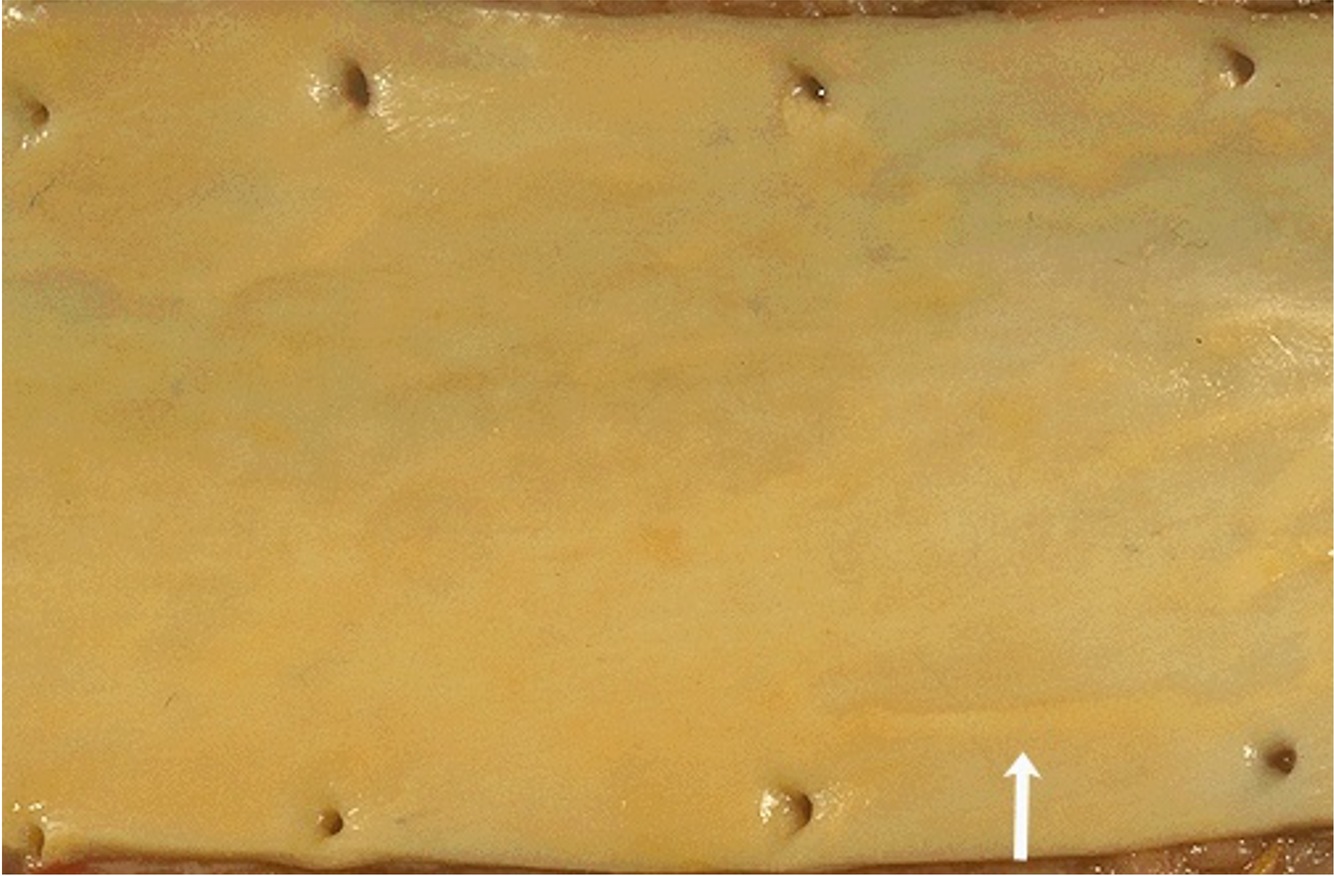
Fatty streak
At which sites does atherosclerosis usually occur?
Vulnerable sites of arteries = bifurcations and curvatures (where we likely have turbulent flow)
Athermoatous plaque can ____ or _____
Athermoatous plaque can obstruct or rupture
Consequences of atheroma - critical stenosis occurd as _____% occlusion
Consequences of atheroma - critical stenosis occurd as 70% occlusion
Consequences of atheroma - name 3 acute plaque changes
3 acute plaque changes:
- rupture
- erosion
- haemorrhage into plaque
In terms of atheromatic plaques, what 4 features make the plaque vulnerable?
- Lots foam cells or extracellular lipid
- Thin fibrous cap
- Few smooth muscle cells
- Clusters inflammatory cells
What do you see here?
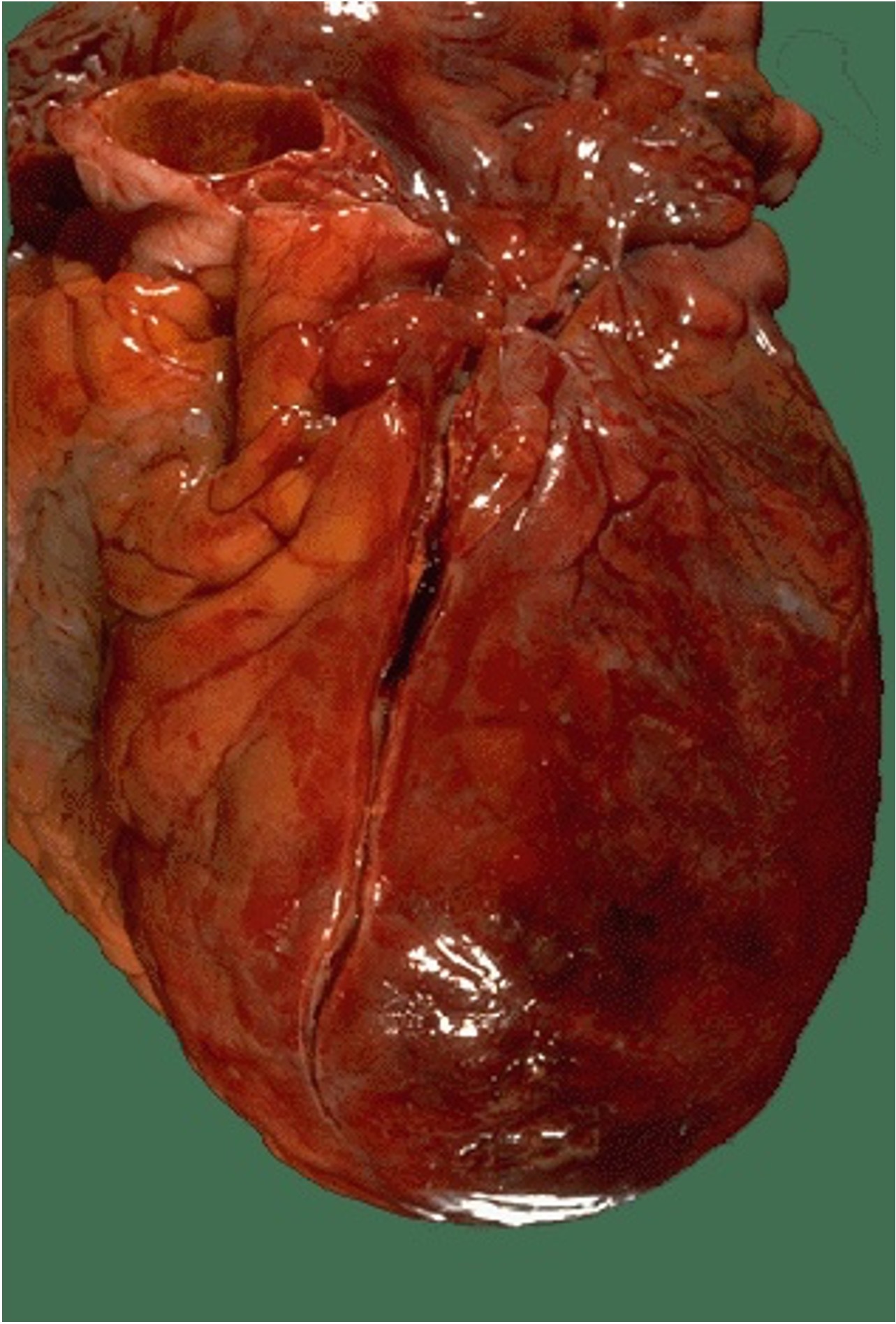
complete occlusion of LAD (left anterior descending) *most commonly occluded coronary artery*
Why is atheromatic vessel changes considered to be the silent killer?
B/c it progresses without any symptoms, and when symptoms develop it’s usually due to reduced blood flow causing myocardial ischaemia
Ischaemic heart disease could present in different ways based on severity and disease advancement. Name 4 presentations
- Angina pectoris
- MI
- Chronic IHD with HF
- Sudden cardiac death
IHD pathogenesis?
Predominant cause is insufficient coronary perfusion relative to myocardial demand due to chronic progressive atherosclerotic narrowing of coronary arteries and variable degrees of superimposed plaque change, thrombosis and vasospasm
IHD:
- at what % of stenosis does a patient typically get stable angina (pain on exertion)?
- at what % of stenosis does a patient typically get unstable angina (pain at rest)?
IHD:
- at what % of stenosis does a patient typically get stable angina (pain on exertion) = 75%
- at what % of stenosis does a patient typically get unstable angina (pain at rest) = 90%
IHD: where are the plaques usually found?
- LAD
- LCX
- RCA
IHD: where are the plaques usually found?
- LAD = 1st few cms (most common)
- LCX = 1st few cms
- RCA = entire length
Name 3 more common and 8 less common MI complications
- Contractile dysfunction
- Arrhythmia
- Myocardial rupture
- Pericarditis (Dressler Syndrome)
- RV infarction
- Infarct extension
- Infarct expnsion
- Mural thrombus
- Ventricular aneurysm
- Papillary muscle rupture
- Chronic IHD => HF
MI
- total mortality in 1st year
- mortality per year after 1st
MI
- total mortality in 1st year = 30%
- mortality per year after 1st = 3-4%
Sudden cardiac death:
- what is it?
- aetiology?
Sudden cardiac death:
- what is it = Unexpected death from cardiac causes in individuals without symptomatic heart disease or early (1hr) after onset of symptoms
- aetiology = most commonly due to ischaemia-induced electrical instability (arrythmias)*
* other conditions also associated: aortic atenosis, mitral valve prolpase, pulmonary hypertension
The major cause of ischaemic heart disease is…
A) Reduced blood flow due to atherosclerosis
B) Increased cardiac demand for oxygen
C) Increased compliment fixation
D) Pump failure leading to hypoperfusion
E) Uncoupling of Na/K channels
A) Reduced blood flow due to atherosclerosis
Cardiac failure - 3 types
- Congestive Heart Failure (L&R)
- Left sided (-> SOB, pulmonary oedema)
- Right sided (-> peripheral oedema)
Cardiac failure - causes (6)
–Ischaemic heart disease (IHD)
–Valve disease
–Hypertension
–Myocarditis
–Cardiomyopathy
– Left sided heart failure (Right)

-
W1 - Calcium metabolism57
-
W1 - Haemostasis & Thrombosis37
-
W2 - Fundamentals of histology26
-
W2 - The immune response to infection67
-
W2 - Lipoprotein metabolism, CVD, obesity28
-
W2 - Liver CPC48
-
W3 - Antimicrobial agents 181
-
W3 - Antimicrobial agents 227
-
W3 - Liver pathology45
-
W4 - lipid update/effect on CVS15
-
W5 - Sodium and fluid balance31
-
W5 - Haematology in systemic disease37
-
W5 - CML & myeloproliferative disorders44
-
W6 - K+ & electrolytes20
-
W6 - Hospital acquired infections13
-
W6 - Pituitary18
-
W6 - electrolyte cases Prof Sam10
-
W7 - Diabetes cases14
-
W7 - 2ndary immunodeficiency & HIV40
-
W7 - plasma cell myeloma & amyloid & MGUS42
-
W8 - Engagement + feedback18
-
W9 - Skin pathology57
-
W9 - Adrenal disease26
-
W10 - Primary immunodeficiency part 135
-
W10 - CNS infections + meningitis34
-
W11 - Lymphoma 113
-
W10 - Primary immunodeficiency part 235
-
W9 - Respiratory pathology59
-
Week 11 - Fungal infections46
-
W11 - Bacterial & viral vaccines18
-
W13 - Lymphoma 251
-
W13 - Breast pathology43
-
W13 - mycobacterium diseases (TB)28
-
W14 - Assessment of renal function11
-
W14 - Neonatal and childhood infections30
-
W14 - AKI & CKD30
-
W15 - Lower GI pathology66
-
W15 - Transplantation34
-
W16 - Blood transfusion 141
-
W16 - Blood transfusion 241
-
W16 - Clinical chemistry CPC17
-
W17 - Allergy49
-
W17 - Intro to SCT35
-
W18 - EMQ on enzymes, chemistry13
-
W18 - Enzymes and cardiac enzymes24
-
W18 - Wound, bone, and joint infection24
-
W19 - Systemic pathology22
-
W19 - Autoimmune & autoinflammatory87
-
W20 - UTI17
-
W20 - Upper GI pathology33
-
W20 - Opportunistic viral infections25
-
W21 - Diabetes CPC27
-
W21 - Neuro-oncology34
-
W22 - Imm modulating therapies 1&266
-
W22 - Hypoglycaemia30
-
W23 - Cerebrovascular disease and trauma35
-
W23 - Neurodegeneration47
-
W24 - Paediatric hematology38
-
W24 - Acute leukaemia24
-
W24 - Leuk cases32
-
W25 - Gastroenteritis40
-
W25 - Haem interactive cases29
-
W25 - CVD40
-
W26 - Gynae path63
-
W26 - myelodysplastic syndrome39
-
W27 - Obstetric haem43
-
W28 - Pancreas & GB38
-
W28 - Viral pandemics and influenza25
-
W29 - Viral hepatitis43
-
W29 - Antivirals20


