
Unless you hail from truly disadvantaged origins, chances are you’ve played video games at some point. And anyone with experience on a Sega, Nintendo, PlayStation, or Xbox will know the immutable law of video games: the first time you face “the big bad boss”, you WILL get your butt handed to you. You just have to accept it, start over, and try again.
Why is this always the case, though?
Here’s why: because you don’t know what to expect. When you don’t know what to expect, you don’t know how to react or respond or fight back. And so you face your final enemy unprepared, relying only on your reflexes to get you through (which, after all those Flamin' Hot Cheetos, aren’t doing so well).
The same is true of any enemy, adversity, or challenge in life: knowing what to expect helps you prepare. That’s what we’re here to help you with today.
The WSET ® Level 1 exam in wine is the first step you’ve taken on your formal education in wine. And in this awesome guide, put together by the experienced (wine-lovin’) team here at Brainscape and certified wine expert Brian Mitchell, we’ll be giving you ALL the cheat codes to the WSET* 1 (you know ... without the actual cheating).
Armed with this information, you’ll know exactly what to expect from your foe on exam day, so you can step up to the plate and smash it, first time, with distinction.
One of the best ways to train for this boss battle is with digital flashcard apps like Brainscape or Mochi, which optimize your learning based on cognitive science. Instead of chugging the entire textbook in one go, flashcards serve up key wine terms, styles, and concepts in small pours you can actually digest. By testing your recall and bringing tricky facts back at just the right time, they help you learn twice as fast, so you can make real progress in as little as ten minutes a day.
Now: about that exam.
What Will We Be Covering in This WSET 1 Study Guide?
- How is the WSET 1 exam formatted?
- What course content is covered in the WSET 1 exam?
- What kind of questions are in the WSET 1 exam?
- Take on Brainscape’s WSET 1 practice exam
- Three fundamental tips for acing the WSET 1 exam
How is the WSET 1 Exam Formatted?
45 Minutes … 30 multiple-choice questions … eternal glory!
Pretty straightforward, isn’t it? Each question has only one correct answer worth one mark each (no marks are subtracted for incorrect answers). You’ll need to score a minimum of 70% to pass the exam but you don’t need to concern yourself with that since you’re aiming for +90% anyway.
The WSET 1 is also a closed-book exam, so don’t dare take your textbook, study notes, or crib notes into the venue. That will not end well for you.
That’s really the long and short of it!
What Course Content Is Covered in the WSET 1 Exam?
Every question that pops up in the WSET Level 1 exam is taken directly from the content covered in the official textbook. So you need not worry about being blind-sided by anything. The WSET examiners are not out to trick you.
The exam itself is carefully curated to assess your knowledge and understanding of the WSET 1 syllabus, which is broken down into the following learning objectives:
Learning Outcome 1: the Key Stages in Grape Growing and Winemaking
There are six multiple-choice questions posed on this section and you should be able to:
- Name the main parts of a grape and what they contain (acid, tannin, water, sugar, etc.)
- Name the key stages in the annual cycle of grape growing and know what happens during ripening.
- Name and define the different grape-growing climates and how they can affect the characteristics of grapes.
- List the requirements for, and the products of, alcoholic fermentation.
- Name and correctly order the key stages in the production of still white, red and rosé wines.
Learning Outcome 2: the Types, Characteristics, and Styles of Wines Made From the Principal Grape Varieties and Other Examples of Wines
There are 18 multiple-choice questions posed in this section (making it the most significant learning outcome), and you should be able to:
- Name and define the types of wine and the characteristics that contribute to their styles.
- Name the principal grape varieties and identify the characteristics and styles of their wines.
- Identify and relate examples of wines from principal grape varieties to the grape varieties, types, characteristics, and styles of wines.
- Identify and relate other examples of wines to the types, characteristics, and styles of wines.
Learning Outcome 3: the Key Principles and Practices for the Storage and Service of Wine
There are 6 multiple-choice questions posed in this section and you should be able to:
- Identify and define the ideal conditions for storing and methods for preserving wine.
- Identify the recommended service temperature description for the principal types and styles of wine.
- State the correct procedures for opening and serving wine.
- Identify the principal food and wine interactions and recognize the effect they typically have on a wine.
If you fulfill each bulleted requirement laid out in these three learning outcomes, then you are ready to take the WSET Level 1 exam!
What Kind of Questions Are on the WSET 1 Exam?
There are 30 multiple-choice questions (and only multiple choice questions) in the exam. Each has only one correct answer and is worth one mark. And while some questions test your understanding of serving and pairing wines with food, there is no practical component for the WSET 1 exam.
Here are a few examples of the types of questions you might expect to come across:
The grape pulp contains:
- (A) Tannin
- (B) Color
- (C) Acid
- (D) None of these
Cava and Prosecco are examples of:
- (A) Still wines
- (B) Sparkling wines
- (C) Fortified wines
- (D) Burgundy wines
Umami makes wines seem sweeter and more fruity.
- True
- False
Screw-cap wines are best stored:
- (A) Upright, in direct sunlight
- (B) On their side, in a warm, dark location
- (C) On their side, in a place where there’s frequent vibration
- (D) Upright, in a cool, dark location
For more practice exam questions like these, sign up for Brainscape’s WSET 1 flashcards and receive our FREE WSET 1 practice exam!
P.S. The answers are: c, b, a, and d
Take on Brainscape’s WSET 1 Practice Exam
There are few better ways to know exactly what to expect from the WSET 1 exam than to actually do one. A practice exam, that is.
The problem is, the Wine & Spirits Education Trust (WSET) is not in the habit of publishing past exams ... so getting your hands on one can prove pretty tricky.
Additionally, the WSET 1 practice exam questions you tend to find “out there” in the virtual ether don’t reflect the challenge in its entirety.
So, we thought we’d solve these problems with Brainscape’s very own WSET 1 mock exam, which we drafted with the help of our panel of wine educators and certified wine expert Brian Mitchell. (To get that delivered to your inbox, simply sign up for Brainscape’s WSET 1 flashcards!)
Our mock exam carries the same mark allocation and weighting as the real WSET 1, so it offers super valuable practice.
Three Fundamental Tips for Acing the WSET 1 Exam
Knowing how to approach your studies is equally as important as knowing what to expect from the exam. So before we end off, we thought we’d share our most important, essential study tips:
Study Tip 1: Start Studying Early
A cautionary tale: You will not pass if you rely on cramming. If you’re new to wine, there is simply too much to learn and you CANNOT cram all of that in your head in a matter of days.
The best approach to preparing for the WSET 1 exam is to learn from day one and spread the material out over the duration of your course, so after each lesson:
- Consolidate what you’ve learned by reading through the textbook again,
- Make notes of the most salient points,
- Write down any questions you have for your instructor, and
- Master the facts using the relevant flashcard deck/s in Brainscape’s certified WSET 1 class.
Study Tip 2: Use Digital Flashcards to Prepare for the WSET 1 Exam
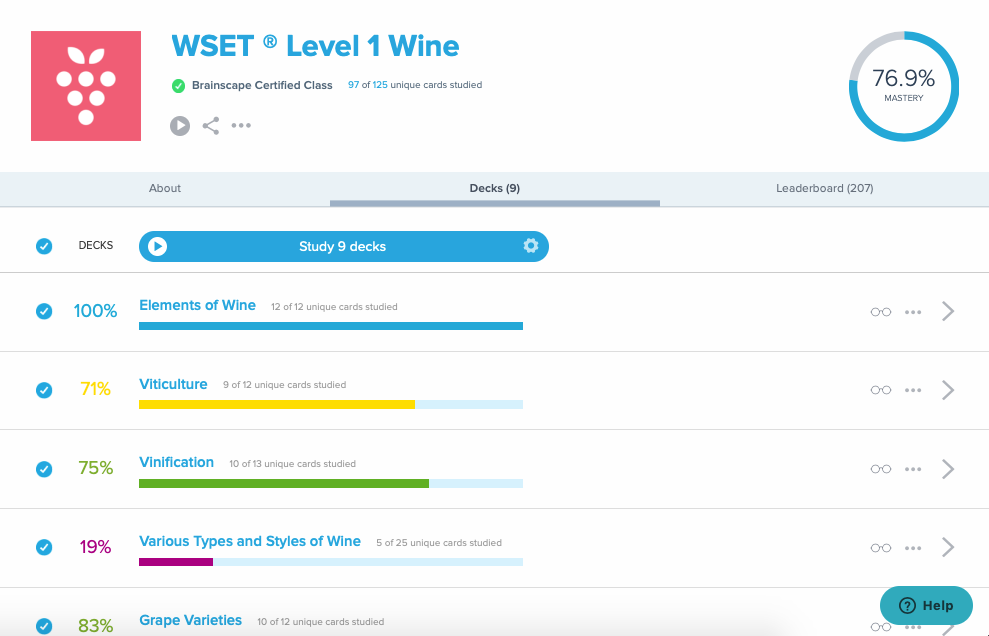
Ah-ha! Now for the real “secret sauce” to acing the WSET Level 1 exam. One of the most effective ways to prepare is by breaking the official curriculum down into clear, bite-sized facts and studying them through digital flashcards in a question-and-answer format.
What makes high-quality flashcards so effective is not just the content, but how they’re used. Well-designed flashcard systems such as Anki and Brainscape are built around cognitive science principles that help your brain absorb and retain information far more efficiently than passive study methods like rereading or highlighting.
Effective digital flashcards typically:
- Force active recall, meaning you must produce the answer from memory instead of recognizing it from a list. This strengthens memory and improves exam performance.
- Encourage self-assessment, prompting you to rate how well you know each concept. This supports metacognition, or awareness of what you truly understand versus what still needs work.
- Use spaced repetition, resurfacing weaker material at optimal intervals while letting you move quickly past facts you already know well. This saves time and helps you learn more efficiently.
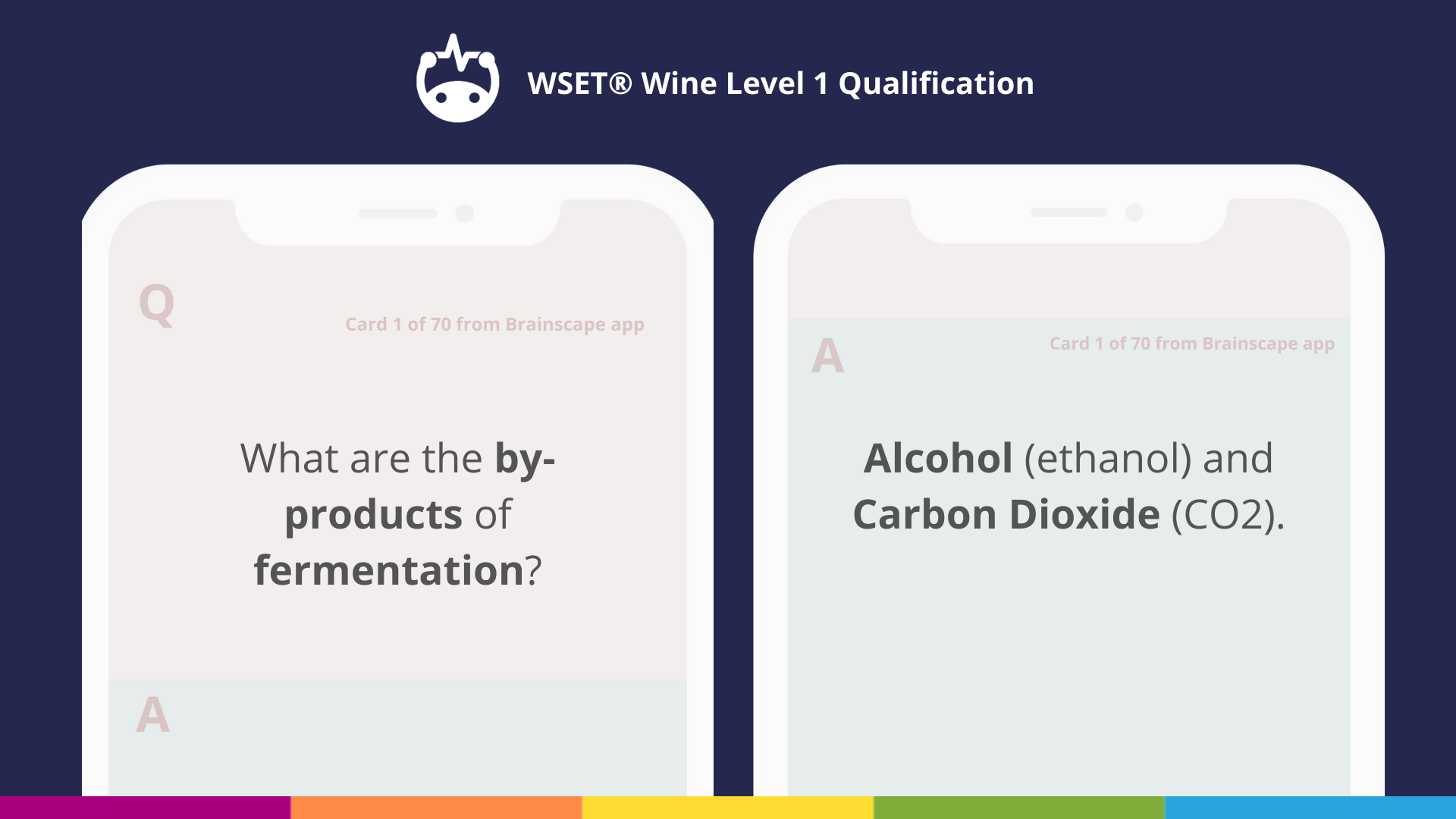
Together, active recall, metacognition, and spaced repetition help learners internalize the exact information they need for exam day. Whether you’re using an expert-built flashcard collection aligned with the WSET syllabus or creating your own cards from the textbook, this approach gives you a structured, efficient way to prepare with confidence.
Study Tip 3: Practice Wine Tasting!
While there is no practical tasting exam in the WSET 1, experiencing the wines you’ll be learning about is the very best way to remember their key characteristics and what makes them so special. So, why not get a group of fellow wine lovers together and do a tasting of some of the world’s principal wine varieties and styles?
Try a red Burgundy next to a Pinot Noir from New Zealand and Napa Valley, USA. Or how about a Chablis, white Burgundy, and oaky Chardonnay from California? Or get a little festive with a Spanish Cava, French Champagne, and Italian Prosecco!
There is so much to discover and your learning journey will be all the richer and more multi-sensory if you can see, smell, and taste the wines you come across in your WSET 1 course. In fact, it’s these experiences that are really going to set your passion for wine afire!
In Summary: What Should You Expect on the WSET Level 1 Exam?
In this wine guide, we’ve covered everything you need to know before you step into the arena with the WSET Level 1 exam in wine, from how it’s formatted, the content covered, and the kinds of questions you can expect to where you can get your hands on a WSET 1 practice exam.
And, we’ve ended off with a few juicy tips to really get you on your way to a distinction and that glorious WSET 1 certification and lapel pin.
Now, here’s what you need to do: study hard, appreciate the journey in all its glory (and the occasional gory), and then march into that WSET Level 1 exam and kick its butt harder than all those “big bad bosses” kicked yours!
Additional Reading
- How to study for the WSET Level 1 exam more efficiently
- How to find and take a WSET Level 1 practice exam
- How to get a job in wine with the WSET Level 1 qualification
*Disclaimer: Brainscape has worked with top wine experts to supplement the official publications and preparation offered by WSET.
References
Kang, S. H. (2016). Spaced repetition promotes efficient and effective learning. Policy Insights from the Behavioral and Brain Sciences, 3(1), 12–19. https://doi.org/10.1177/2372732215624708
Karpicke, J. D. (2012). Retrieval-based learning: Active retrieval promotes meaningful learning. Current Directions in Psychological Science, 21(3), 157-163.
Lally, P., & Gardner, B. (2013). Promoting habit formation. Health Psychology Review, 7(sup1), S137-S158.
Xu, J., Wu, A., Filip, C., Patel, Z., Bernstein, S. R., Tanveer, R., Syed, H., & Kotroczo, T. (2024). Active recall strategies associated with academic achievement in Young Adults: A systematic review. Journal of Affective Disorders, 354, 191–198. https://doi.org/10.1016/j.jad.2024.03.010