The key molecules that are required to build structures that enable organisms to function are
- Carbohydrates
- Proteins
- Lipids
- Nucleic Acids
- Water
Carbon atoms are key to the organic compounds because:
Each carbon atom can form four covalent bonds – this makes the compounds very stable (as covalent bonds are so strong they require a large input of energy to break them) Carbon atoms can form covalent bonds with oxygen, nitrogen and sulfur Carbon atoms can bond to form straight chains, branched chains or rings Carbon compounds can form small single subunits (monomers) that bond with many repeating subunits to form large molecules (polymers) by a process called polymerisation
Macromolecules
are very large molecules -That contain 1000 or more atoms therefore having a high molecular mass -Polymers can be macromolecules, however not all macromolecules are polymers as the subunits of polymers have to be the same repeating units
Carbohydrates
-Carbohydrates are one of the main carbon-based compounds in living organisms -All molecules in this group contain C, H and O -As H and O atoms are always present in the ratio of 2:1 (eg. water H2O, which is where ‘hydrate’ comes from) they can be represented by the formula Cx (H2O)y -The three types of carbohydrates are monosaccharides, disaccharides and polysaccharides
The Two Forms of Glucose
-Glucose exists in two structurally different forms
– alpha (α) glucose and beta (β) glucose and is therefore known as an isomer
—This structural variety results in different functions between carbohydrates
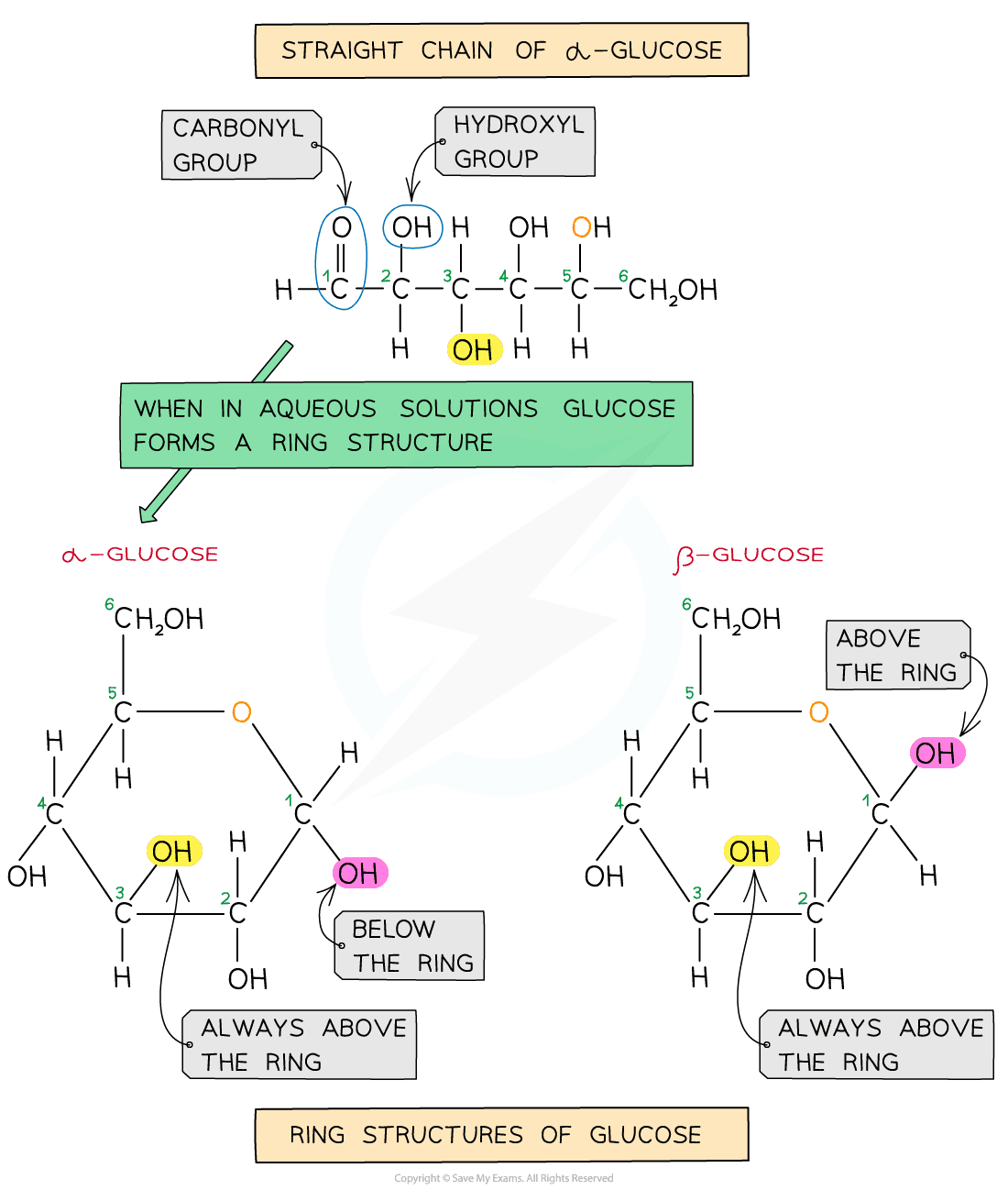
types of carbohydrates
Glucose
- The most well-known carbohydrate monomer is glucose
- Glucose has the molecular formula C6H12O6
- Glucose is the most common monosaccharide and is of central importance to most forms of life
different types of monosaccharide
-There are different types of monosaccharide formed from molecules with varying numbers of carbon atom, for example:
—Trioses (3C) eg. glyceraldehyde
—Pentoses (5C) eg. ribose
—Hexoses (6C) eg. glucose
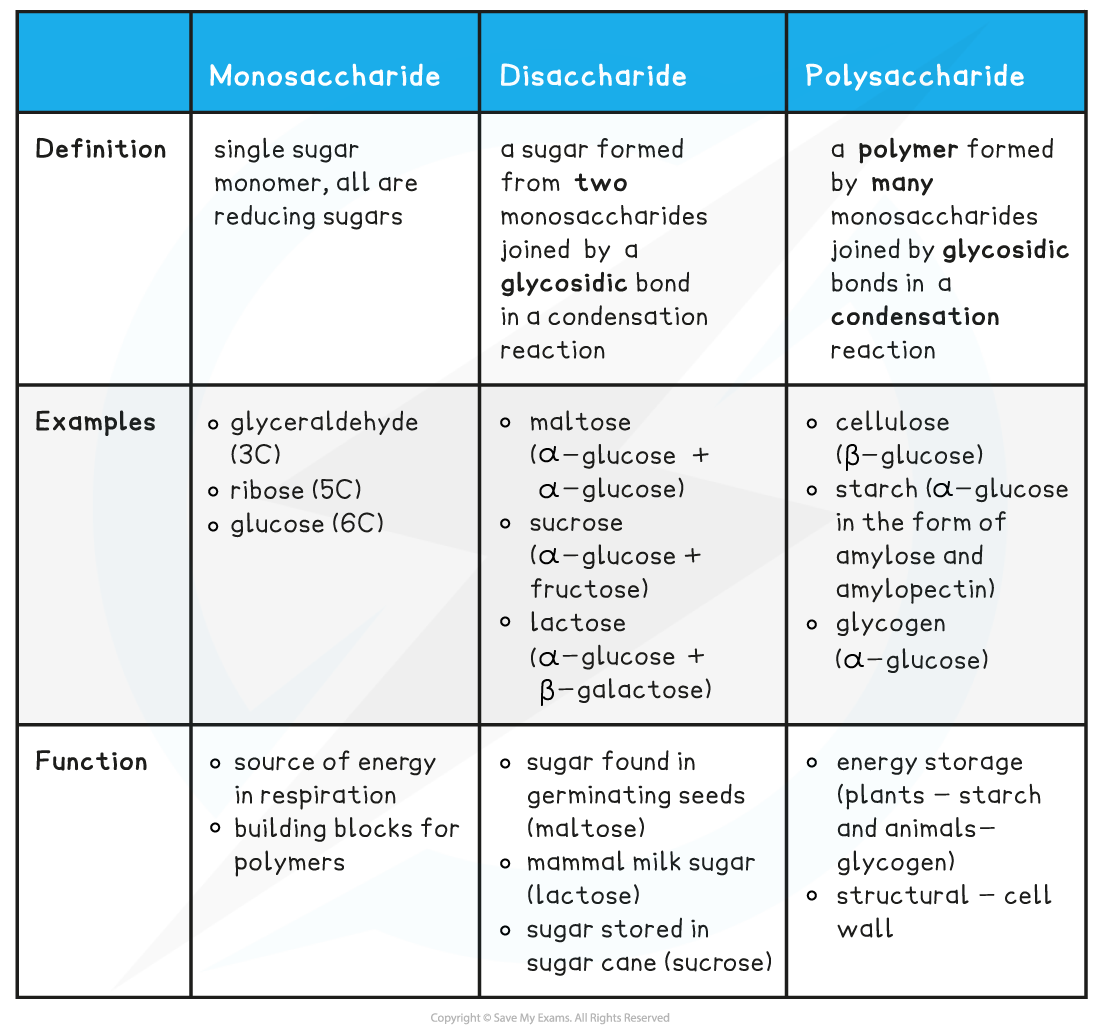
Structure of polysaccharides table
polysaccharides: a-glucose : B-glucose Starch: yes : no Glycogen: yes : no Cellulose: no: yes
monosaccharide
- def: single sugar monomer, all are reducing sugars
- example: glyceraldehyde, ribose, glucose
- function: source of energy in respiration, building blocks for polymers
disaccharide
def: a sugar formed from two monosaccharides joined by a glyosidic bond in a condensation reaction
- examples: maltose(a-glucose + a-glucose), sucrose(a-glucose + fructose), lactose (a-glucose + B-galactose)
- Function: sugar found in germinating seeds(maltose), mammal milk sugar(lactose(, sugar stored in sugar cane (sucrose
polysaccharide
- def: a polymer formed by many monosaccharides joined by glyosidic bonds in a condensation reaction
- examples: cellulose(B-glucose), Starch(a-glucose in the form of amylase and amylopectin), glycogen (a-glucose)
- function: energy storage (plants-starch-and animals-glycogen), structural - cell wall
A covalent bond
is the sharing of two or more electrons between two atoms
-The electrons can be shared equally forming a nonpolar covalent bond or unequally (where an atom can be more electronegative δ) to form a polar covalent bond
covalent bonds features
- Generally each atom will form a certain number of covalent bonds due to the number of free electrons in the outer orbital e.g. H = 1 bond, C = 4 bonds
- Covalent bonds are very stable as high energies are required to break the bonds
- Multiple pairs of electrons can be shared forming double bonds (e.g. unsaturated fats C=C) or triple bonds
When two monomers are close enough that their
outer orbitals overlap this results in their electrons being shared and a covalent bond forming. If more monomers are added then polymerisation occurs (and / or a macromolecule forms)
Condensation
- Also known as dehydration synthesis (‘to put together while losing water’)
- A condensation reaction occurs when monomers combine together by covalent bonds to form polymers (polymerisation) or macromolecules (lipids) and water is removed
Hydrolysis
- Hydrolysis means ‘lyse’ (to break) and ‘hydro’ (with water)
- In the hydrolysis of polymers, covalent bonds are broken when water is added
Reducing sugars
can donate electrons (the carbonyl group becomes oxidised), the sugars become the reducing agent
—Thus reducing sugars can be detected using the Benedict’s test as they reduce the soluble copper sulphate to insoluble brick-red copper oxide
—Examples: glucose, fructose, maltose
Non-reducing sugars
cannot donate electrons, therefore they cannot be oxidised
-To be detected non-reducing sugars must first be hydrolysed to break the disaccharide into its two monosaccharides before a Benedict’s test can be carried out
—-Example: sucrose
why does the body form the Glycosidic Bond between monosaccharides
- To make monosaccharides more suitable for transport, storage and to have less influence on a cell’s osmolarity, they are bonded together to form disaccharides and polysaccharides
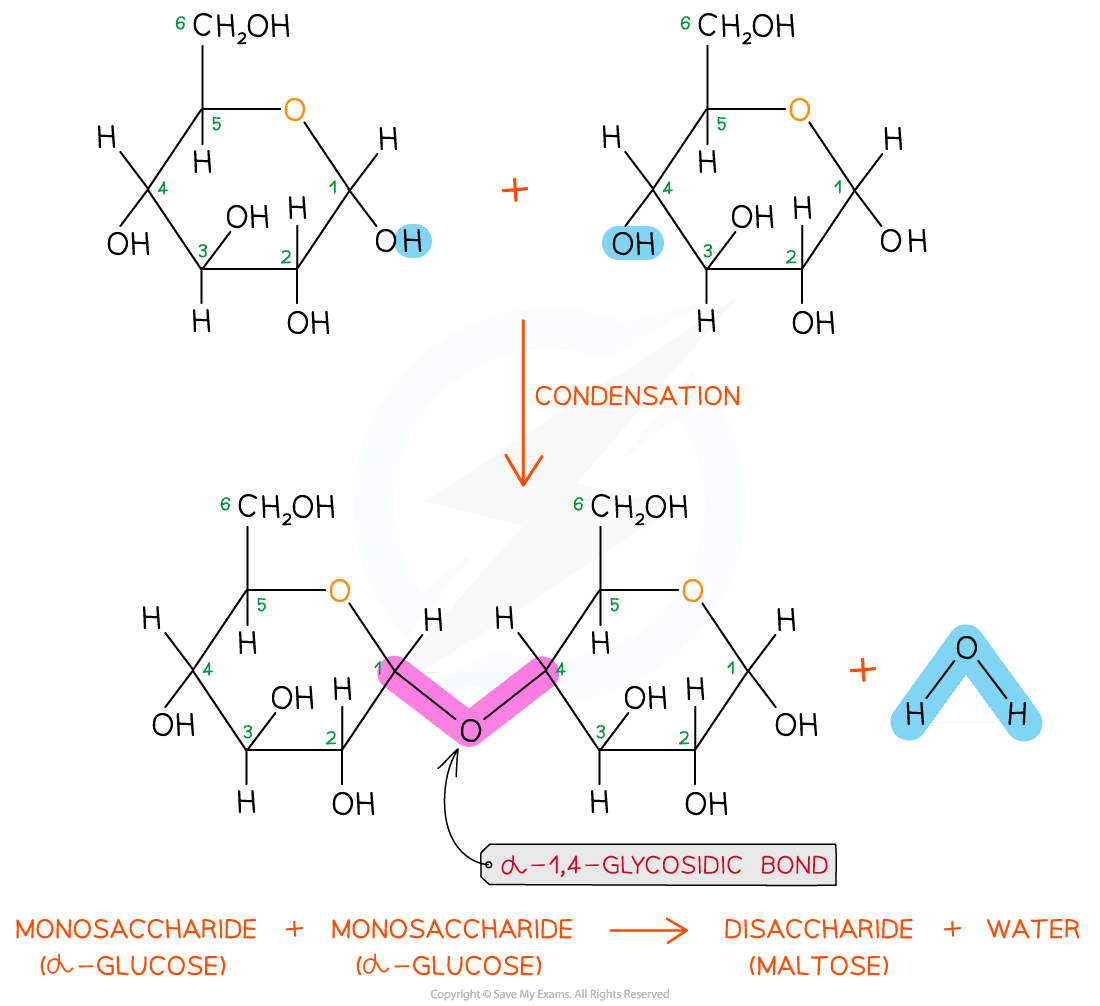
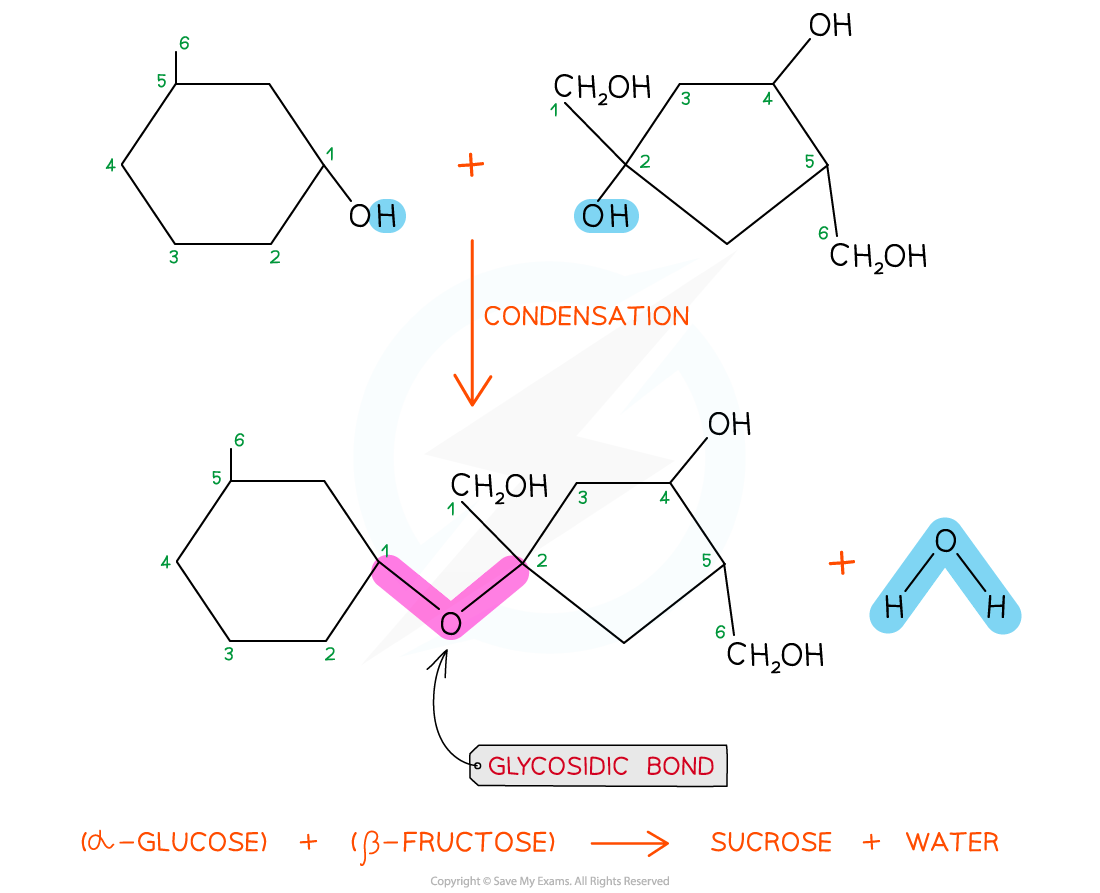
- Disaccharides and polysaccharides are formed when two hydroxyl (-OH) groups (on different saccharides) interact to form a strong covalent bond called the glycosidic bond (the oxygen link that holds the two molecules together)
- Every glycosidic bond results in one water molecule being removed, thus glycosidic bonds are formed by condensation
The formation of a glycosidic bond by condensation between two monosaccharides (glucose) to form a disaccharide (maltose)
- Each glycosidic bond is catalysed by enzymes specific to which OH groups are interacting
- As there are many different monosaccharides this results in different types of glycosidic bonds forming (e.g maltose has a α-1,4 glycosidic bond and sucrose has a α-1,2 glycosidic bond)
The formation of a glycosidic bond by condensation between α-glucose and β-fructose to form a disaccharide (sucrose)
Types of Glycosidic Bonds Table
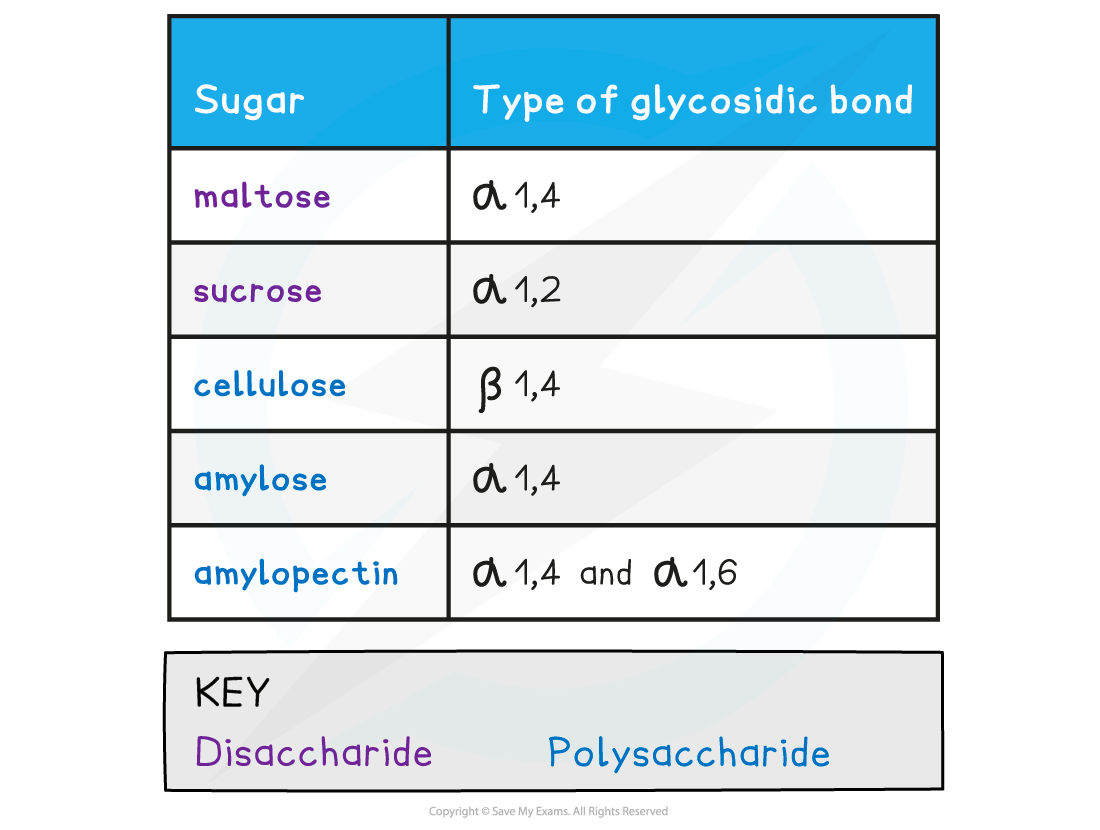
Breaking the Glycosidic Bond
- The glycosidic bond is broken when water is added in a hydrolysis (meaning ‘hydro’ – with water and ‘lyse’ – to break) reaction
- Disaccharides and polysaccharides are broken down in hydrolysis reactions -Hydrolytic reactions are catalysed by enzymes, these are different to those present in condensation reactions
- Examples of hydrolytic reactions include the digestion of food in the alimentary tract and the breakdown of stored carbohydrates in muscle and liver cells for use in cellular respiratio


-
Chapter 115
-
Chapter 1.227
-
Chapter 221
-
Chapter 2.252
-
Chapter 2.343
-
Chapter 2.410
-
Chapter 313
-
Chapter 3.222
-
Chapter 429
-
Chapter 4.228
-
Chapter 5.136
-
Chapter 5.211
-
Chapter 6.124
-
Chapter 6.220
-
Chapter 7.127
-
Chapter 7.232
-
Chapter 8.144
-
Chapter 8.228
-
Chapter 9.141
-
Chpater 9.29
-
Chapter 10.132
-
Chapter 10.219
-
Chapter 11.142
-
Chapyer 11.248


