From Gene to Polypeptide
- A gene is a sequence of nucleotides that forms part of a DNA molecule (one DNA molecule contains many genes)
- This sequence of nucleotide bases (the gene) codes for the production of a specific polypeptide (protein) Protein molecules are made up of a series of amino acids bonded together
- The shape and behaviour of a protein molecule depends on the exact sequence of these amino acids (the initial sequence of amino acids is known as the primary structure of the protein molecule)
- The genes in DNA molecules, therefore, control protein structure (and as a result, protein function) as they determine the exact sequence in which the amino acids join together when proteins are synthesised in a cell
Constructing Polypeptides: Transcription & Translation
-A gene is a sequence of nucleotide bases in a DNA molecule that codes for the production of a specific sequence of amino acids, that in turn make up a specific polypeptide (protein) -This process of protein synthesis occurs in two stages:
—Transcription– DNA is transcribed and an mRNA molecule is produced
—Translation – mRNA (messenger RNA) is translated and an amino acid sequence is produced
Transcription
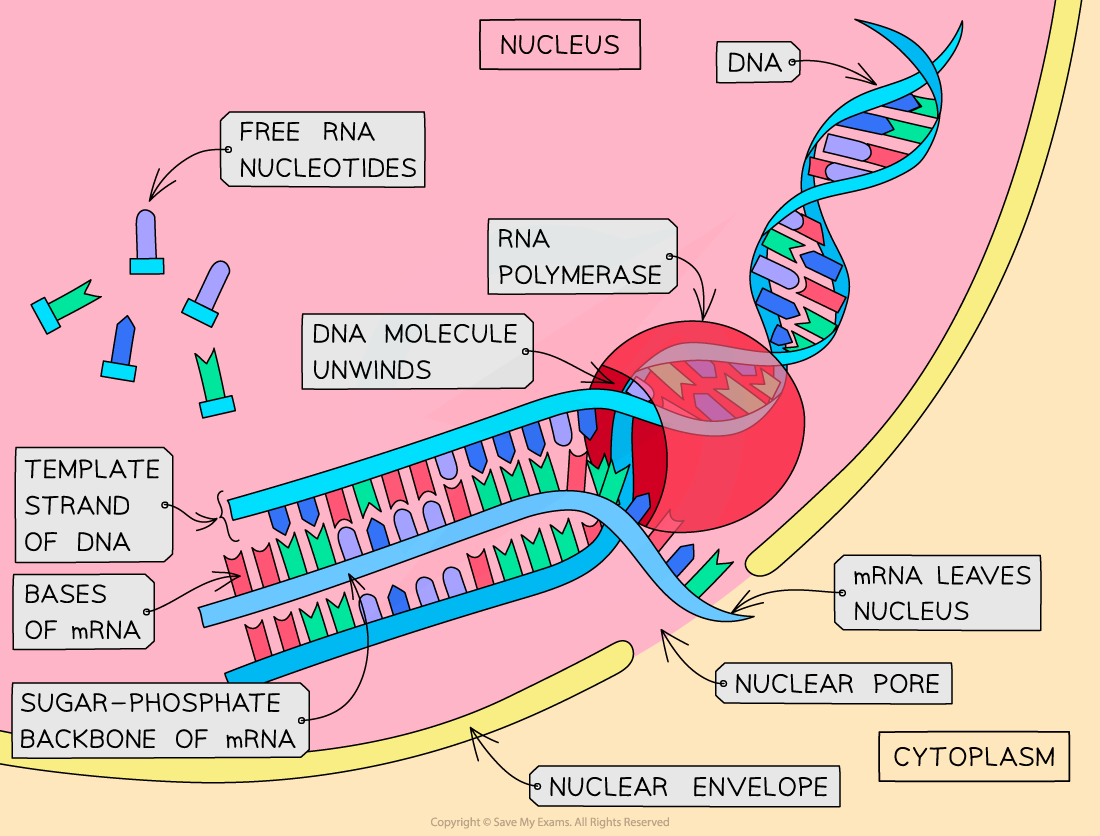
- This stage of protein synthesis occurs in the nucleus of the cell
- Part of a DNA molecule unwinds (the hydrogen bonds between the complementary base pairs break)
- This exposes the gene to be transcribed (the gene from which a particular polypeptide will be produced)
- A complimentary copy of the code from the gene is made by building a single-stranded nucleic acid molecule known as mRNA (messenger RNA)
- Free activated RNA nucleotides pair up (via hydrogen bonds) with their complementary (now exposed) bases on one strand (the template strand) of the ‘unzipped’ DNA molecule
- The sugar-phosphate groups of these RNA nucleotides are then bonded together by the enzyme RNA polymerase to form the sugar-phosphate backbone of the mRNA molecule
Translation
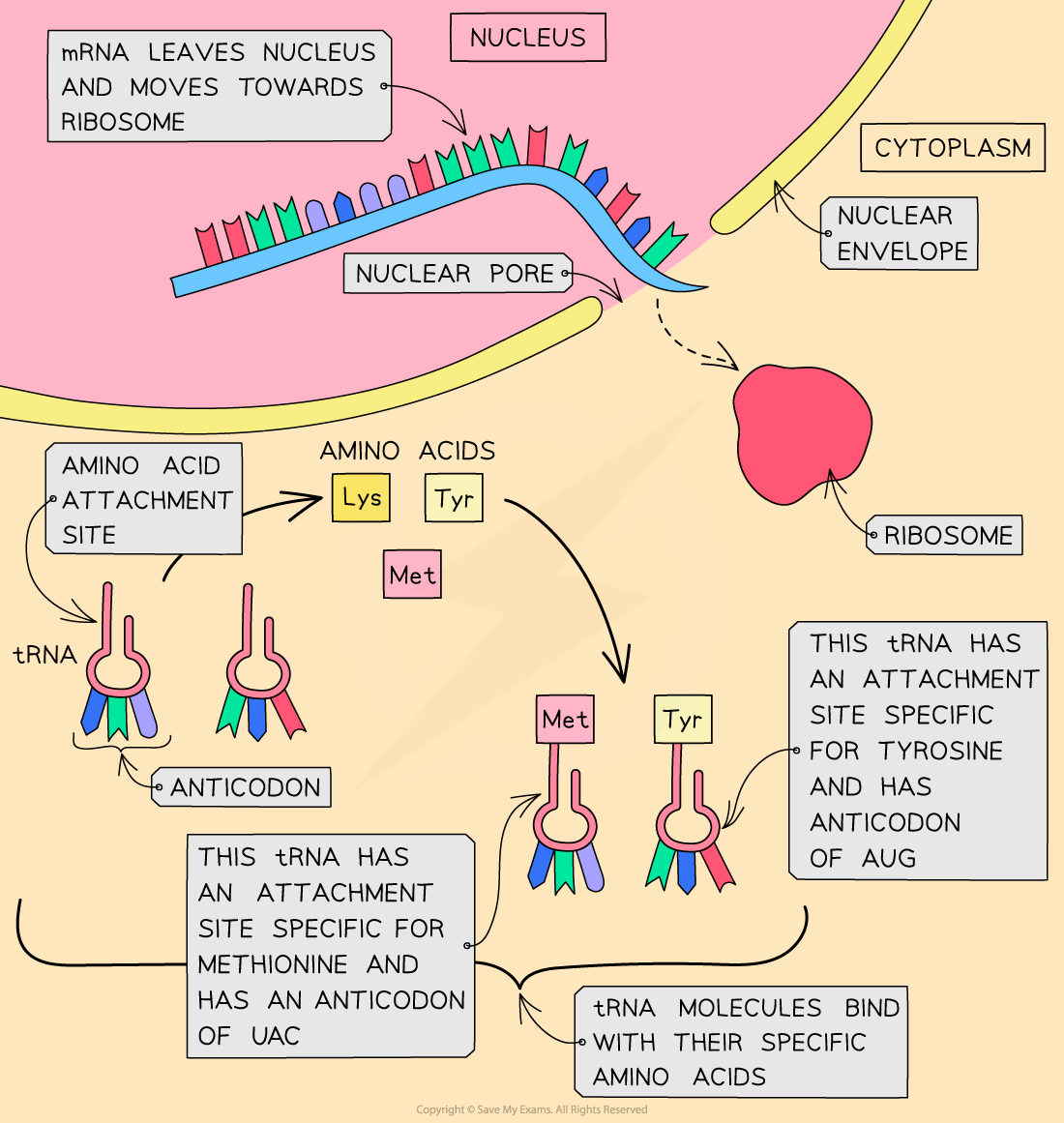
- This stage of protein synthesis occurs in the cytoplasm of the cell
- After leaving the nucleus, the mRNA molecule attaches to a ribosome
- In the cytoplasm, there are free molecules of tRNA (transfer RNA)
- These tRNA molecules have a triplet of unpaired bases at one end (known as the anticodon) and a region where a specific amino acid can attach at the other
- There are at least 20 different tRNA molecules, each with a specific anticodon and specific amino acid binding site
- The tRNA molecules bind with their specific amino acids (also in the cytoplasm) and bring them to the mRNA molecule on the ribosome
Gene Mutations & Their Effect on Polypeptides
-A gene mutation is a change in the sequence of base pairs in a DNA molecule that may result in an altered polypeptide -Mutations occur continuously -As the DNA base sequence determines the sequence of amino acids that make up a protein, mutations in a gene can sometimes lead to a change in the polypeptide that the gene codes for -Most mutations do not alter the polypeptide or only alter it slightly so that its structure or function is not changed (as the genetic code is degenerate)
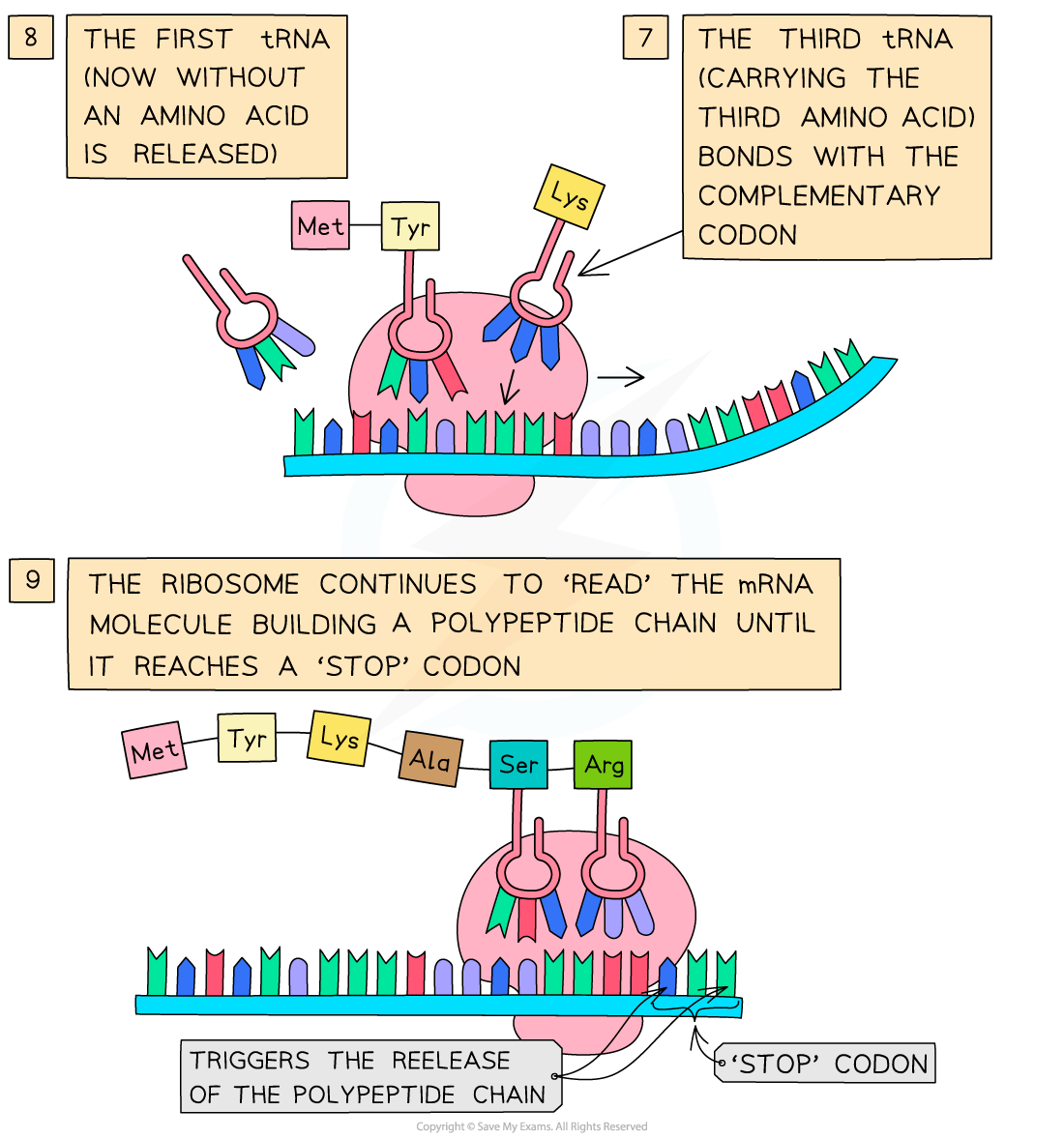
The translation stage of protein synthesis – an amino acid chain is formed
-There are different ways that a mutation in the DNA base sequence can occur:
-Insertion of nucleotides -Deletion of nucleotides -Substitution of nucleotides
Insertion of nucleotides
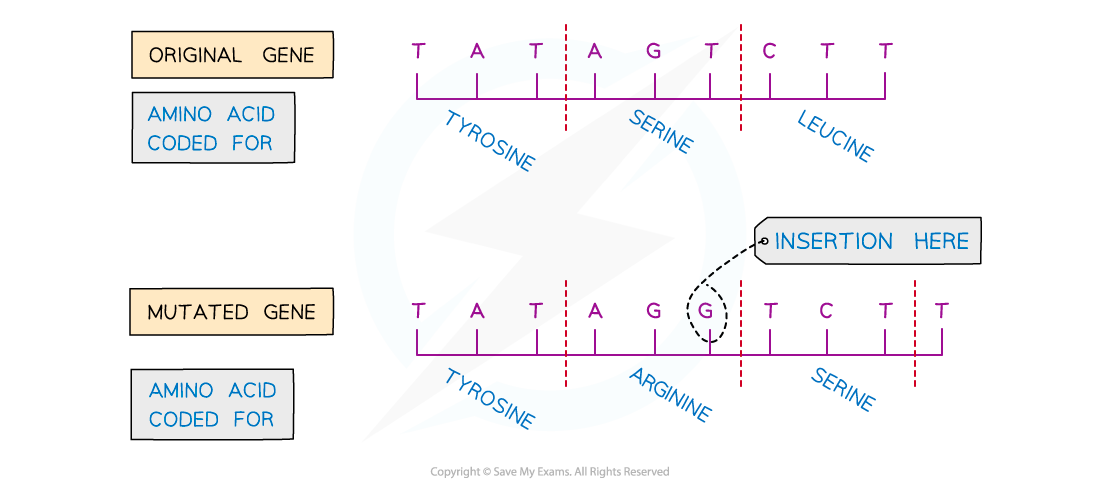
- A mutation that occurs when a nucleotide (with a new base) is randomly inserted into the DNA sequence is known as an insertion mutation
- An insertion mutation changes the amino acid that would have been coded for by the original base triplet, as it creates a new, different triplet of bases
- An insertion mutation also has a knock-on effect by changing the triplets (groups of three bases) further on in the DNA sequence
- This is sometimes known as a frameshift mutation
- This may dramatically change the amino acid sequence produced from this gene and therefore the ability of the polypeptide to function
Deletion of nucleotides
- A mutation that occurs when a nucleotide (and therefore its base) is randomly deleted from the DNA sequence
- mutation changes the amino acid that would have been coded for -
a deletion mutation also has a knock-on effect by changing the groups of three bases further on in the DNA sequence
- This is sometimes known as a frameshift mutation
- This may dramatically change the amino acid sequence produced from this gene and therefore the ability of the polypeptide to function
Substitution of nucleotides
- A mutation that occurs when a base in the DNA sequence is randomly swapped for a different base
- Unlike an insertion or deletion mutation, a substitution mutation will only change the amino acid for the triplet (a group of three bases) in which the mutation occurs; it will not have a knock-on effect
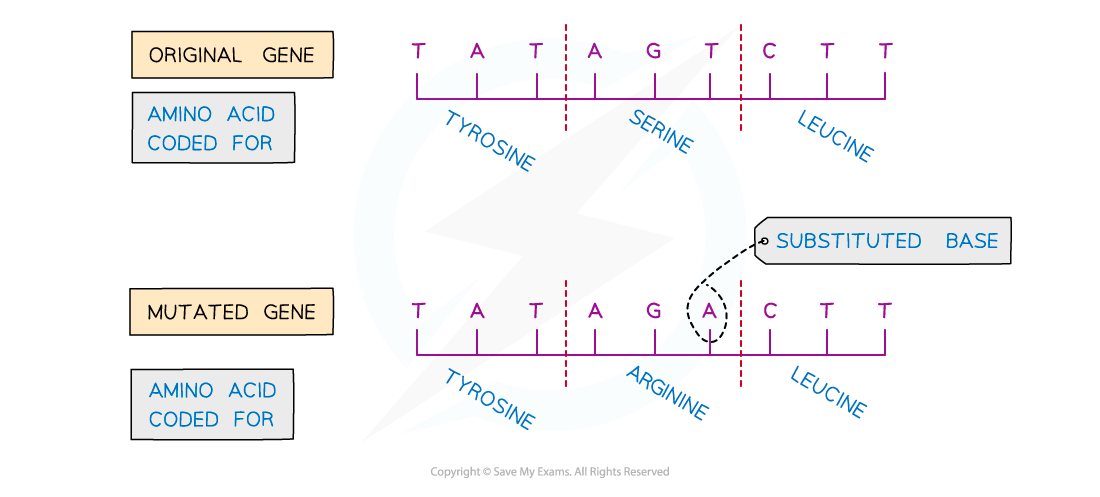
Substitution mutations can take three forms:
- Silent mutations
- Missense mutations
- Nonsense mutations
The effect of gene mutations on polypeptides
- Most mutations do not alter the polypeptide or only alter it slightly so that its appearance or function is not changed
- However, a small number of mutations code for a significantly altered polypeptide with a different shape
- This may affect the ability of the protein to perform its function.
A silent mutation is a change in the
- nucleotide sequence that results in the same amino acid sequence.
- This is possible because some amino acids can be coded for by up to four different triplet codon sequences.
- Silent mutations are often a change in the 2nd or 3rd base in the codon, rather than the first.
Nucleotides to Amino Acids
- A gene is a sequence of nucleotides that forms part of a DNA molecule (one DNA molecule contains many genes)
- This sequence of nucleotides codes for the production of a specific sequence of amino acids in a polypeptide
- As the nucleotide sequence determines the sequence of amino acids, changes in this sequence (mutations) can sometimes lead to a change in the polypeptide that the gene codes for
Sickle cell anaemia
-In most people, the β-globin polypeptide chains begin with the amino acid sequence:
—-Val-His-Leu-Thr-Pro-Glu-Glu-Lys-
- This sequence of amino acids is coded by the HbA (normal) allele of the gene
- In some people, there is a substitution mutation in the gene which codes for the amino acid sequence in the β-globin polypeptide chains:
—-The DNA base sequence —-CTT is replaced by CAT (the first thymine in the triplet is replaced by adenine) CTT codes for the amino acid glutamine, whereas CAT codes for the amino acid valine -In these people, therefore, the β-globin polypeptide chains begin with the amino acid sequence:
—-Val-His-Leu-Thr-Pro-Val-Glu-Lys-
- This sequence of amino acids is coded by the HbS (sickle cell) allele of the gene
- Therefore, a single change in the amino acid sequence of the β-globin polypeptide results in the genetic disease sickle cell anaemia in individuals with two copies of the Hb^S allele
Nonsense mutations
– the mutation creates a premature stop codon (signal for the cell to stop translation of the mRNA molecule into an amino acid sequence), causing the polypeptide chain produced to be incomplete and therefore affecting the final protein structure and function (cystic fibrosis is an example of a disease caused by a nonsense mutation, although this is not always the only cause)
silent mutations
– the mutation does not alter the amino acid sequence of the polypeptide (this is because certain codons may code for the same amino acid as the genetic code is degenerate)
what happens in the ribosome
- The triplet of bases (anticodon) on each tRNA molecule pairs with a complementary triplet (codon) on the mRNA molecule
- Two tRNA molecules fit onto the ribosome at any one time, bringing the amino acid they are each carrying side by side
- A peptide bond is then formed between the two amino acids -This process continues until a ‘stop’ codon on the mRNA molecule is reached
– this acts as a signal for translation to stop and at this point the amino acid chain coded for by the mRNA molecule is complete -This amino acid chain then forms the final polypeptide
-What happens when the gene has been transcribed
(when the mRNA molecule is complete), the hydrogen bonds between the mRNA and DNA strands break and the double-stranded DNA molecule re-forms
-The mRNA molecule then leaves the nucleus via a pore in the nuclear envelope
-Missense mutations
– the mutation alters a single amino acid in the polypeptide chain (sickle cell anaemia is an example of a disease caused by a single substitution mutation changing a single amino acid in the sequence)

-
Chapter 115
-
Chapter 1.227
-
Chapter 221
-
Chapter 2.252
-
Chapter 2.343
-
Chapter 2.410
-
Chapter 313
-
Chapter 3.222
-
Chapter 429
-
Chapter 4.228
-
Chapter 5.136
-
Chapter 5.211
-
Chapter 6.124
-
Chapter 6.220
-
Chapter 7.127
-
Chapter 7.232
-
Chapter 8.144
-
Chapter 8.228
-
Chapter 9.141
-
Chpater 9.29
-
Chapter 10.132
-
Chapter 10.219
-
Chapter 11.142
-
Chapyer 11.248


