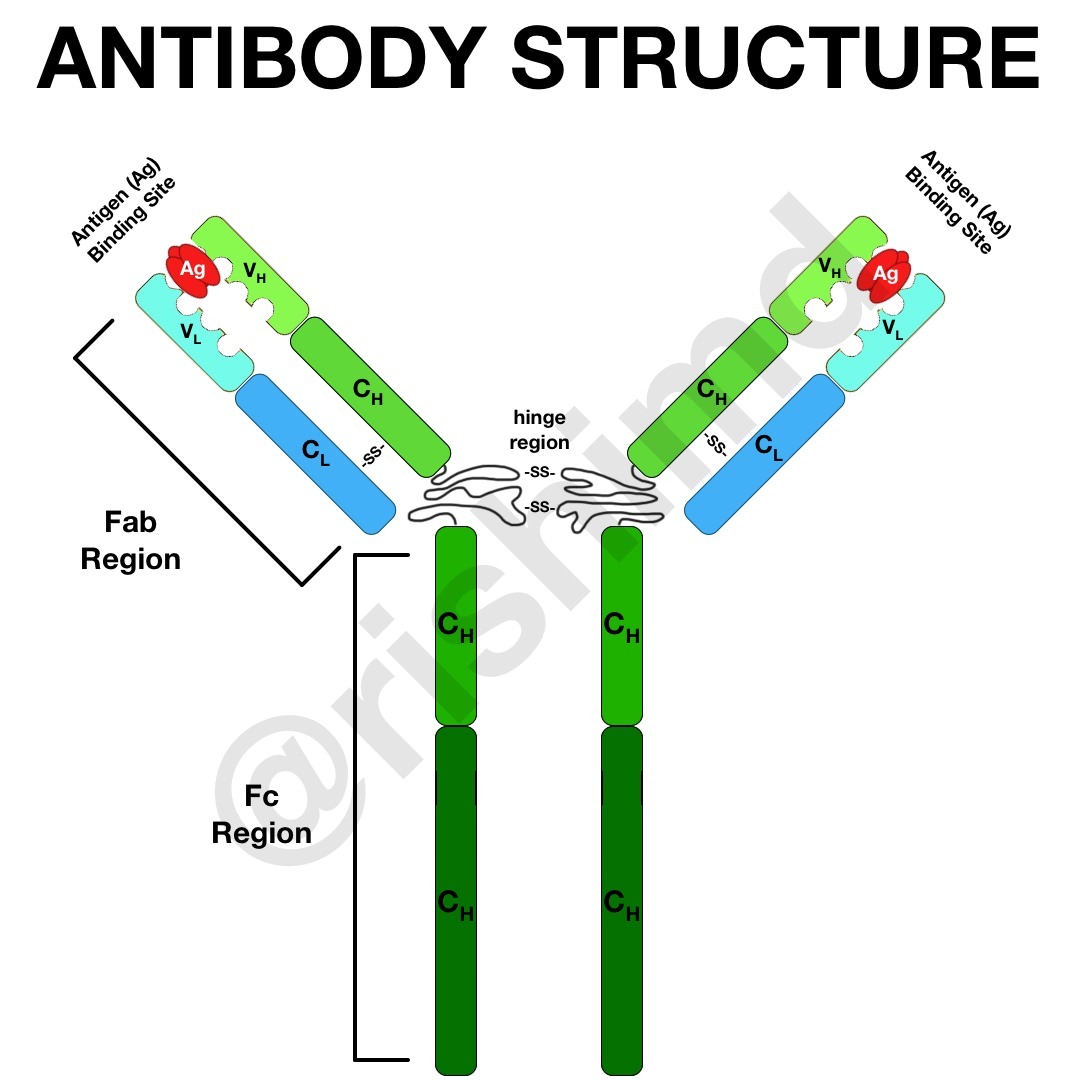
structure of antibody?
- antigen binding site is combination of light chain and heavy chain
- Fragment antigen binding is at the top
- Fc is at the bottom: determines role of antibody (if IgE / IgM etc)
- how does immune system recognise pathogens?
- whats an antigen? different types? [2]
- immune system recognises pathogens by responding to non-self (self v non self)
- antigens: anything that elicits immune response
- self antigen: immune system responds to self :(
- foreign antigen: antigen from outside body
what are the receptors found on lymphocytes? - explain basic overview of adaptive immune system
what receptors found in innate immune system? on which cells/
- *adaptive immunity:**
- lymphocytes are covered in receptors:
- *- antigen specific T cell receptor (TcR):** two types - αβ and γδ (gamma delta)
- antigen specific B cell receptor (BcR): immunglobin on B cell surface
1. once B or T cells is activated by recognising antigen: resting cell -> activated cell. massive cell division. makes cytokines, come killer cells and make antibodies - *innate immunity:**
- phagocytes, macrophages & neutrophils receptors:
- *- pattern recognition receptors (PRR)
- Fc receptors**
- response immediately
explain mechanism of skin macrophages producing cytokines -
cytokines -
skin macrophages:
- covered in molecules (Toll like receptors) that recognise pathogen associated molecular patterns (PAMPs) (things only found in bacteria / viruses like flagella)
- signalling through Toll like receptors causes them to be activated and make pro-inflammatory cytokines
- produce cytokines (TNF-a & IL-1B). cytokines work on endothelial cells - make luminal surface sticky: causes neutrophils to stick (how they know where to go)
what is inflammation?
when white cells leave the blood and move into the tissues - in process of gettting rid of pathogens, kill normal tissue too
what happens when a B cell become activated?
when B cell activated:
- divide lots (aka clonal expansion)
- B cells can become:
- plasma cells (make antibodies)
- memory cells
when T cell activated:
- clonal expansion (due to IL-2)
what controls T cell clonal expansion?
IL-2
what is an immunogen?
what is an epitope?
immunogen: anything that elicits an immune response - most (but not all) antigens are immunogens
epitope: portion of antigen that is recognised and bound by a receptor on an immune cell
how do innate immune cells recognise antigens?
how do u describe innate immune cells’ response to self?
have Pattern Recognition Receptors (PRRs) recognise Pathogen Associated Molecular patterns (PAMPs) (structures found in microbes but not people - limited no. of structures)
- can be on surface, in lysosomes or cytoplasm
inherent lack of response to self (tolerance) - antigens arent present
what are Toll like receptors?
which TLR recognise flagella and LPS?
what happens as a response to TLR engagement?
- *Toll-like receptors: examples of PRRs:**
- TLR-5: recognises flagella
- TLR-4: recognises LPS (on gram-negavtive bacteria)
get both them on plasma membranes and in lysosomes.
TLR engagement:
- dimerization of receptor
- activation of kinases
- activation of TF
- causes production of cytokines
how do B cells recognise antigens?
- B-cells have recognition molecules called immunoglobins (Ig): often the eptiope is conformational
- B-cells recognise antigens directly (without help of other cells)
- activated B cells differentiate into plasma cells: secrete immunglogulin (‘antibody’)
how is the great number of receptor diversity generated on antibodies?
- each developing B cells expresses a distinct receptor
- not different genes for millions of different receptors
- INSTEAD: diversity is generated by mixing and matching gene segements within the heavy and light chain loci:
- Immunglobin heavy chain has:
a) V segments (40); b) D segments (25); c) J segments (6)
- get splicing of each of ^ to make lots of different genes: combinatorial diversity
- also: additional nucleotides can be added at the joints of ^^ to make more variation: junctional diversity
THEN:
any of immunoheavy chain stuff can associate with any of the light chains: more diversity: combinatorial diversity
how do t cells recognise antigens? what are the distinguishable features?
- use TCR - T cell receptor
- T cells are presented antigens by antigen presenting cells (APCs): recognise linear antigens
- The APC presents the antigen to the T cell using the major histocompatability complex (MHC)
how does antigen recognition differ between T cells and B cells?
- T cells: use APCs, B cells do not
- T cells recognise short, linear peptide antigens, B cells recognise conformational epitopes
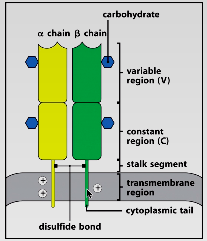
what is the structure of T cell receptor like?
- two chains: alpha and beta chains
- both chains have a constant (same between all TCR) and a variable region (different: recognises different antigens)
- antigen recognition with the peptide and MHC happens at the top
what are the two types of MHC cells? which cells express each type?
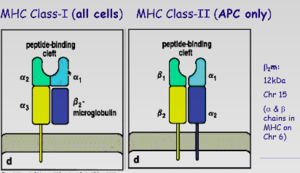
- *MHC Class 1**: expresed by all cells. made from:
- alpha chain with 3 domains
- peptide-binding cleft between a1 and 2 (see slide)
- alpha chain is encoded by MHC.
- alpha chain associates with B2 microglobulin
- *MHC Class 2:** expressed by APC cells only
- alpha and beta chains (both formed by cell)
- peptide-binding cleft: formed from B1 and alpha1
Both have peptide-binding cleft: but the fit between the amino acid side chains inthe peptide and the grove of MHC molecule determine binding
what are the properties of MHC that ensure the maximum number of peptides can be presented?
- *1. MHC genes are polygenic**: more than one type of MHC class I and MHC class II molecule - can present slightly different range of peptides
- *2. MHS genes are highly polymorphic**: multple alleles in the population mean that most people are heterozygous for MHC genes. (as a result - mother and father MHC genes are likely to be different - its this what is a barrier to organ transplant)
polygenic and polymorphic of MHC genes ensures mutlple different MHC molecules expressed, increasing the reportoire of peptides that can be presented
what is immunlogical tolerance?
immunlogical tolerance: the immune system attempting to eliminate self reactive cells that recognise self as antigens
removal during development: central tolerance
control when out in the body: peripheral tolerance
* overview of how general immune response works, e.g. for cut in the arm? *
make cells in: bone marrow (B-cells) and thymus (T-cells, CD4 & CD8) - primary lymphoid tissue. sit there until immune response required
cut happens:
- inflammation - acute localised inflammation iniates immune response
- blood vessels becomes leaky at site of injury - swelling from also makes lymph node swell
- lymph node acts as a net (draining lymph node) - catching anything thats come in from site of injury
- dendritic cells go from cut site to the draining lymph node - hold out pathogen in MHC molecules - recognised by T cells
- *- T cell clonal expansion**
what is general difference between response for extracelluar vs intracellular pathogens?
extracellular: humoral immune response. secretion of:
- antibodies
- complement proteins
- antimicrobrial peptides
intracellular: can’t secrete cuz pathogen is inside cell
- cytotoxic t cells
- NK cells
- T cell-dependent macrophage activation
which is the Fc end of an antibody - what does it do?
- Fc - bottom of Y bit
- dictates the function of antibody once bound to antigen
- has different isotypes: IgM, IgD, IgG, IgA, IgE
where are the variable regions of antobody?
what is the miracleof the immune system?
fragment antigen-binding (Fab fragment)
miracle of immune system:
- have billions of different B cells
- each one secretes a different antibody molecule
- so we have all antibodies which recognise nearly ALL possible pathogens - mixing and matching of genes
role of dendritic cells?
- dendritic cells go around tissue, continually monitoring and assessing environment by processing proteins into peptides.
- in prescence of pathogen - PAMPS are activated by dendritic cell.
- dendritic cells go down afferent lympahtics to lymph nodes
- hold proteins out on MHC Class 1/2 molecules.
- if recognised by CD4/8 - clonal expansion and cytoxic fun happens
what are 5 roles of antibodies once activated?
- neutralization
- agglunation (the clumping of particles)
- Opsonization: coat pathogens that allow other immune cells to come and kill
- antibody dependent cell killing
- activation of compliment cascade


-
FunMed EOYS251
-
FunMedEOYS347
-
FunMedEOYS459
-
FunMedEOYS153
-
FunMedEOYS427
-
FunMed EOYS Long 16
-
big boy things51
-
CR EOYS142
-
CR EOYS248
-
CR EOYS351
-
Calculations6
-
CR EOYS421
-
MET EOYS154
-
big boys29
-
MET EOYS253
-
MET EOYS343
-
MET EOYS445
-
MET EOYS538
-
BB EOYS150
-
BBB2
-
BB EOYS255
-
Short king spring65
-
BB EOYS350
-
BB EOYS446
-
:O29
-
BB EOYS447
-
Loco EOYS43
-
LOCO SSS59
-
LOCO EOYS 441
-
Loco EOYS344
-
LOCO EOYS 553
-
LOCO SSS246
-
LOCO EOYS542
-
LOCO EOYS629
-
SSS FunMed52
-
Spotter Qs130
-
SSS FunMed252
-
METSSS44
-
METSS249


