What is DNA cloning?
When DNA is extracted from an organism all its genes are obtained –> then a particular gene is copied (cloned)
Cloning a gene means isolating an exact copy of a single gene from the entire genome of an organism
This normally involves copying the DNA sequence of that gene into a smaller, more accessible piece of DNA e.g. plasmid.
Why clone DNA?
- To obtain a pure sample of an individual gene separated from all other genes in the cell
- Determine the nucleotide sequence of specific genes –> So mutations can be identified e.g. gene defects related to specific diseases
- So the specific DNA can be amplified
- So the specific protein can be expressed –> Organisms can be ‘engineered’ for specific purposes e.g. insulin production, insect resistance, lab research etc.
- So the protein’s function can be investigated
Give an overview of gene cloning.
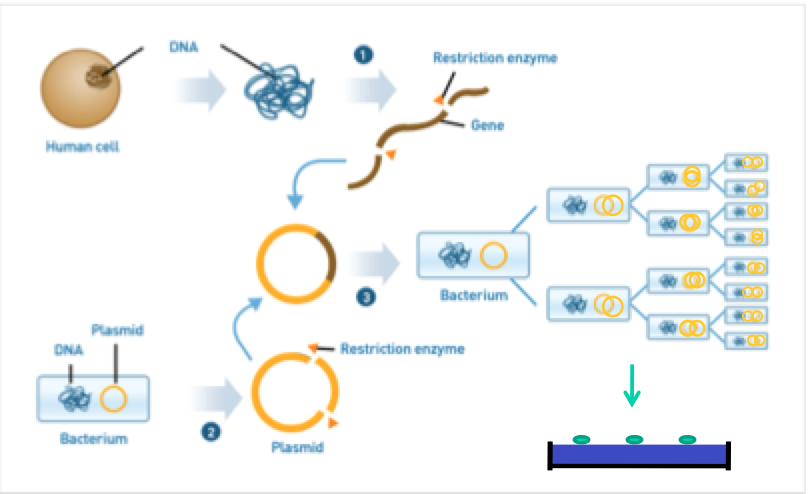
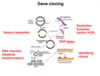
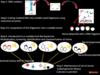
- DNA is purified from a cell. Fragment of the DNA that contains a gene of interest is isolated using a restriction enzyme or PCR
- The DNA fragment is inserted into a circular DNA molecule, vector, in this case a plasmid (from bacterium) to produce a recombinant DNA molecule.
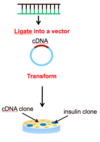
- Transform host cells with the vector which then replicates producing numerous identical copies of itself & the gene that it carries
When host cell divides copies of recombinant DNA are passed to progeny & further vector replication takes place
After large number of cell divisions a colony or clone of identical host cell is produced. Identify clone.
Basically…
Chop DNA –> ligate it into the plasmid –> form recombinant DNA –> incorporate plasmid into bacteria host by transformation –> bacteria plated –> colonies containing desired genes can be identified and isolated.
Key applications of gene cloning?
Some key applications are in:
- Medicine
- Agriculture
- Research
- Forensic science
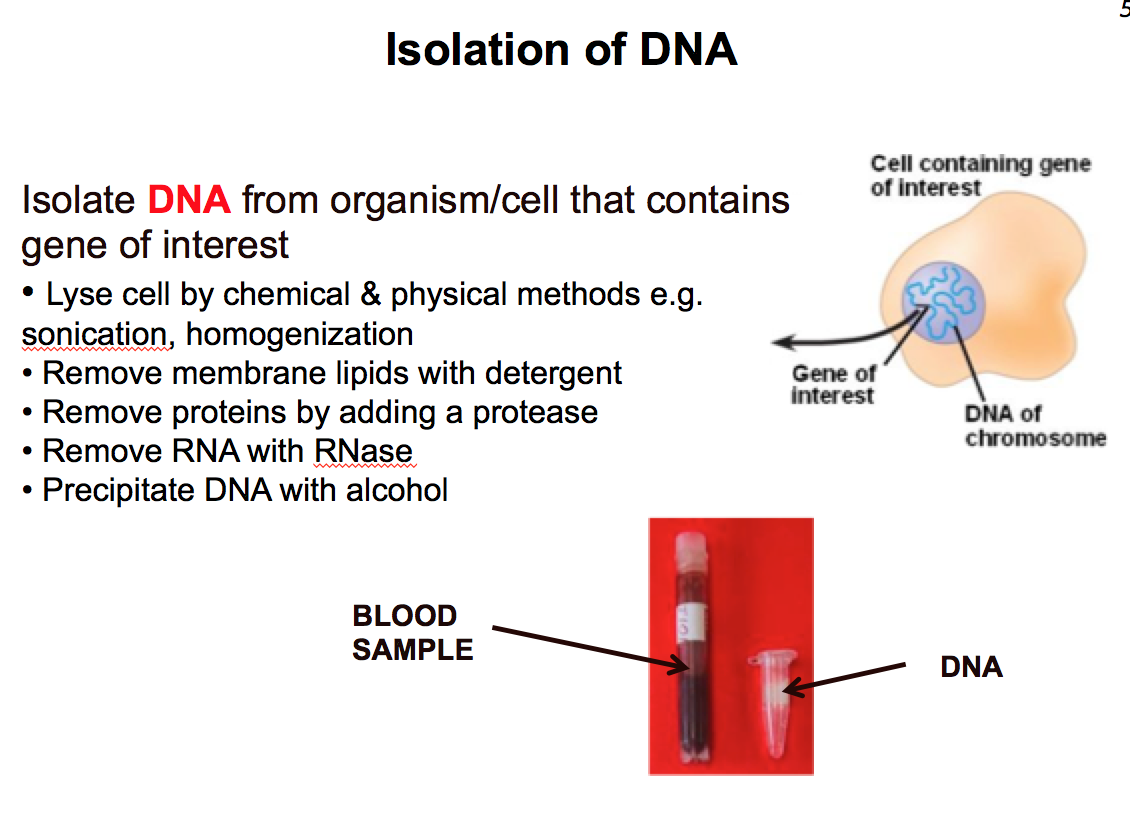
Outline how DNA is extracted from a cell.
What happens once the DNA has been extracted?
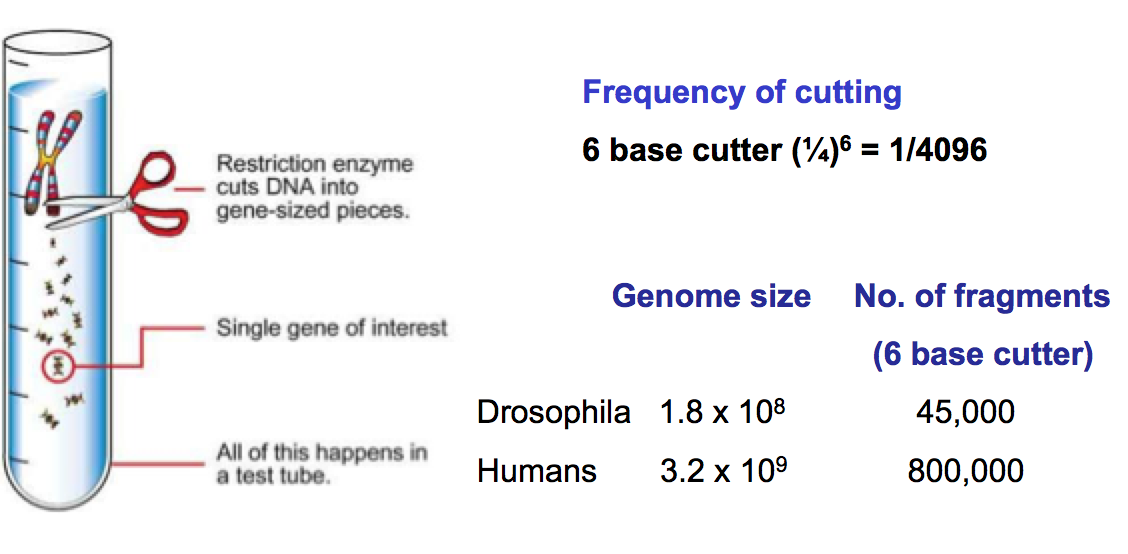
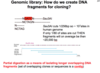
DNA is fragmented with restriction enzymes (endonucleases) e.g. EcoRI, HindIII etc. cut the gene into small pieces
Outline the basic structure of plasmids.
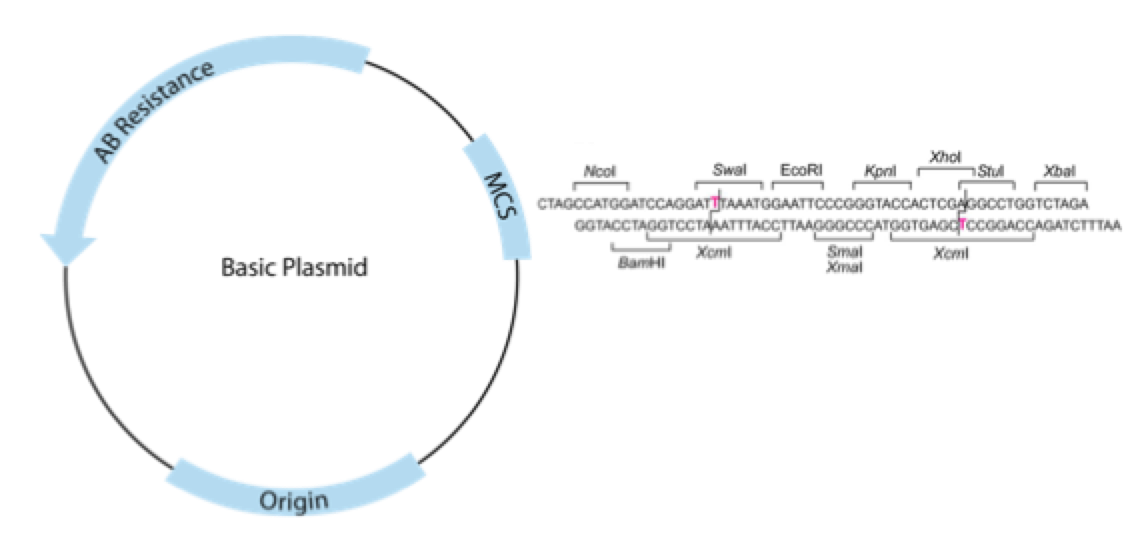
The three main motifs present in plasmid DNA:
- Origin of replication –> used to initiate DNA replication
- Antibiotics resistance genes
- Multiple cloning site (MCS) –> region where we insert genes.
How are sticky ends created using restriction enzymes?
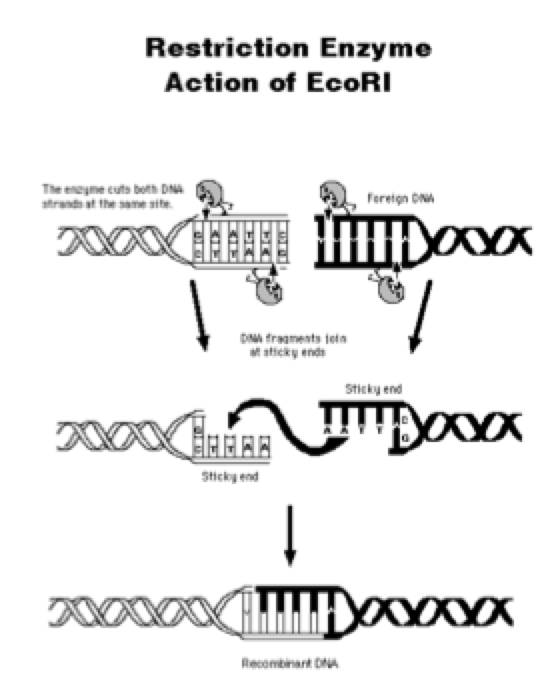
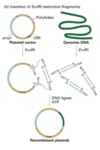
- Different DNA pieces cut with the same restriction enzyme can join or recombine –> because it creates sticky ends that are complementary
- Restriction enzymes create staggered cuts in specific sequences –> known as cohesive “sticky” or blunt ends –> when joined together the sticky ends anneal (hybridise
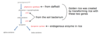
- After which the DNA can be ligated using DNA ligase –> form sugar-phosphate backbone
How does DNA ligation work?
DNA ligation is catalysed by DNA ligase
It joins two DNA strands together by catalysing the formation of the phosphodiester backbone –> DNA ligase requires ATP for this process.
Outline the process of joining foreign DNA into a plasmid using a single restriction enzyme.
Single restriction enzyme
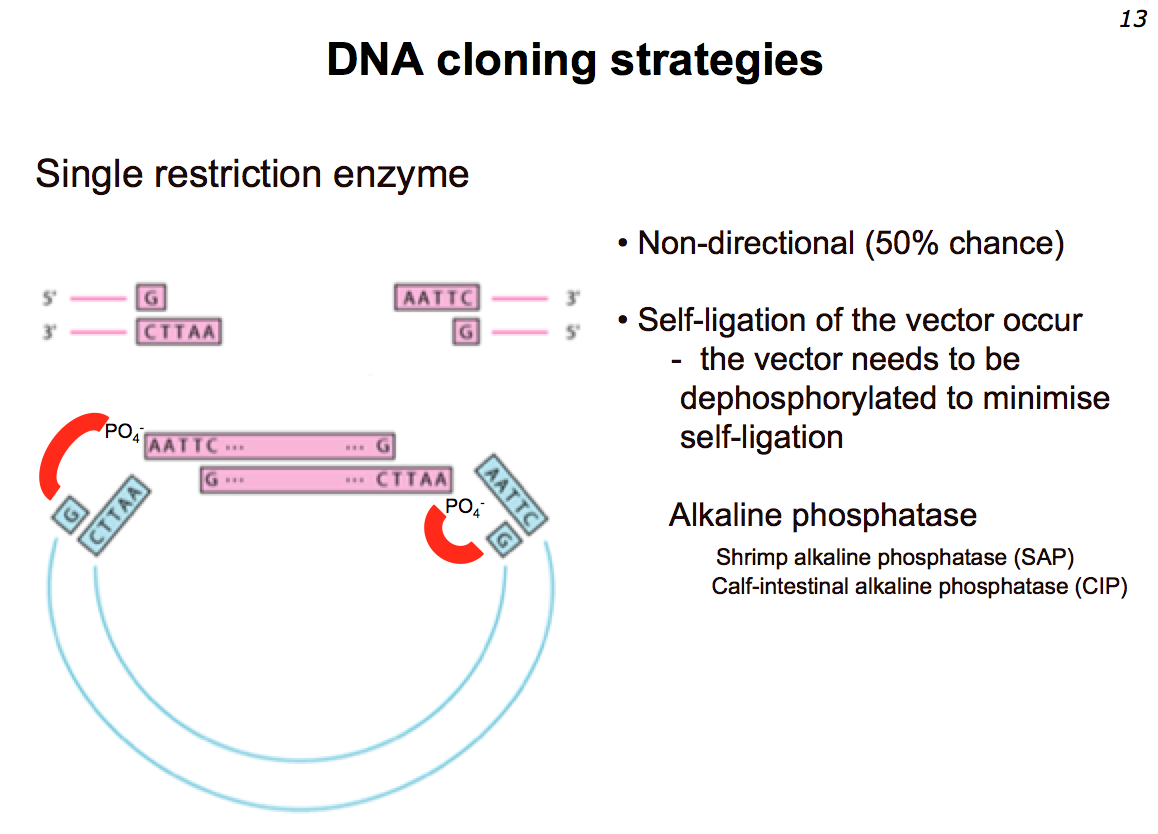
Using the same restriction enzyme to cut DNA –> sticky ends created –> allows DNA to join…
But note this is non-directional –> 50/50 chance of obtaining the correct orientation –> adding to that…
Another problem being self-ligation –> ends join back together –> prevented using alkaline phosphatase
What is directional cloning?
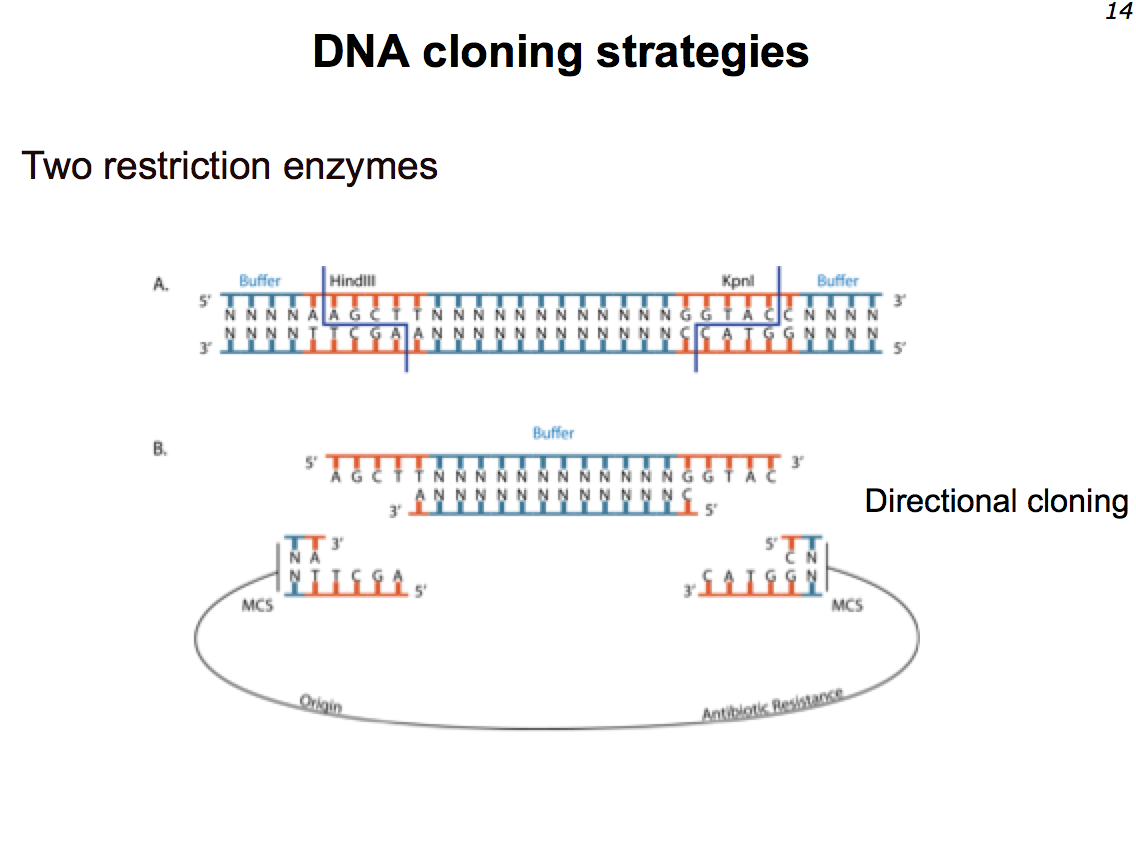
This is when two different restriction enzymes are used –> resulting in two different ends –> which ensures that the DNA is inserted with the correct orientation.
What is blunt end ligation?
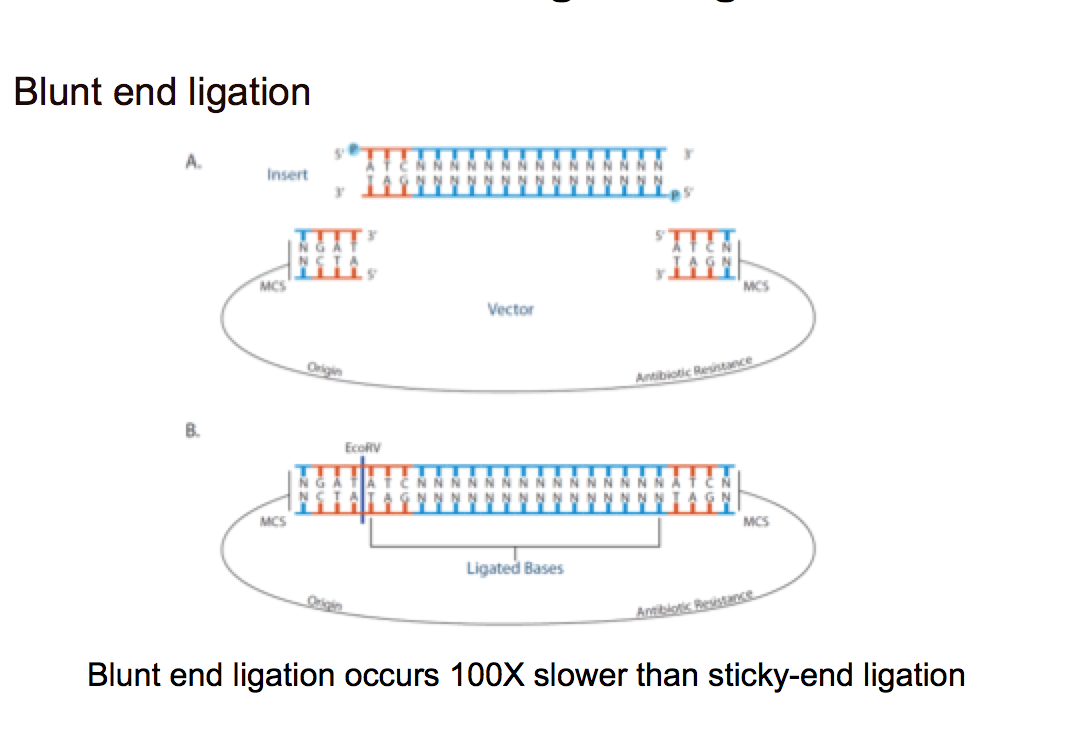
DNA is chopped creating a blunt end/straight end and then allowed to anneal together.
Blunt end/Straight end ligation –> hard to ligate –> no hydrogen bonds stabilizing the DNA
How is DNA extracted from agarose gels?
- Cut out specific target bands from agarose
- Melt agarose gel (low melting point - 50 degrees) —> additionally DNA will also separate to single strand.
- Alternatively, use Sodium Iodide –> break up agarose chains. - Purification of the DNA fragments –> using spin column
What is essential in order to perform PCR-based cloning?
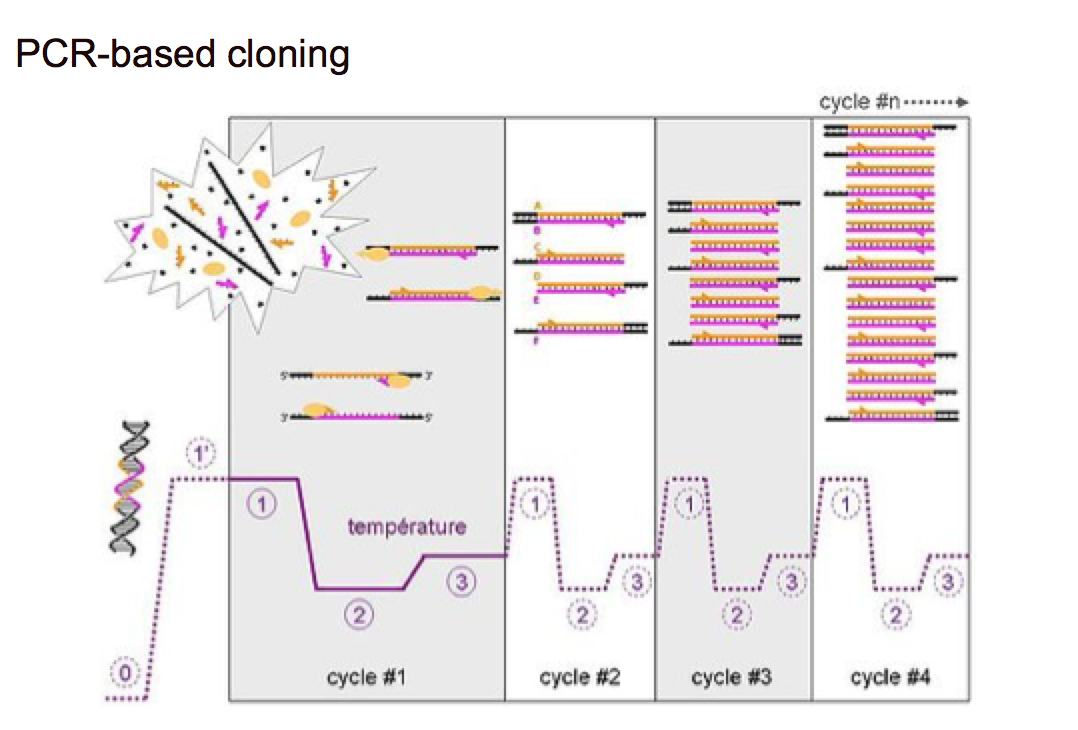
PCR-based cloning
- PCR requires some sequence information about 2 regions of DNA of interest to synthesize the appropriate primers
- Primers are oligonucleotides complementary to different regions on the 2 strands of DNA template (flanking the region to be amplified)
- Primers ~15-20 nucleotides designed to be ~200-2000 bp apart
- One hybridizing to one strand of dsDNA, the other hybridizing to the other strand such that both primers are oriented with their 3’ ends pointing towards each other.
- Primer acts as a starting point for DNA synthesis –> The oligo is extended from its 3’ end by DNA polymerase
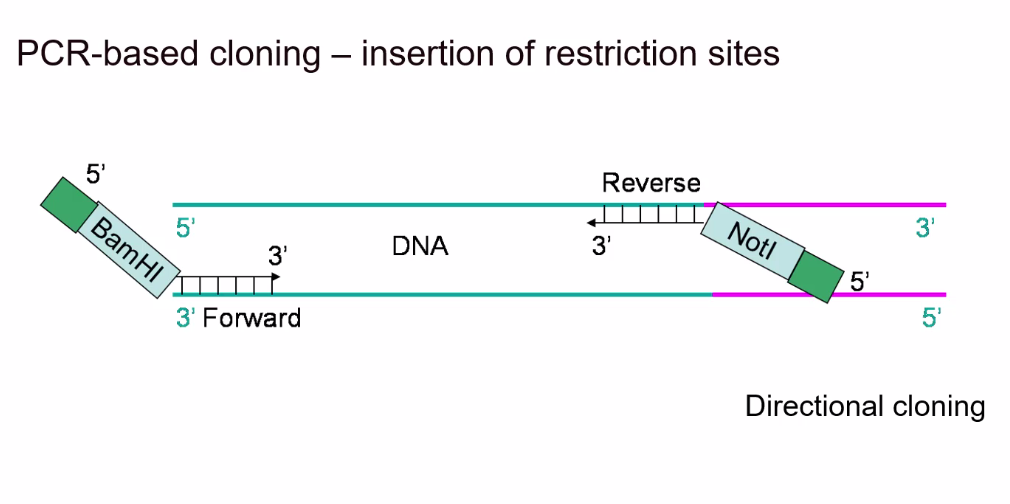
How can restriction enzymes be used to increase the efficiency of PCR cloning?
- Add a base sequence at the end of each primer which corresponds to a particular restriction enzyme –> i.e. BamHI –> they won’t anneal to target.
- Run PCR
- After several cycles –> chop at the restriction sites
Check!!!!!!
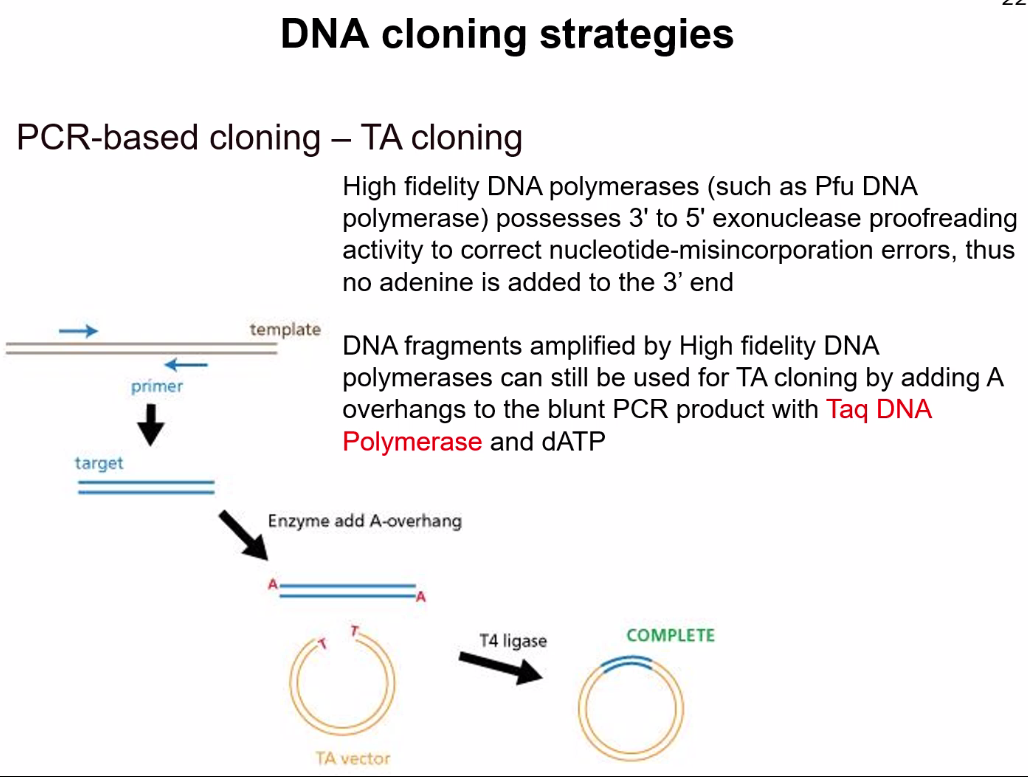
What is PCR - TA cloning?
- Buy plasmid already linearized which has a single T base sticking out –> Both T overhangs –> no self-ligation.
- Run PCR without any restriction sites –> using Taq DNA polymerase –> special feature which adds an adenine to the 3’ end of the product.
- Thus, the A and T bases can anneal when joined together.
- Taq has no proofreading/ exonuclease activity –> makes mistake every 400 bases –> avoid this? –> run PCR with proofreading enzyme –> after run a cycle with Taq polymerase to create A sticky end –> results in higher accuracy.
Only problem –> Not directional –> 50:50 chance for correct orientation.
What are are the three enzymes that can potentially be used for DNA ligation?
The three different methods use…
- DNA ligase: T4 DNA ligase (from bacteriophage T4) –> most common
- DNA topoisomerase I
- DNA recombinase
How can DNA topoisomerase I be used for DNA ligation?
Just an example –> different mechanisms
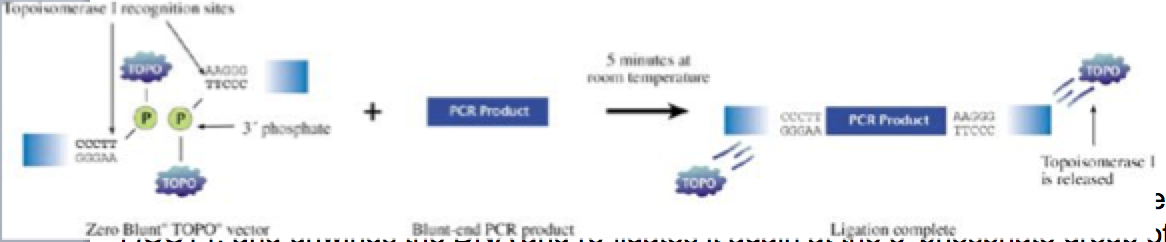
TOPO Cloning
Enzyme basically attached to plasmid –> ready to ligate.
Vaccinia virus topoisomerase I specifically recognises and digests DNA sequence (C/T)CCTT, and unwinds the DNA and re-ligates it again at the 3’ phosphate group of the last thymidine
TOPO vectors carry (C/T)CCTT at the two linear ends. The linear vector DNA already has the topoisomerase enzyme covalently attached to both of its strands’ free 3’ ends.
PCR is performed to amplify target DNA fragment.
Once the PCR products and TOPO vectors are mixed, the topoisomerase catalyse ligation of the two ends at r.t. in 5 min.
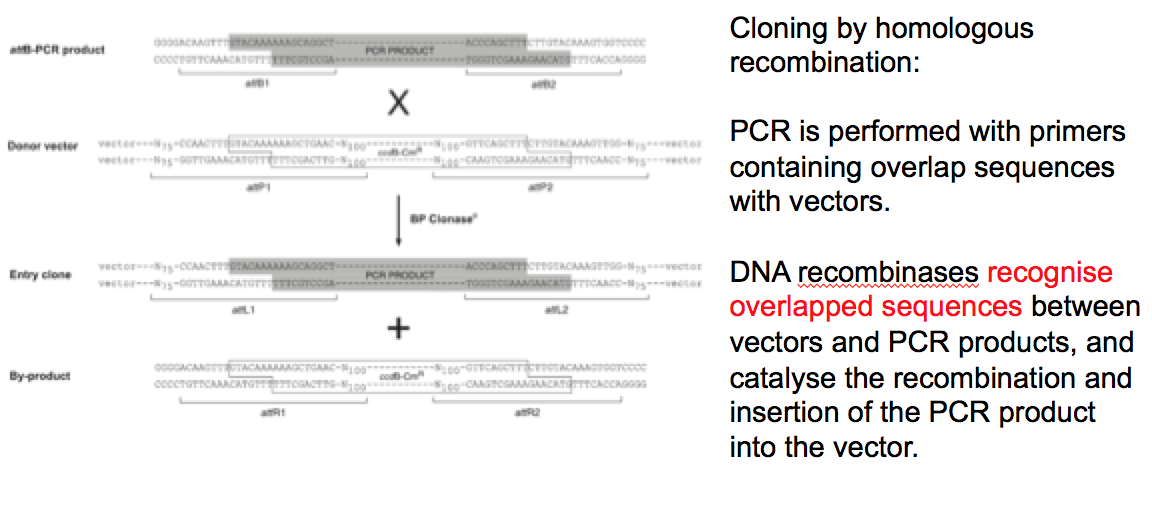
How can DNA recombinase be used for DNA ligation?
Recognises an overlap region
PCR is performed with primers containing overlap sequences with vectors.
DNA recombinases recognise overlapped sequences between vectors and PCR products, and catalyse the recombination and insertion of the PCR product into the vector.
Basically –> if the enzyme recognises an overlap sequence –> it can combine the two (PCR product + plasmid).
What is bacterial transformation?
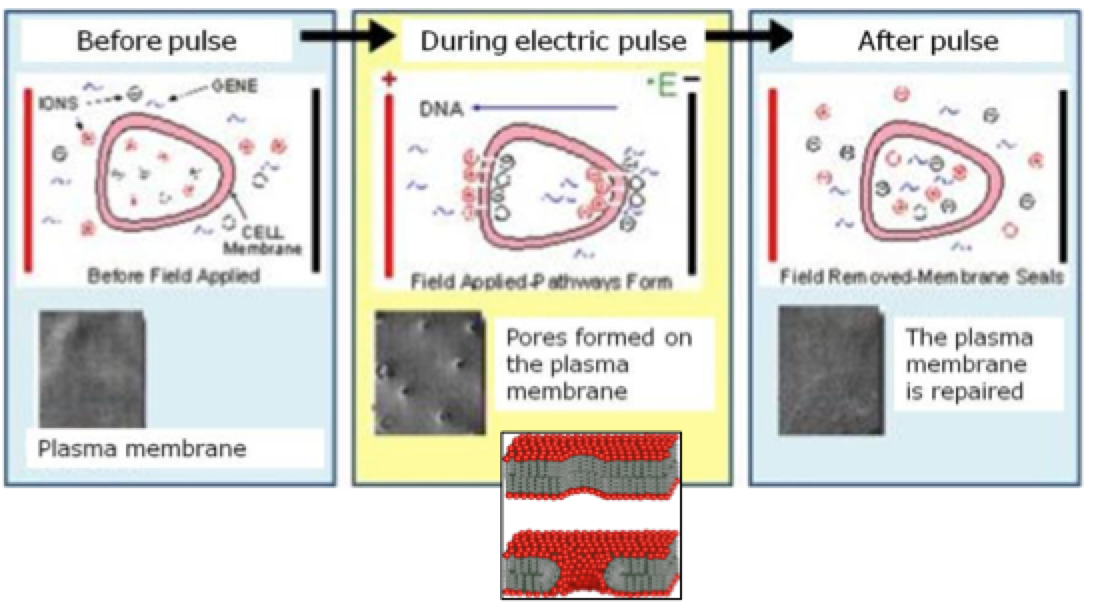
Bacterial transformation (Electroporation)
Allows for the insertion of the plasmid into a host bacteria.
Process:
- Electrical shock –> creates pore
- Since DNA moves due to charge (as it is charged) –> It will move from one pole to the other (minus side to plus side)
- Randomly it will enter the cell via these pores
How is CaCl2/Heat shock method used for bacterial transformation?
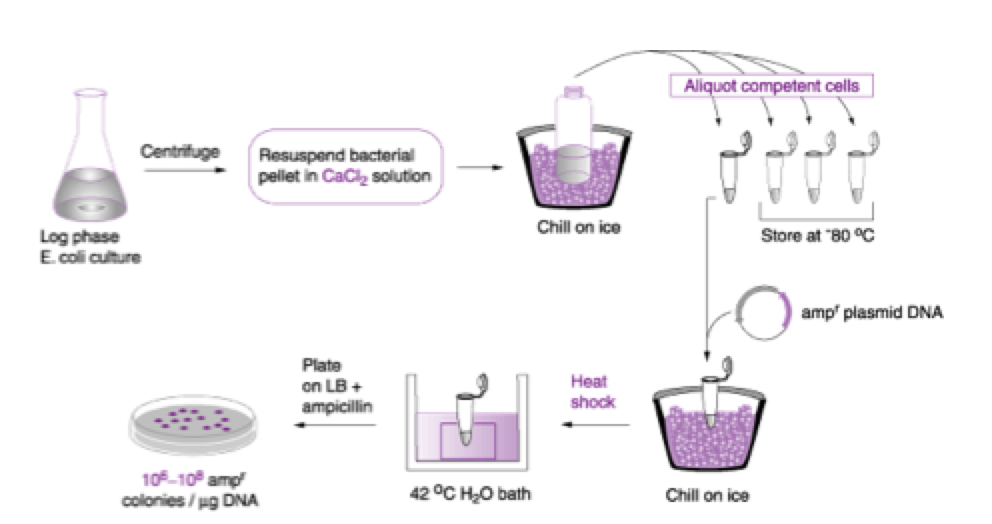
Preferred as its cheaper
- Culture bacteria –> then incubate them with CaCl2 in cold condition –> due to changes of the cell surface structure –> they become more permeable to DNA (we say the cell becomes competent –> ‘eager’ to take up DNA).
- The heat-pulse (42 degree for one minute) creates a thermal imbalance on either side of the cell membrane, which forces the DNA to enter the cells through pores.
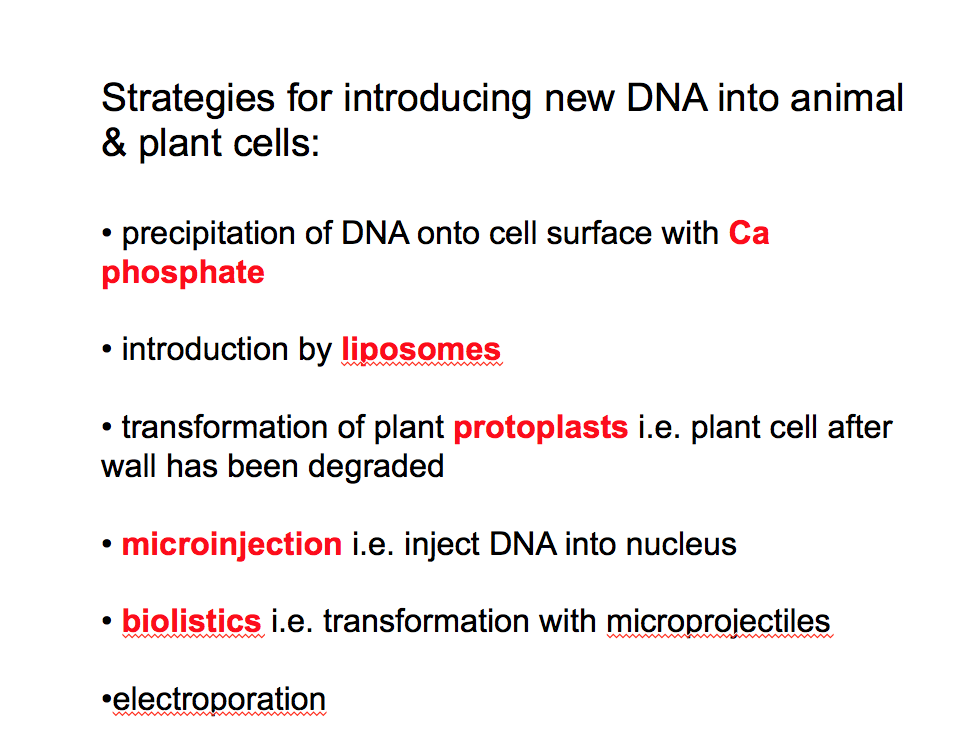
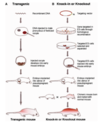
What are the other methods for introducing DNA into plant and animals cells?
What is the origin site in plasmid DNA?
Origin of replication: site at which replication is initiated, thus plasmid multiply independently of main bacterial chromosome.
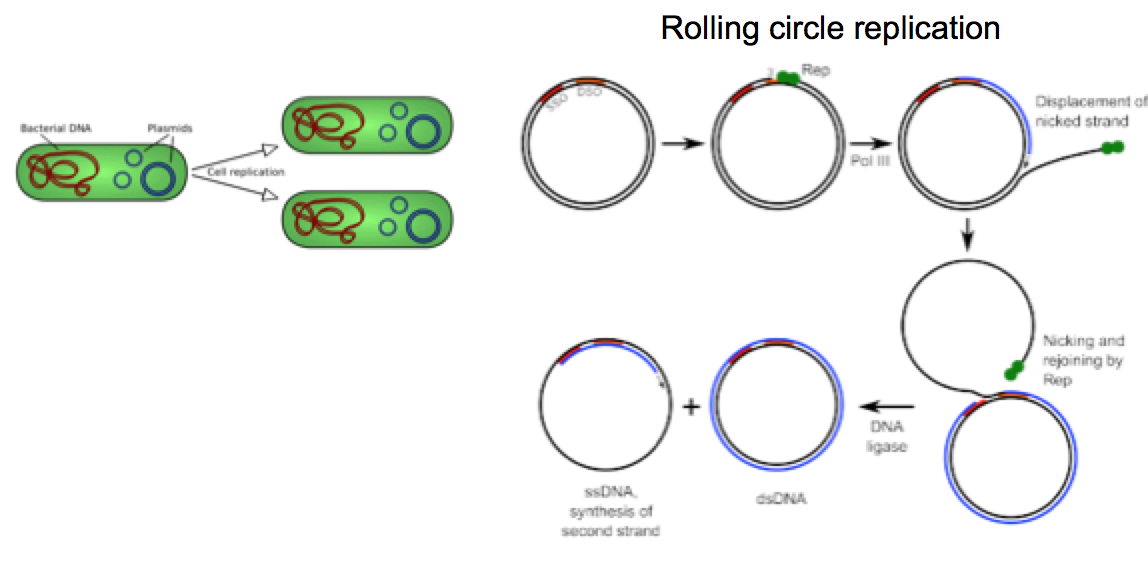
How does replication of bacterial plasmid DNA occur?
- Plasmid DNA can remain in circular shape in bacteria
- Plasmid DNA replicates in rolling circle way
- Thus linear plasmid DNA cannot be replicated



-
DNA structure - Lecture53
-
DNA structure - Book42
-
Kenji - Lectures85
-
Kenji - Book27
-
DNA replication - Lecture45
-
DNA replication - Book45
-
Transcription/Translation - Lecture88
-
Transcription/Translation - Book95
-
Gene Cloning - Lecture70
-
Gene cloning - Book25
-
Eukaryotic Genetics - Lecture165
-
Bacterial Genetics - Lecture99
-
Genomics - Lecture64
-
Gene Regulation60


