
So you’ve decided to take the TOEFL. Congratulations! That means you’re planning to study, work, or move abroad. You’ve got big things ahead!
But before you catch that flight to your dream university or job, there’s this one annoying hurdle in your way: the Test of English as a Foreign Language. On top of work, study, and life, you have to work out how to study for TOEFL (and when!).
The good news? You don’t have to figure out how to prepare on your own. This TOEFL study guide walks you through exactly what to expect on the exam, how to build a smart study plan, and which tools can make a massive difference in how quickly you improve.
(Pro tip: digital TOEFL flashcards from apps like Brainscape are the fastest way to memorize vocabulary and grammar.)
What You’ll Learn in This TOEFL Study Guide
In this guide, we’ll walk you through:
- What the TOEFL actually tests (and why it matters so much)
- How the exam is structured and scored
- The ideal study timeline based on your goals and schedule
- The smartest ways to study using science-backed techniques
- Why digital flashcards are a powerful study weapon
- Specific tips for mastering each TOEFL section: reading, listening, speaking, and writing
- What to do the week before the test, and how to stay calm on exam day
This TOEFL study guide gives you every step you need to build your exam prep plan and crush the test.
What’s On The TOEFL?
The TOEFL checks how well you can use English in school or academic settings. It has four parts:
- Reading: You read short academic passages and answer questions about main ideas, details, and vocabulary.
- Listening: You listen to short talks or conversations and answer questions about what you hear.
- Speaking: You give short spoken answers about your opinions or summarize what you read or heard.
- Writing: You write two short essays. One combines reading and listening. The other asks for your own opinion.
What Is The TOEFL Test Format?
The TOEFL takes about two hours and is computer-based. It’s sometimes called TOEFL iBT, which stands for “internet-based test”. Each section is scored from 0 to 30. The total possible score is 120.
Expert Tip: Learn the test format before exam day. When you know how the TOEFL works, you can manage your time better and feel calmer during the test. You will also know what kinds of questions to expect, so nothing will surprise you. If you already understand the structure, your brain can focus on answering questions instead of worrying about what comes next.
Practice each section many times. When the format feels familiar, you can move through the test more smoothly and with more confidence.
When Should You Start Studying For The TOEFL?
Most students need about two to three months to prepare well for the TOEFL. This gives you time to learn new words, review grammar, and practice the four skills: reading, listening, speaking, and writing.
If your English is already strong, you may only need four to six weeks. But if you want a high score, or if your grammar and vocabulary still need work, start earlier.
How much time you need depends on:
- Your current English level
- Your target score
- How many hours per week you can study
The earlier you begin, the more confident you’ll feel.
How Should You Study For The TOEFL?
Studying shouldn’t be random guesswork. Here are five top tips grounded in cognitive science for an evidence-based TOEFL study guide to optimizing your prep:
# 1. Use Online & Mobile Flashcards To Study More Efficiently
One of the best ways to prepare for the TOEFL is by studying with digital and/or mobile flashcards. They help you swiftly build vocabulary, reinforce grammar, and memorize tricky phrases, all in short, focused sessions. What makes flashcards especially effective is a technique called spaced repetition.
Spaced repetition is a smart way of reviewing information, where the material you struggle with is shown more often, while the stuff you already know appears less frequently. This helps your brain hold onto new words and concepts for the long term, without wasting time on the things you’ve already mastered.
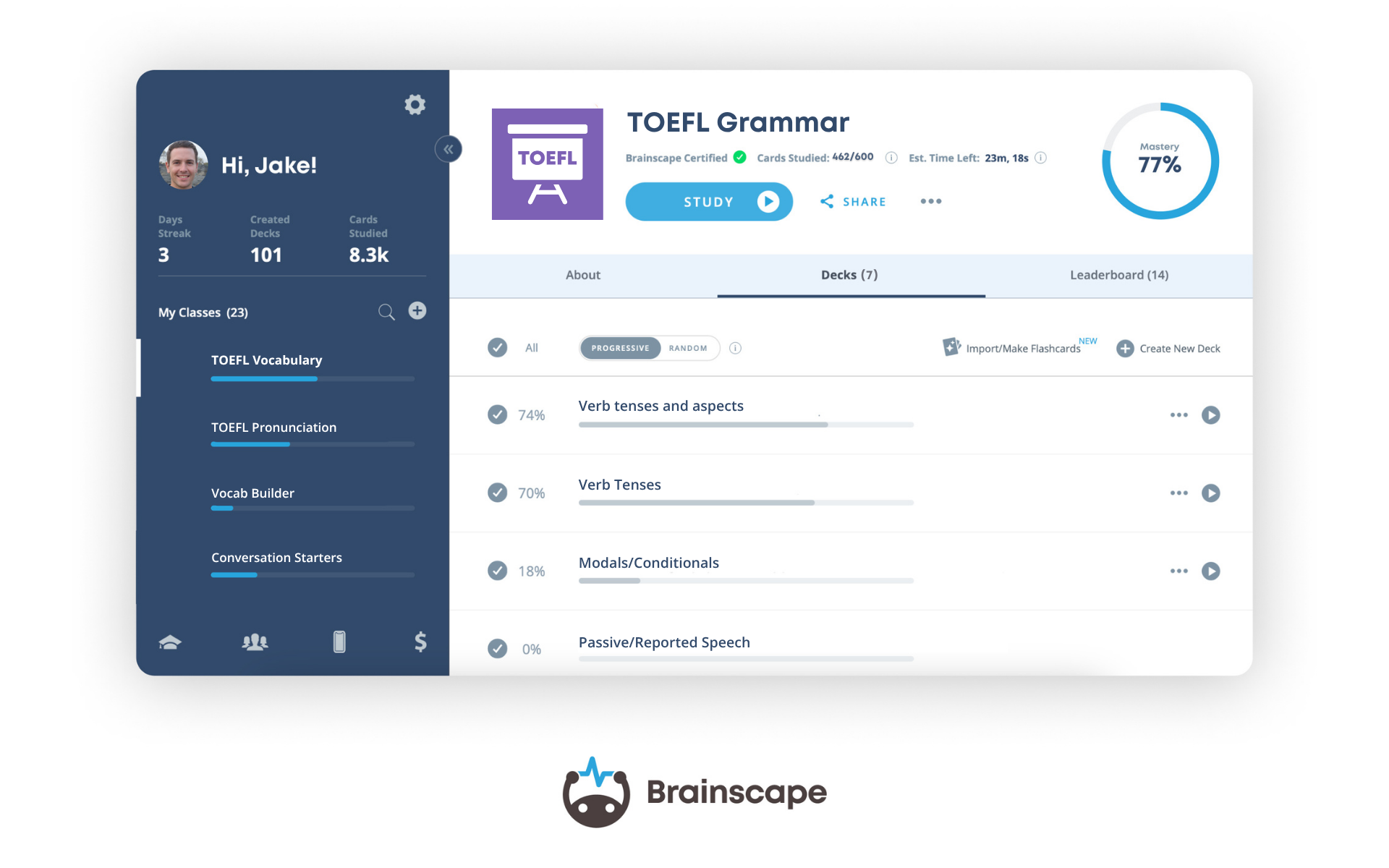
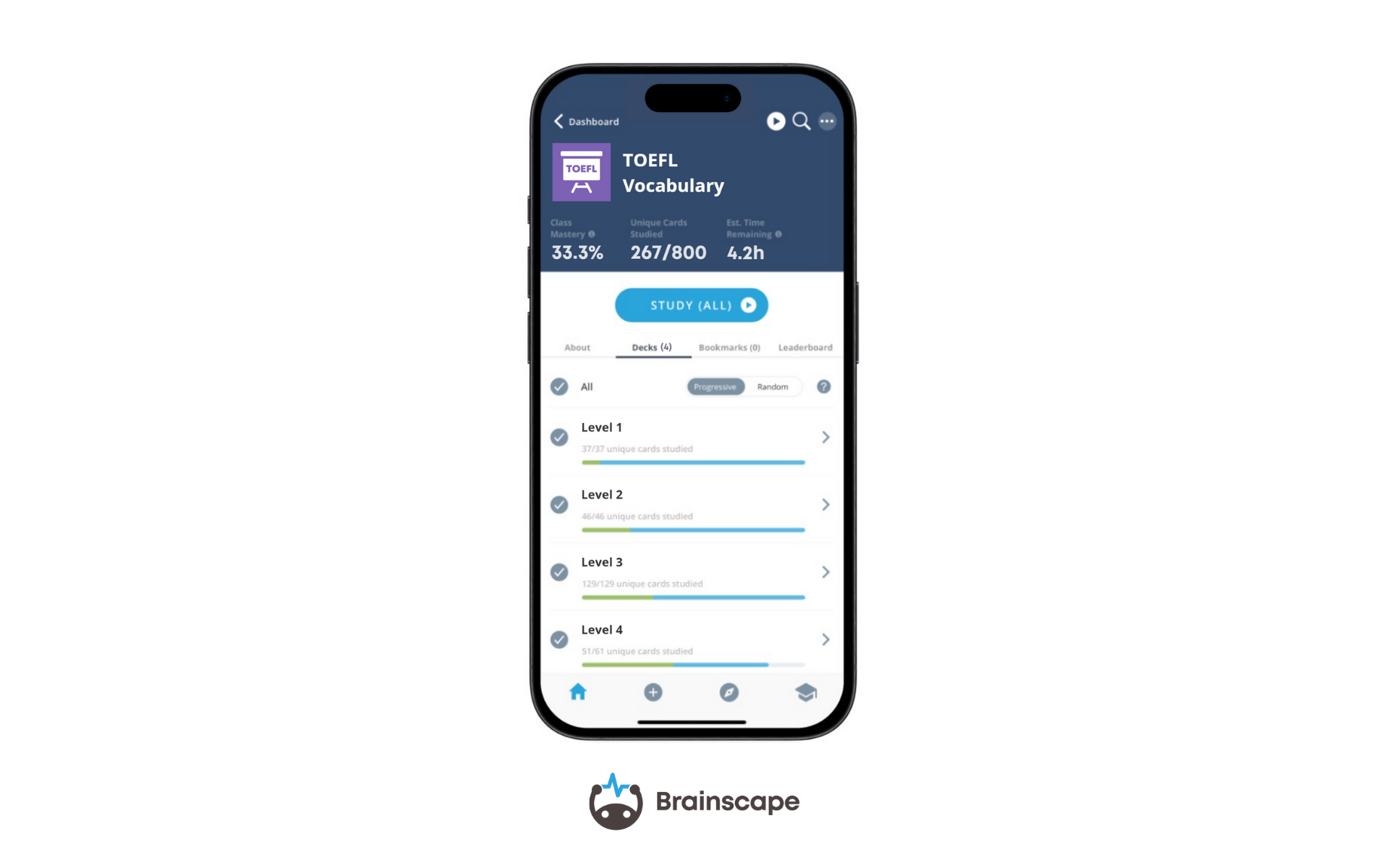
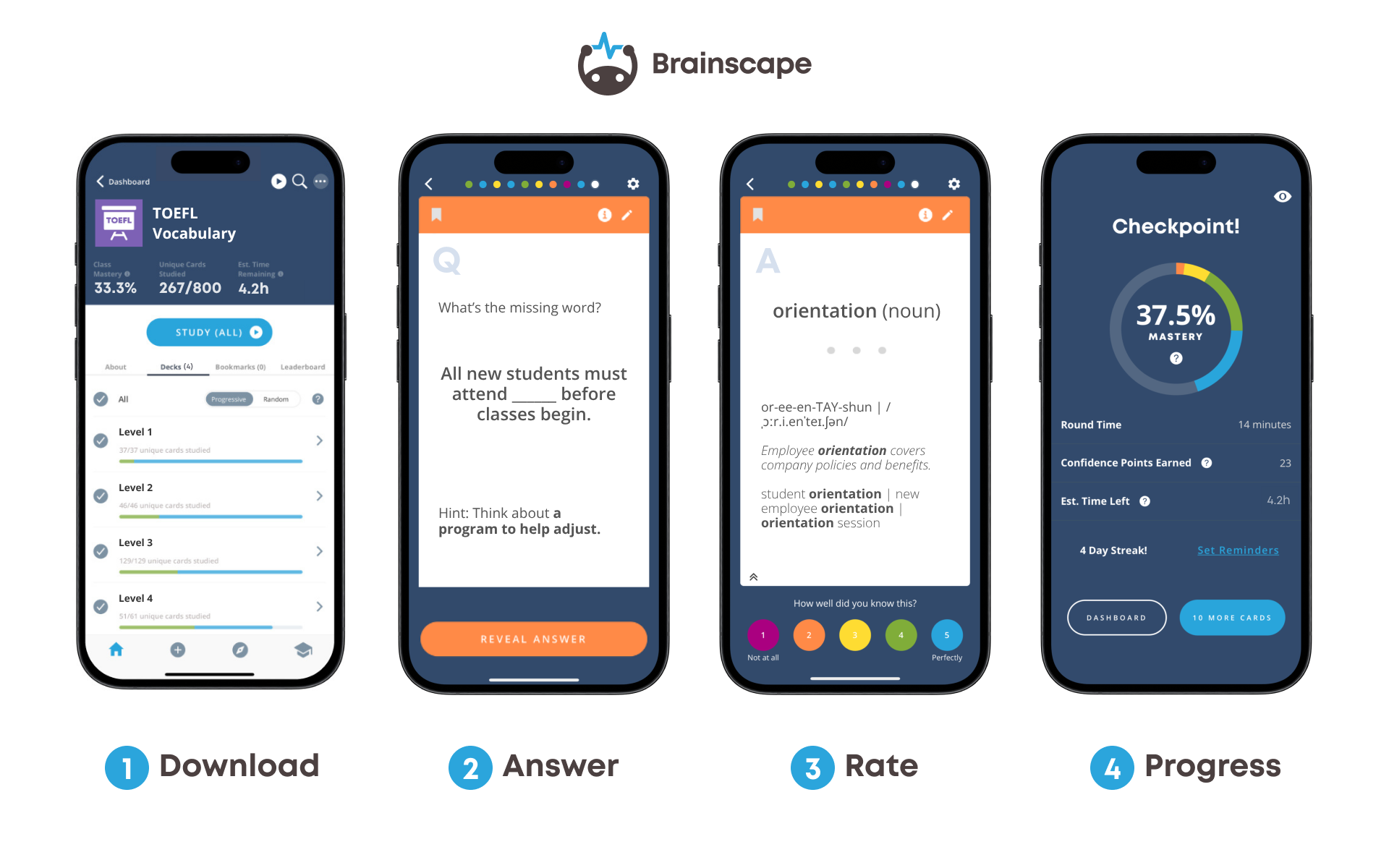
Digital flashcard apps like Brainscape (which have certified flashcards for the TOEFL) leverage this precise study strategy. Every time you review a flashcard, you rate how well you know the answer. The system uses that rating to decide when you should see the card again. That way, your study sessions automatically adjust to focus on your weak areas. No more wasting time guessing what to do next: just open the app, and study the best thing for you to study right now.
# 2. Break Study Time by Skill
Don’t cram all four TOEFL sections into one sitting. Rotate your focus so you dedicate time to each skill: reading, listening, speaking, and writing. This means that if one skill is a weakness, you can adjust your study schedule to spend more time on that.
# 3. Spend Time Strengthening Your Language
Whether it's grammar, vocabulary, or pronunciation, this is the time to give extra effort to your areas of difficulty. Again, flashcards can help you identify patterns of error or difficulty, and give you the intensive practice you need to help you be more accurate and confident with your English.
# 4. Take Timed Practice Tests
The clock matters. TOEFL gives you a lot to do in a short window, so part of your prep has to be about pacing.
On test day, you’ll have about 90 seconds per reading question and roughly 60 seconds per listening question, with speaking and writing sections running on strict timers. That’s not much wiggle room. Practice tests under real timing conditions train you to keep moving, resist overthinking, and budget your focus so you don’t run out of minutes before you run out of questions.
The more you’ve practiced finishing on time, the calmer you’ll feel in the actual exam, because you’ll know from experience that you can. You can find practice tests on the ETS website and in most TOEFL Prep courses.
# 5. Sample Weekly Study Plans
Everyone’s schedule looks a little different, so your TOEFL preparation plan should match your availability and goals. Here are a few examples of study plans you can follow, depending on how much time you have before test day and how intensively you want to study.
4-Week Plan (intensive):
- 1 hour/day
- 15 minutes each on vocab, reading, listening, and speaking/writing
8-Week Plan (standard):
- 30–45 minutes/day
- Alternate vocab + reading on Mon/Wed/Fri, listening + speaking on Tue/Thu
12-Week Plan (light):
- 20–30 minutes/day
- Flashcards every day, one major focus skill per week
Expert Tip: Studying regularly for shorter periods of time is more effective than cramming everything into one week, so try to have two or three short study sessions a day, rather than one hour with several topics. Sacrificing sleep for a last-minute scramble directly prevents you from learning vocab!
How Can You Improve Your TOEFL Vocabulary Fast?
Focus on High-Frequency Academic English: Words like “summarize,” “evaluate,” and “imply” are common in TOEFL questions and passages. Learn those first.
Use Flashcards Consistently: Flashcard apps make this easy (especially apps like Brainscape, which has hundreds of vocabulary flashcards from the Academic Word List). Even a few 10-15 minute study sessions per day can help you quickly improve your vocabulary.
Read in Context: Explore TED Talk transcripts, opinion pieces from reputable news sites, or science articles. Seeing words in context helps you understand their tone and meaning.
Pay Attention to Word Parts: Learn the components of words so you can understand a word you’ve never even seen before. For example:
- Prefix: “dis-” = not
- Root: “struct” = build
- Suffix: “-ion” = result of an action
Put it together, and “disruption” means “the result of something being un-built.” Knowing parts like these helps with unfamiliar vocabulary.
Why Do Flashcards Work So Well For TOEFL Preparation?
Digital flashcards are one of the most powerful study tools out there, especially when you use them the right way.
The TOEFL test is packed with advanced vocabulary, grammar patterns, and idiomatic expressions. You’ll encounter tricky words not just in the Reading and Listening sections, but also when you’re writing essays or speaking on the spot. If you don’t know what a word means or how to use it, you’re stuck. That’s why building a strong academic vocabulary is essential to your TOEFL preparation plan.
So why use digital flashcards?
Because flashcard apps automate spaced repetition and active recall: two of the most important methods in cognitive science for boosting memory. But what do they mean?
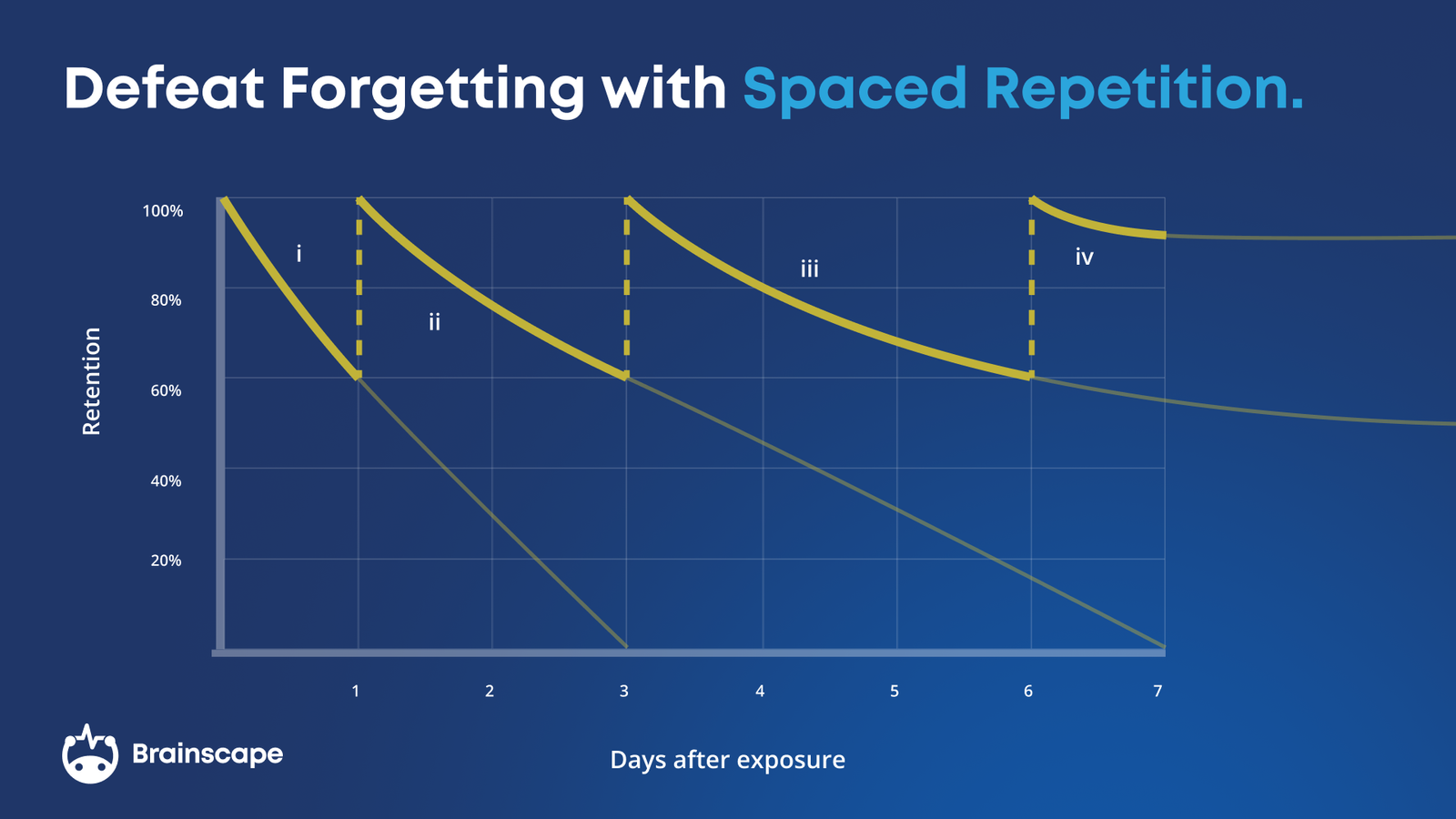
Spaced repetition is all about timing. Your brain is constantly deciding which memories to keep and which ones to toss. If you review a word too soon, your brain says, “Yeah, yeah, I got it already”: that’s a waste of your study time. But if you wait too long, your brain completely forgets the word, so you have to start from scratch.
Adaptive digital flashcards hit the sweet spot by showing you each flashcard just before you’re likely to forget it. This strengthens the memory and pushes it deeper into long-term storage. Brainscape’s spaced repetition algorithm keeps track of how well you know each concept and automatically adjusts how often you see it.
Active recall is the practice of trying to remember something from scratch, without hints or options to choose from. It’s the opposite of rereading or rewatching, which is a completely passive way to review material. It might feel productive, but the knowledge doesn’t stick.
Every time you flip a flashcard and try to recall the answer first, you’re strengthening those mental connections. Over time, this makes it easier to retrieve the right word during the test, when you need it most.
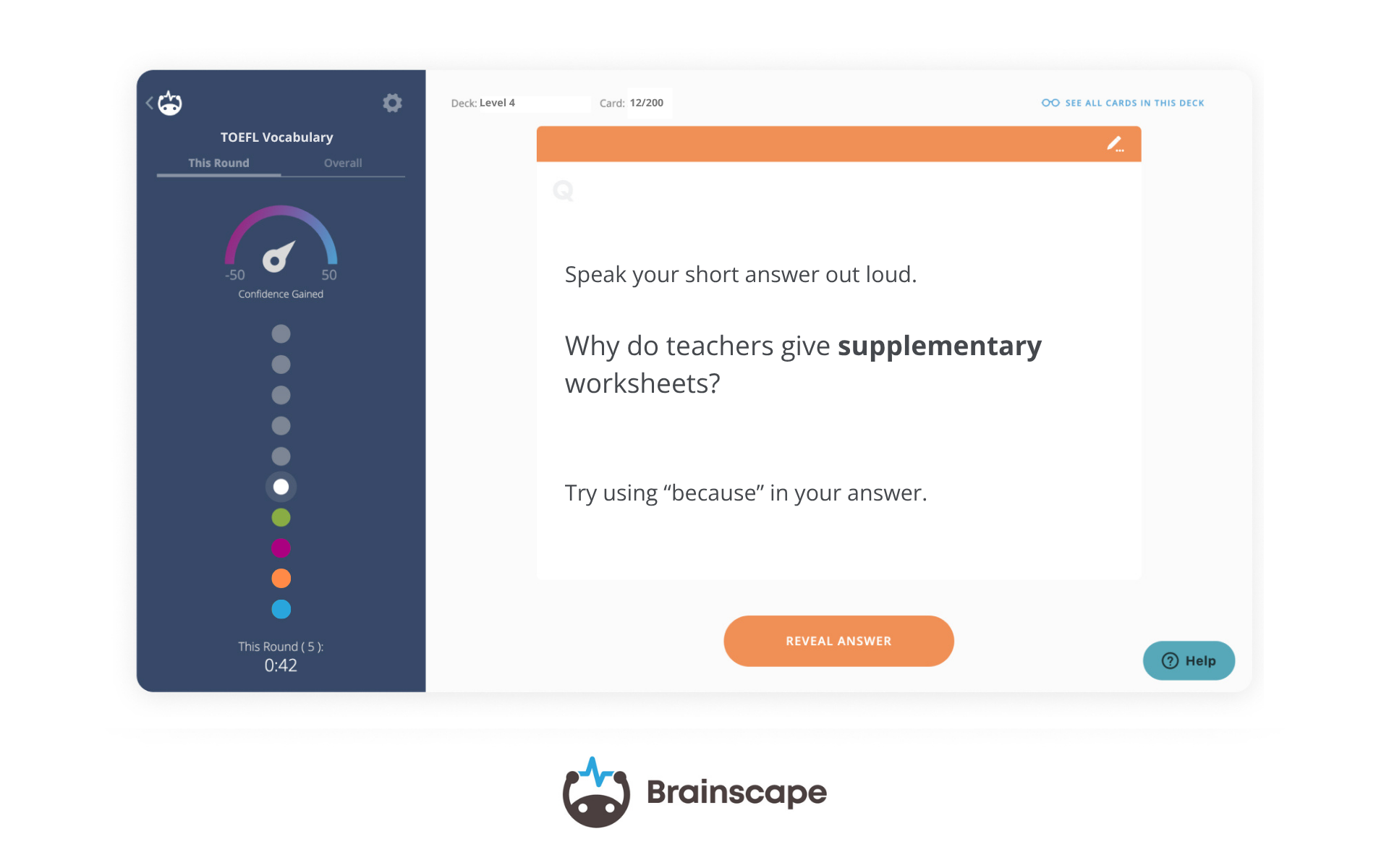
The TOEFL flashcards offered by Brainscape, for example, take that cognitive science and combine it with pre-made content to make studying more efficient. The less mental energy you spend managing your study sessions, the more you can put into actual learning.
How Should You Prepare For The TOEFL Reading Section?
The Reading section can be tough because the texts are long and time goes by fast.
Tips to improve:
- Read the passage quickly first to find the main idea.
- Then go back to answer the questions.
- Focus on “main idea,” “detail,” and “vocabulary” questions.
- Practice under time limits (about 90 seconds per question)
Read 6 Tips for TOEFL Reading Practice and try our Advanced English Reading Practice Questions to train your speed and comprehension.
How Should You Prepare For The TOEFL Writing Section?
The Writing section has two parts:
- Integrated writing: You read and listen to short passages, then summarize them.
- Independent writing: You write an essay about your opinion.
Tips to improve:
- Plan before you write. Spend two or three minutes making an outline.
- Use a simple structure: introduction, two body paragraphs, conclusion.
- Practice writing essays in 20–30 minutes.
- Read model answers to learn good sentence structure and linking words.
Check out 5 Tips for TOEFL Writing Practice (Plus Question Bank) for more detailed tips on improving your TOEFL writing. Then, practice your skills here: Advanced English Writing Practice Questions.
How Should You Prepare For The TOEFL Listening Section?
In the Listening section, you’ll hear short talks and conversations. You’ll need to remember information and understand meaning.
Tips for success:
- Take short notes. Write key words, not full sentences.
- Try to predict what questions might come next.
- Listen for tone and emotion. This often helps you choose the right answer.
How Should You Prepare For The TOEFL Speaking Section?
The Speaking section can feel stressful, but as always, regular practice will help you feel confident.
Tips to improve:
- Record yourself speaking English. Listen again to find mistakes.
- Practice using short templates for common question types.
- Speak naturally. Focus on clear sentences, not perfect grammar.
- Practice timing your answers. You have about 45 seconds to speak.
Read How to Practice Your TOEFL Speaking Skills for more speaking tips, then try our Advanced English Speaking Practice Prompts to improve your fluency.
What Should You Do The Week Before The TOEFL?
You’ve been studying for weeks. You’ve done more than 90% of the prep at this point. Your final week is all about reviewing, refining, and relaxing. It’s crucial to rest so that your brain stays sharp but doesn’t get fatigued.
Take a Full-Length Practice Test Under Real Conditions
Choose one day to simulate the actual TOEFL exam as closely as possible. Set a timer, eliminate distractions, and complete all four sections in a single sitting. This helps build your stamina, reveal any lingering weak spots, and give you confidence that you can handle the pacing and pressure of test day.
Review Flashcards, Especially Any Lingering Weak Spots
Now, more than ever, it’s time to double down. Keep hammering your flashcards every day to make sure any lingering gaps in vocabulary, grammar, or phrasing are fully locked in. Even short sessions can help strengthen those last few weak spots and give you an extra edge on test day.
Prepare Your Documents And Logistics
Make sure you know exactly what to bring on test day: usually a valid ID and your registration confirmation. Double-check your test center’s location and rules (or your home internet setup if you’re taking the TOEFL iBT at home), and plan how you’ll get there. You don’t want any last-minute surprises that reduce your focus.
Build a Calm Routine to Reduce Anxiety
In the final days before the test, consistency is your best friend. Go to sleep and wake up at the same time each day, eat nutritious meals, and keep caffeine and screens in check.
Avoid cramming late at night. Instead, keep your study sessions short and focused, and leave plenty of time for sleep. A calm, rested mind performs better.
Finally, make sure you’re having consistent sleep, especially the night before the exam. Even if you’re tempted to pull an all-nighter and squeeze in as many practice questions as possible, sleep is far more valuable to your brain on exam day. Aim for at least eight hours of uninterrupted rest, and try to go to bed and wake up at the same time you’ve been practicing during your prep week.
A well-rested brain is far better at concentrating, recalling information, and staying calm under pressure.
TOEFL Exam Day Tips: How to Stay Focused and Confident
The exam might feel like a huge task! But after weeks of preparation, it’s really just the cherry on top. You’ve done the work: this is your chance to show it off!
Some stress is natural. You can reduce stress with a plan to manage the hours leading up to the test.
On the morning of the exam, eat a balanced breakfast that will keep you fueled without making you feel sluggish. Avoid anything too greasy or sugary, since that can mess with your energy levels later on. Make sure you're well hydrated, too!
Plan to arrive at the test center early. Give yourself extra time in case of traffic, public transport delays, or any unexpected hiccups. The last thing you want is to feel rushed or flustered before the test even starts. If you're taking the test from home, make the same plan to be ready at least 15 minutes before the exam starts.
To stay calm and focused throughout the exam, try a few mental strategies. Before each section, close your eyes for a few seconds and take a few deep breaths to reset your focus. Use positive visualization to picture yourself moving through the test with ease and confidence. Remember all the times you answered correctly during your preparation. If you start feeling overwhelmed, remind yourself to take things one question at a time, just like flashcards.
Your preparation has brought you this far. Now it’s just about staying steady, trusting your practice, and putting your hard-earned knowledge to work. You've got this!
Final Thoughts: Your TOEFL Study Plan Starts Now
This TOEFL study guide gave you the tools, strategies, and structure to prepare like a pro. Use it to build your plan, manage your stress, and tackle the test with confidence.
Digital flashcards are your daily power-up. Use them to learn key vocabulary, drill tough grammar, and strengthen your weak spots. On the day that you walk into the exam with confidence, your future self will thank you.
Links To Resources
Articles
- How to Practice Your TOEFL Speaking Skills
- How to Practice TOEFL Listening Skills (With Free Videos)
- 6 Tips for TOEFL Reading Practice (Plus Question Bank)
- 5 Tips for TOEFL Writing Practice (Plus Question Bank)
Practice Questions
- Listening Practice Questions Videos
- Advanced English Reading Practice Questions
- Advanced English Writing Practice Questions
- Advanced English Speaking Practice Prompts
References
Huang, S., Deshpande, A., Yeo, S.-C., Lo, J. C., Chee, M. W. L., & Gooley, J. J. (2016). Sleep restriction impairs vocabulary learning when adolescents cram for exams: The need for sleep study. Sleep, 39(9), 1681–1690. https://doi.org/10.5665/sleep.6092
Job, V., Dweck, C. S., & Walton, G. M. (2010). Ego depletion—Is it all in your head? Implicit theories about willpower affect self-regulation. Psychological Science, 21(11), 1686-1693.
Lally, P., & Gardner, B. (2013). Promoting habit formation. Health Psychology Review, 7(sup1), S137-S158.
TOEFL for students. Why Choose the TOEFL iBT Test? (n.d.). https://www.ets.org/toefl/test-takers/ibt/about/why.html