Pericardium
Sac of connective tissue that encloses the heart and forms the first wall of the great vessels
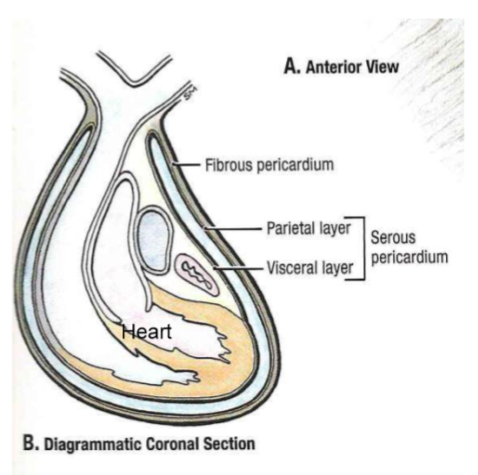
Parts of pericardium
Pericardium is made of fibrous and serous pericardium. Serous pericardium has 2 parts: 1. Parietal layer - connected with the fibrous pericardium 2. Visceral layer - forming the inner layer of the pericardium tissue, touching the heart
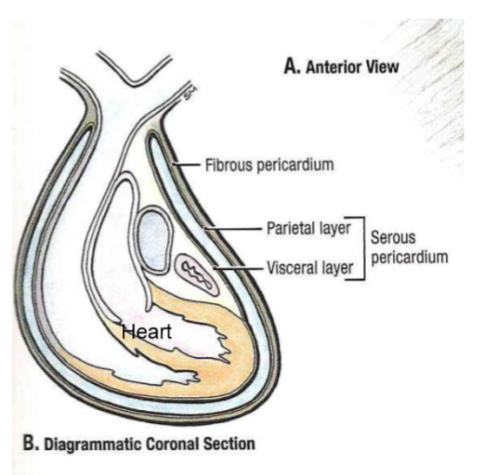
Coronal place
Head band across the head is the coronal plane
Facts about fibrous pericardium
- It is inelastic, but it can slowly grow to accomodate a growing heart 2. Fibrous pericardium fuses with the diaphragm 3. The heart hangs inside the lumen of the fibrous pericardium, it is 2 to 4 cm below the fibrous pericardium
Pericardial fluid
- Made by the visceral pericardium 2. It is essentially an ultra filtrate of plasma 3. About 20 ml of fluid 4. Function is to lubricate
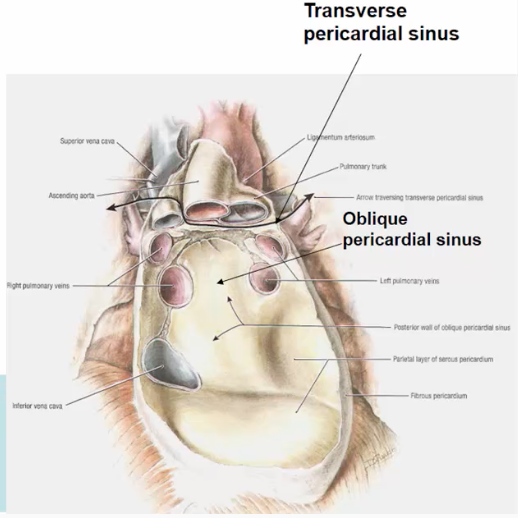
Transverse and oblique pericardial sinus
Transverse pericardial sinus is used to cut out heart in cadavers and doesnt have much clinical significance
Oblique pericardial sinus is where the fluids first accumulate when the cabbages are leaking in an open heart surgery. Ultrasound is done to check for accumulation of fluid
Cardiac Tamponade
Accumulation of fluid in the pericardial cavity of the heart that can be due to for example a stab wound that cuts open the pericardial sac and the walls of the heart such that blood starts to leak into the pericardial cavity.
As a results the heart cannot dilate as much to take in blood and that can be life threatening.
What is the clinical presentation of cardiac tamponade
- Jugular venous distention due to elevated venous pressure
- Distant heart sounds
- Hypotension
- Dyspnea
How is cardiac tamponade treated
By performing pericardiocentesis
- This process involved removing excessive fluid from the pericardial cavity with the help of a needle and a syringe
- Performed with the aid of an ultrasound
Paricarditis
- Inflammation of the walls of the pericardial sac, can be due to infection or malignancy.
- Acute pericarditis can be fibrous (viral), purulent (bacterial) or hemorrhagic (blood).
- Pain reamains substernal
- Clinically it is different from MI since the patients when they lay down or take deep breaths causes their heart to push against the wall of the pericardial sac which causes even more pain whereas in MI it relieves pain
Pericardial friction rub
- Highly characteristic of pericarditis
- Friction and vibration occur due to the serous layer of the pericardium being rough
- Sound is louder with EXPIRATION
- Sounds like a squeaky rubber
Anatomy of the pericardial sac and its associated structures
- Blood comes from the pericardiophrenic artery
- Innervations of the pericardial sac are from the phrenic nerve - “C3, 4, 5 keeps the diaphragm alive”
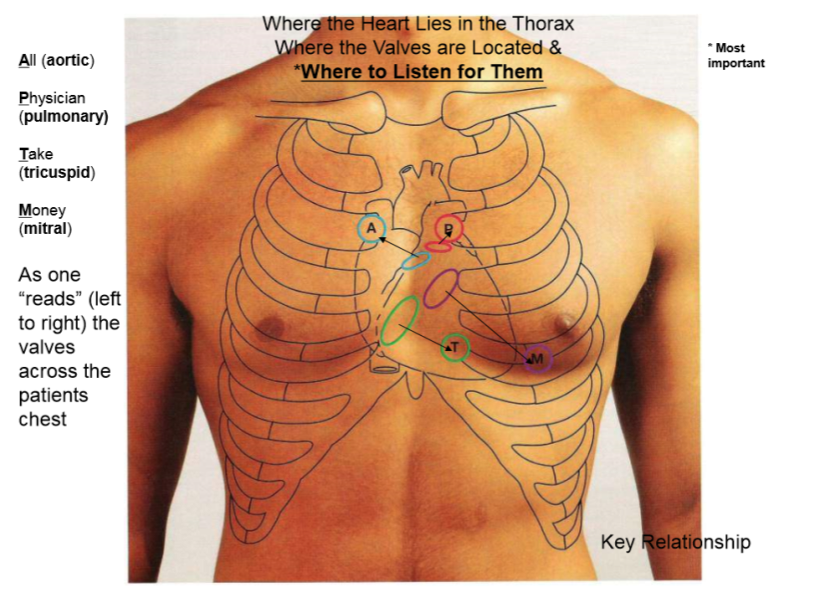
Best places to hear the heart sounds
Coronary suculus
Seperates atria from the ventricles
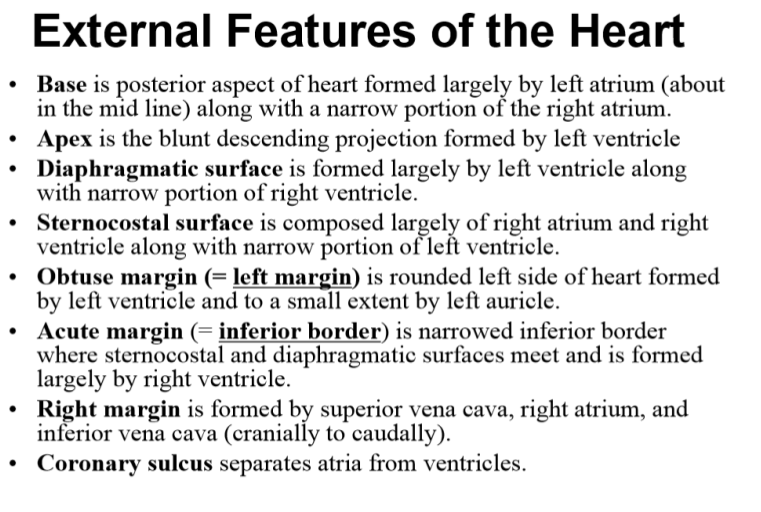
Know where these structures are
There are 8
Base
Apex
Diaphragmatic surface
Sternocoastal surface
Obtuse margin
Acute margin
Right margin
Coronary suculus
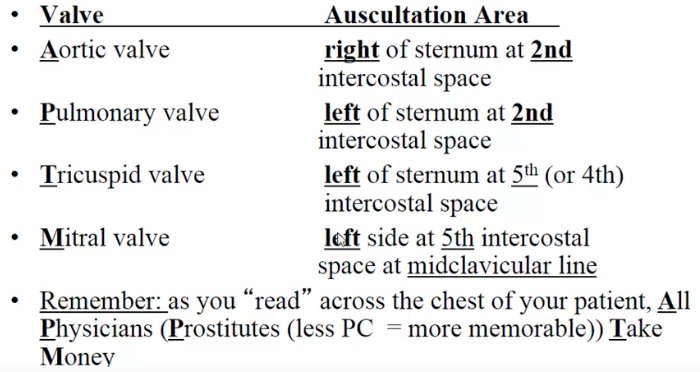
What is the pnemonic and its corresponding location on the patient’s chest
Fibrous skeleton of the heart
It is only clinically relevant when the fiber stretches and the valve is no longer able to perform its function. It is called the heart valve failing - 50% of aortic valve insufficiency is due to the stretching of the fibrous skeleton of the heart

-
Body Fluids and Electrolytes20
-
Cell Biology and Histology of Vascular System24
-
Heart Structures17
-
Lipoprotein structure10
-
Body Fluids Flipped Class4
-
Congenital Heart Defects32
-
Resting Potential Generation8
-
Cardiac Myocyte19
-
Histo Vascular12
-
Action Potential Generation29
-
Normal Cardiac Electrophysiology45
-
Normal Heart Exam20
-
Electrocardiography25
-
Abnormal Electrophysiology48
-
Autonomic Nervous System48
-
Cardiac Cycle27
-
Myocardial Performance41
-
Treatment of Cardiovascular Disorders27
-
Hemodynamics33
-
Infectious and Valve Disease26
-
Sepsis9
-
Vasculitis Disorder24
-
Microcirculation22
-
Hypotension19
-
Cardiac Valve Dysfunction14
-
Cardiac Output and Shunts17
-
Cardiomyopathies24
-
Regional Circulations28
-
Hypertension25
-
Coagulation and Fibrinolysis25
-
Atherosclerosis22
-
Development of Heart47
-
Drugs29
-
Drugs - Randomized29
-
Treatment of Cardiovascular diseases drugs12
-
Lipoproteins24
-
Katie Diseases5


