THE MIDBRAIN
KEY FEATURES
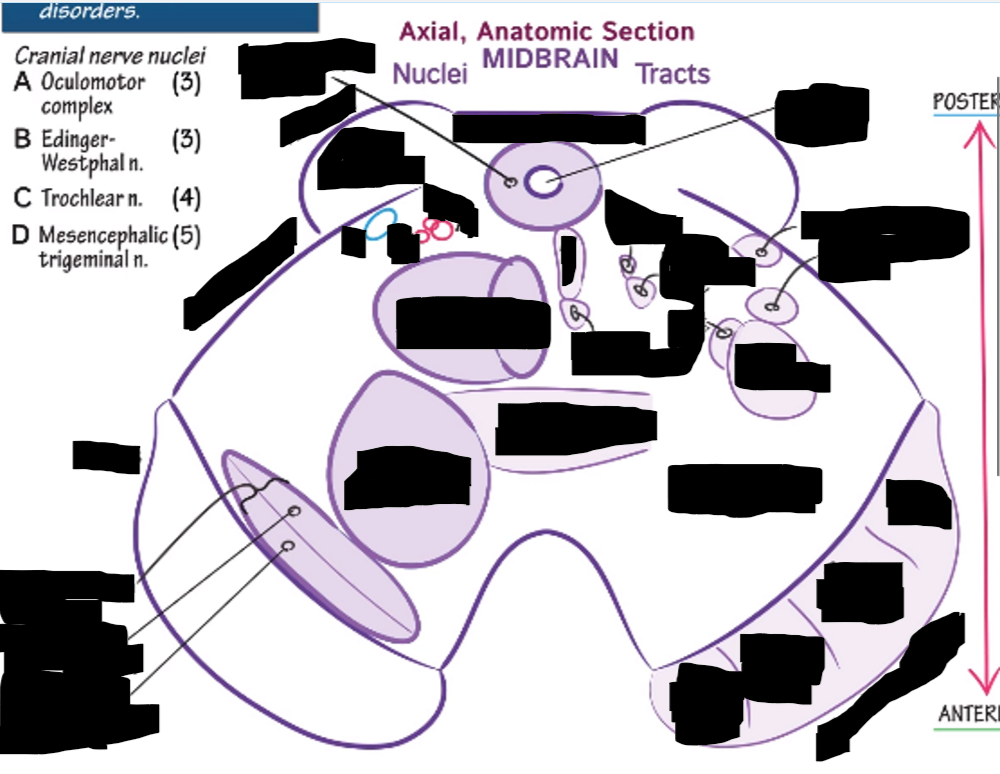
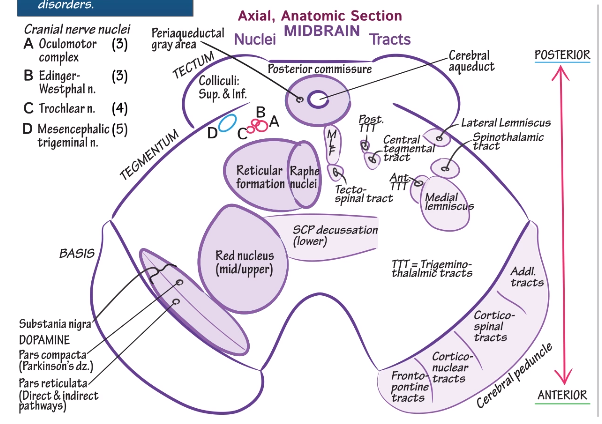
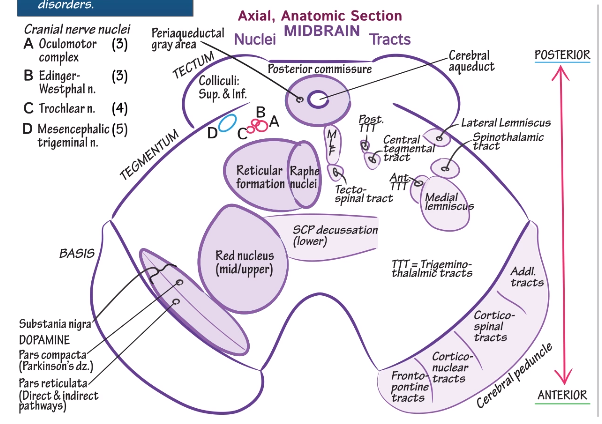
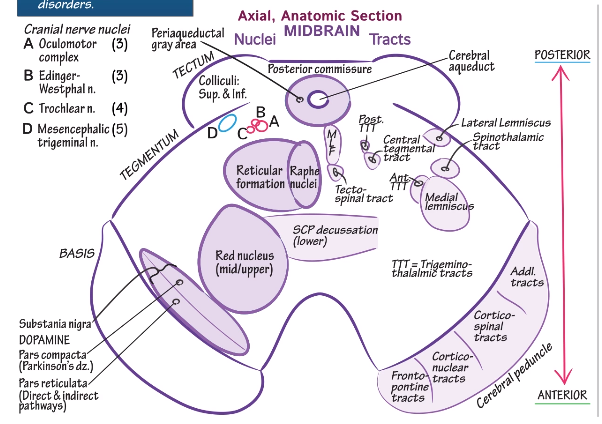
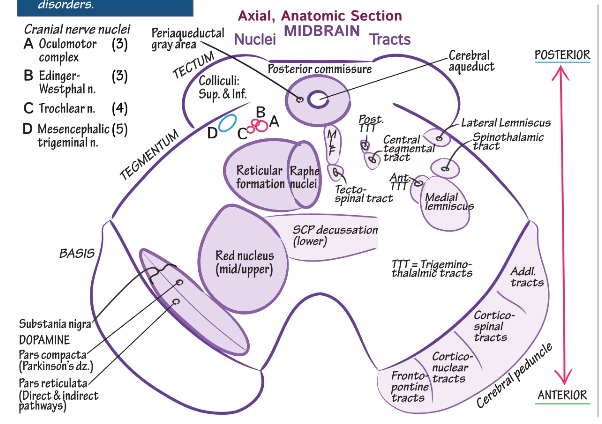
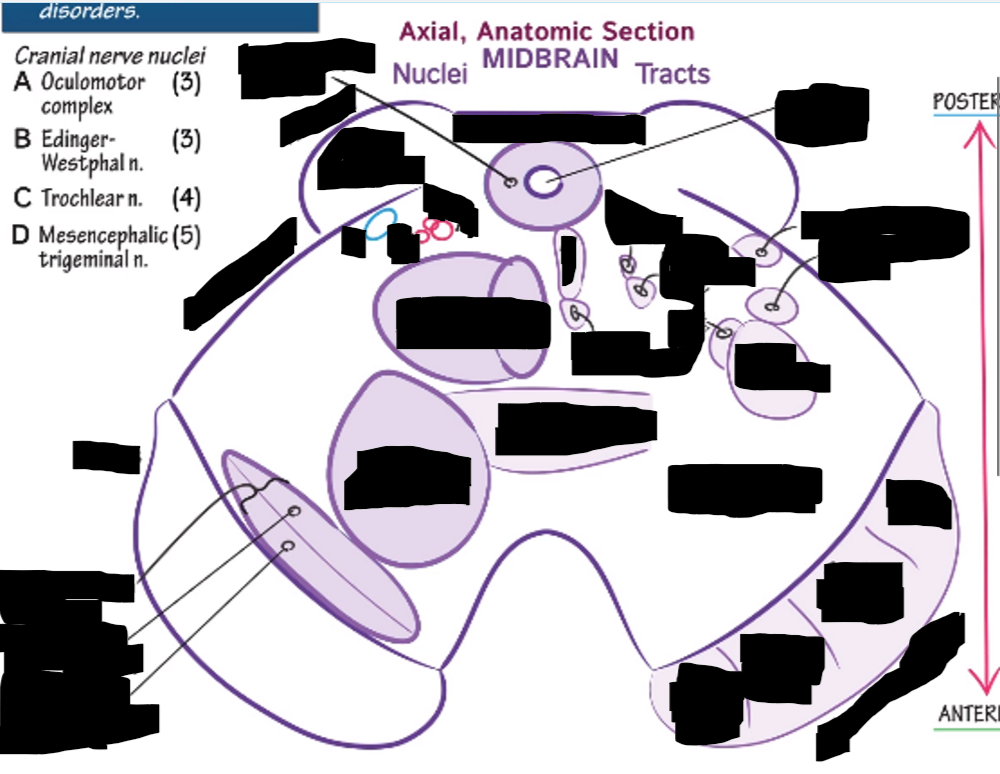
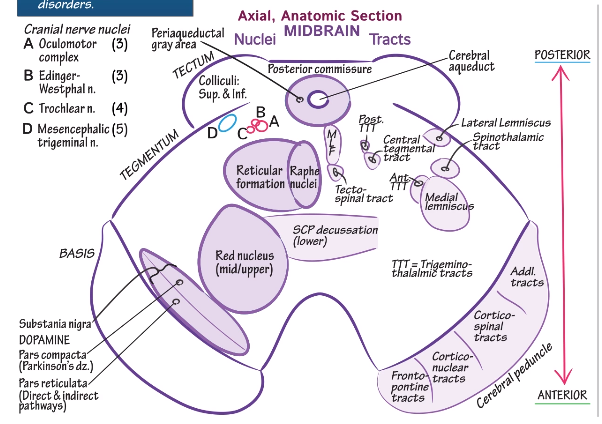
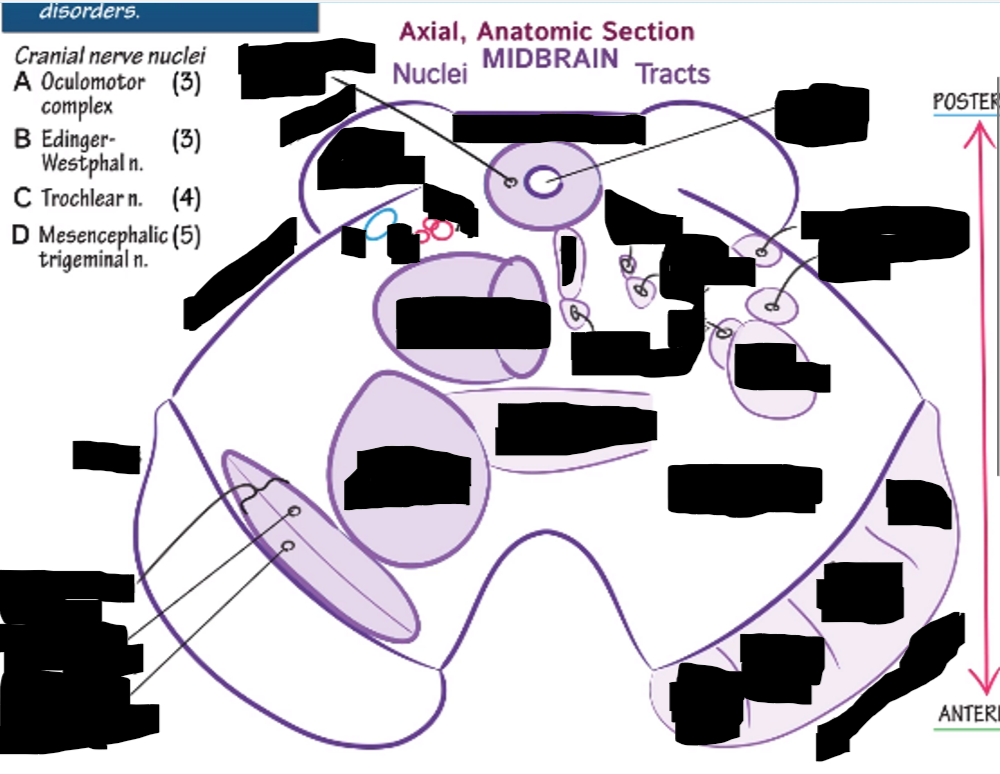
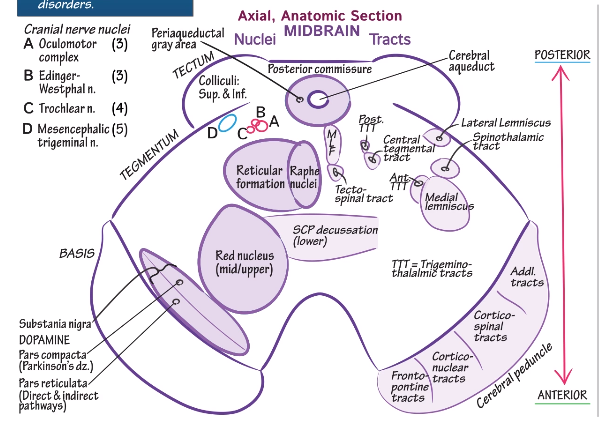
- The cerebral peduncles lie anteriorly.
- The posterior commissure lies posteriorly.
- The bilateral, thinly-shaped substantia nigra are essential for motor activation.
- The bilateral, circular-shaped, red nuclei.* The colliculi lie posteriorly.
- The cerebral aqueduct (of Sylvius) is the midbrain portion of the brainstem CSF.
- The periaqueductal gray area surrounds the cerebral aqueduct.
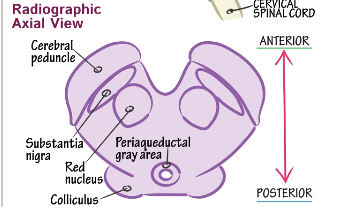
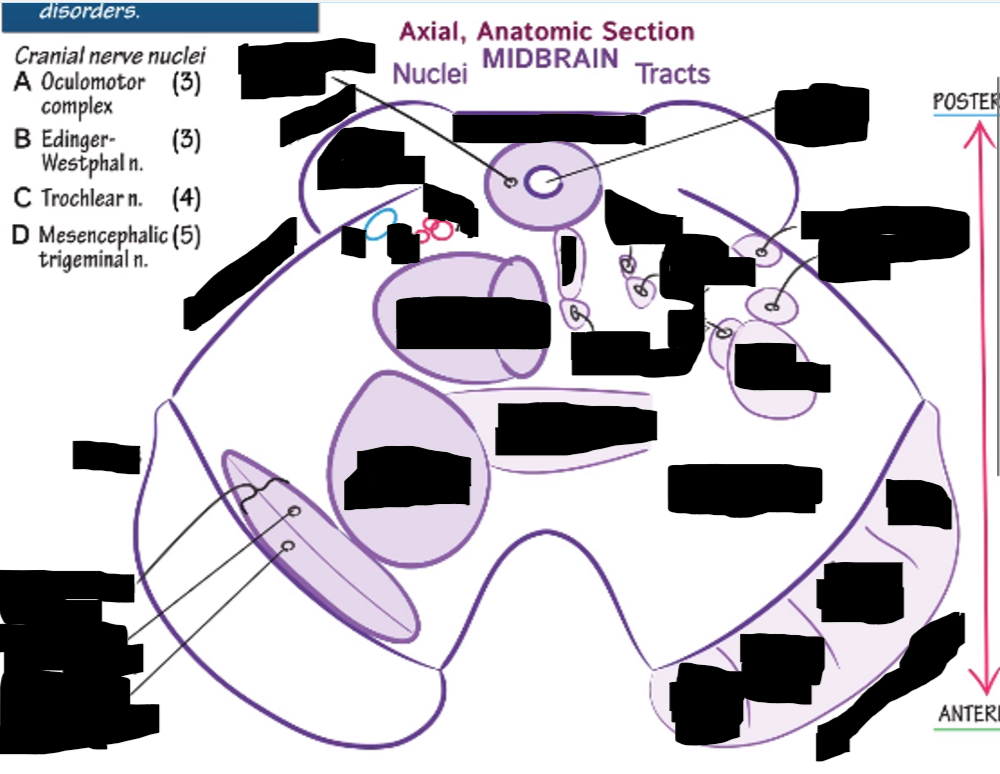
Identify
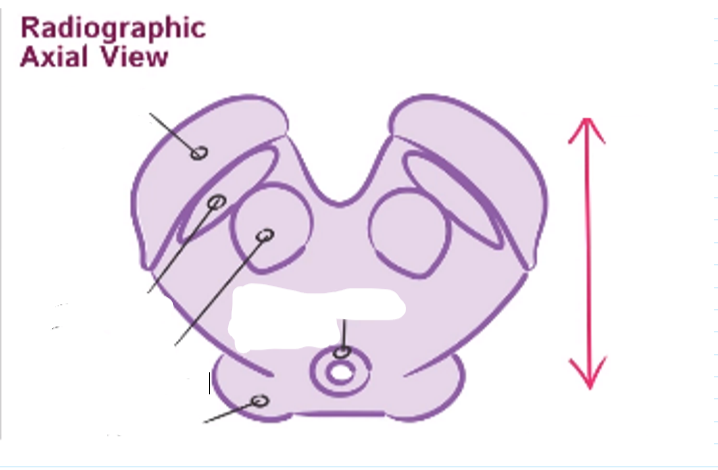
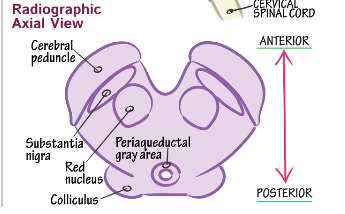
Identify
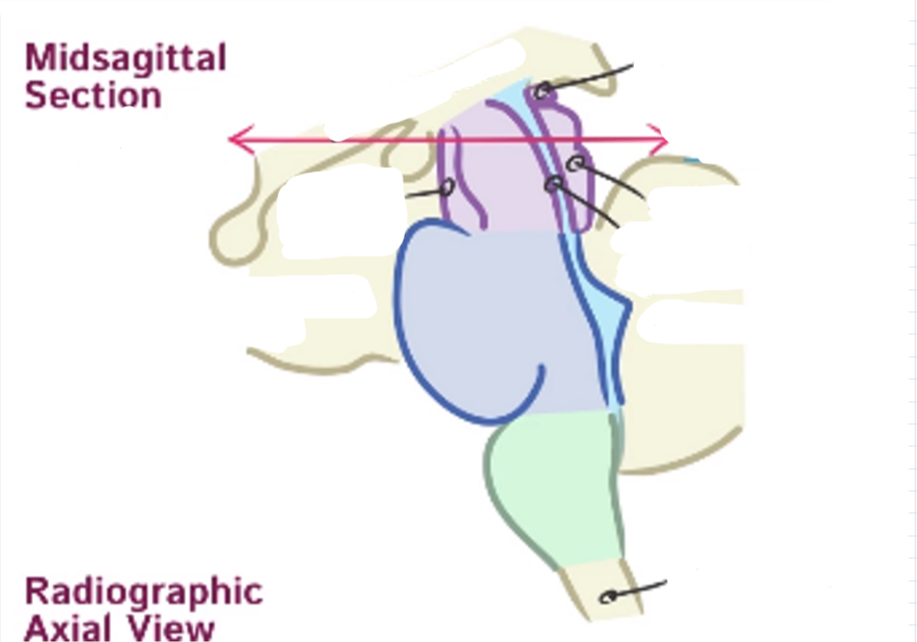
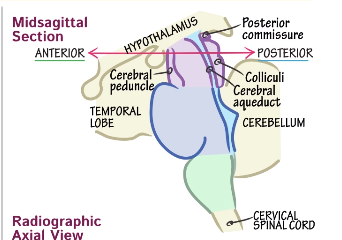
Identify
cerebral peduncle (aka crus cerebri)
The center of the crus divides into the corticonuclear tracts (aka corticobulbar tracts), medially, and the corticospinal tracts, laterally.
Weber’s Syndrome AKA
Midbrain Stroke
Midbrain Stroke: Weber’s Syndrome
A syndrome of ipsilateral third nerve palsy and contralateral face and body weakness from injury to the paramedian midbrain.
CLINICAL CASE
Patient presents with sudden onset of double vision and right-side weakness. Exam reveals left eye third nerve ophthalmoplegia with impaired pupillary constriction and also right face, arm, and leg weakness.
substantia nigra
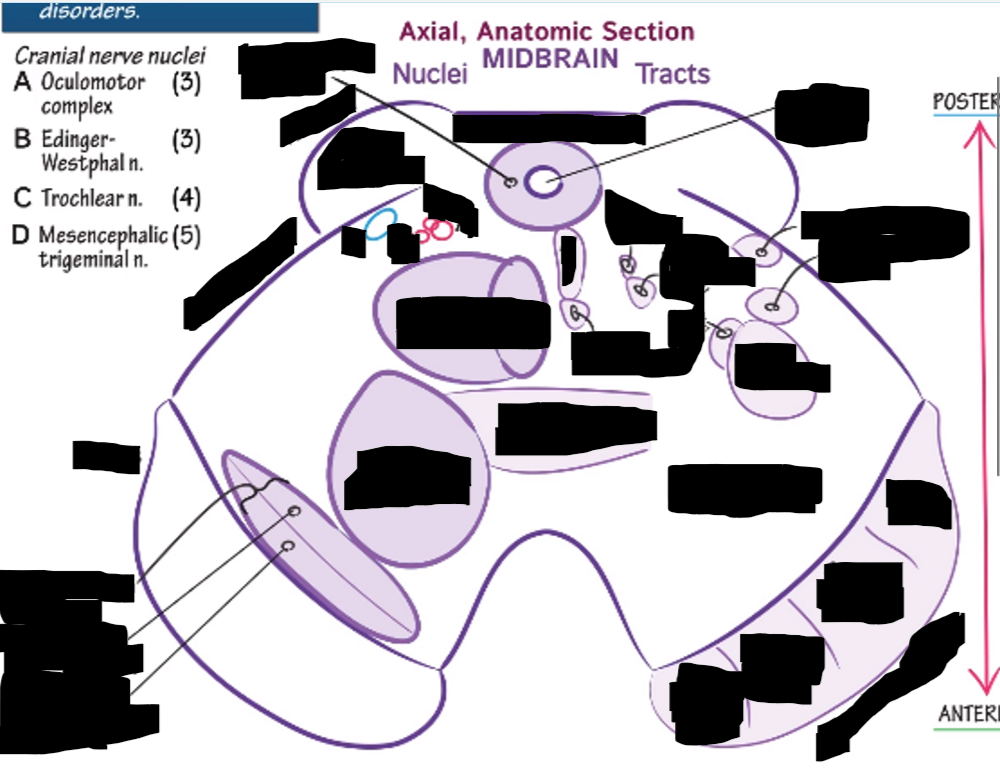
- lies just posterior to the white matter pathways in the base of the midbrain. It relies on dopamine, so its melanin-rich. The substantia nigra divides into:
- The pars compacta (posteriorly); loss of dopamine in the pars compacta results in Parkinson’s disease.
- The pars reticulata (anteriorly); this iron-rich division of the substantia nigra is fundamental to the direct and indirect pathways
red nucleus
- The red nucleus produces upper extremity flexion movements, which are observed in decorticate posturing – we discuss this in detail elsewhere.
Lateral midbrain
Cluster of major sensory tracts:
- Medial lemniscus.
- Anterior trigeminothalamic tract (we abbreviate TTT for trigeminothalamic trac).
- The spinothalamic tract (of the anterolateral system) (moving posteriorly).
- Then, the lateral lemniscus.
- The posterior trigeminothalamic tract (further posterior).
Periaqueductal gray area
- Most notably contains opioids, which help in pain control.
- It is also packed with neuropeptides, monoamines, and amino acids.
- Electrical stimulation of the periaqueductal gray area to produce analgesia was first attempted in the 1970s but has had mixed results. Of note, the periaqueductal gray area receives ascending spinomesencephalic fibers via the anterolateral system, which play a role in the emotional aspect of pain, and it receives descending fibers from the hypothalamus via the dorsal longitudinal fasciculus.# Periaqueductal gray area functions include far-reaching modulation of sympathetic responses (ie, pupillary dilation and cardiovascular responses); parasympathetic-induced micturition; modulation of reproductive behavior; and even affect locomotion and vocalization. However, its most widely recognized function is in pain modulation.
Medial longitudinal fasciculus AKA
MLF
Medial longitudinal fasciculus
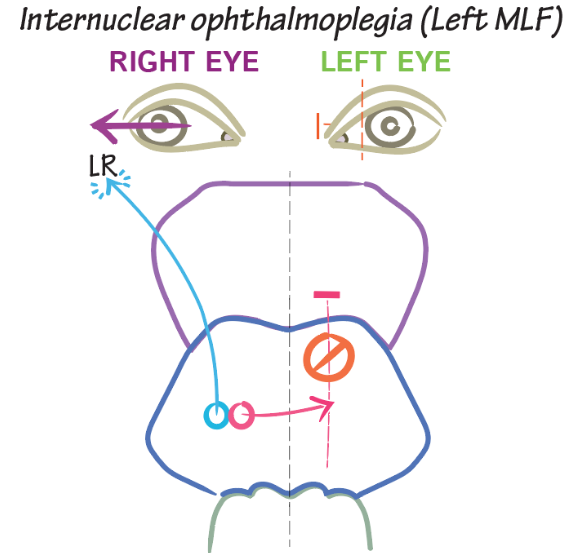
Plays an important role in conjugate horizontal eye movements.
Clinical Correlation - Internuclear ophthalmoplegia (MLF syndrome)
Internuclear ophthalmoplegia (MLF syndrome)
In an internuclear ophthalmoplegia, the unaffected eye abducts but the ipsilateral eye is unable to adduct. The unaffected eye is not totally unaffected, it actually has horizontal nystagmus upon abduction, presumably because of the divergence that occurs from the left eye adduction failure. It commonly occurs from demyelinating plaques in multiple sclerosis.
Reticular formation
Serves numerous functions; the most notable one is helping to produce wakefulness.
Initially, the indistinct histology of the reticular formation led people to believe it was simply a “diffuse arousal network,” but now the functional specialization of the reticular formation is well recognized.
The reticular formation divides into lateral, medial, and median zones. Indicate that the raphe nuclei populate the median zone.
They are primarily serotinergic and are modulated by psychotropic medications.
The raphe nuclei affect
sleep–wake cycles, pain management, and motor activity but are most commonly referenced for their role in mood disorders and the hallucinatory effects of illicit drugs.
The raphe nuclei lie along
much of the height of the midline brainstem as six separate subnuclei, which divide into rostral and caudal nuclear groups based on whether they lie above or below the mid-pons. The rostral raphe group (aka oral raphe group) comprises the upper pontine and midbrain raphe nuclei: the caudal linear, dorsal raphe, and median raphe nuclei.
The caudal raphe group comprises
the lower pontine and medullary raphe nuclei: the raphe magnus, raphe obscurus, and raphe pallidus nuclei. Note that additional serotinergic reticular formation areas are also categorized as part of the raphe nuclei.
Efferent projections from the rostral raphe group
mostly ascend into the upper brainstem and forebrain, whereas projections from the caudal raphe group primarily descend into the lower brainstem and spinal cord. Afferents to the raphe nuclei also exist, which generally originate from behavioral brain areas.
Posterior commissure
A white matter tract involved in the pupillary light reflex.
The nucleus of the posterior commissure helps control vertical eye movements.
Dorsal Midbrain Syndrome AKA
Parinaud Syndrome)
Dorsal Midbrain Syndrome (aka Parinaud Syndrome) Manifestations
Manifestations of Dorsal Midbrain Syndrome
- Upgaze palsy with convergence-retraction nystagmus
- Meaning when the patient attempts to look up, there is convergent/retractory episodic jerking.
- Eyelid retraction
- Light-near dissociation
- Meaning, the pupils do NOT respond to light but do constrict to near response.
Dorsal Midbrain Syndrome (aka Parinaud Syndrome) Common Causes
Compressive:
- Pineal Tumors
- Hemorrhages with dorsal midbrain compression
Non-compressive:
- MS plaques
- Dorsal midbrain ischemic strokes
- Neuroinfectious causes
Superior colliculi
Involved in visual function.


-
Neuroscience Week 1: Cranial Nerves110
-
Neuroscience Week 1: Cranial Nerve V (Trigeminal Nerve)8
-
Neuroscience Week 1: Cranial Nerve VII (Facial Nerve)1
-
Neuroscience Practical 181
-
Neuroscience Week 1: Craniofacial Embryology45
-
Neuroscience Week 1: Eye Structure26
-
Neuroscience Week 1: Extraocular Muscles16
-
Neuroscience Week 2: Topography and Functional Levels of CNS105
-
Neuroscience Week 2: Myelin Disorders75
-
Neuroscience Week 2: Organization and Cellular Components of the Nervous System144
-
Neuroscience Week 2: Development of the CNS & PNS119
-
Neuroscience Week 2: Neurotransmitters133
-
Neuroscience Week 3: Motor Unit and Fiber types28
-
Neuroscience Week 3: Muscle Stretch Reflex37
-
Neuroscience Week 3: Brainstem and Cranial Nerves39
-
Neuroscience Week 3: Herniation Syndromes8
-
Neuroscience Week 3: Motor Neuron Signs18
-
Neuroscience Week 3: Spinal Cord Lesions23
-
Neuroscience Week 3: Common Cranial and Facial nerve Lesions24
-
Neuroscience Week 3: Diseases Associated with Peripheral Nerve Injury11
-
Neuroscience Week 3: Congenital Malformations and Perinatal Brain Injury12
-
Neuroscience Week 3: Lower Motor Neurons119
-
Neuroscience Week 3: Spinal Cord Overview33
-
Neuroscience Week 3: Major Tracts of the Spinal Cord24
-
Neuroscience Week 3: Descending Spinal Cord Pathways41
-
Neuroscience Week 3: Ascending Spinal Tracts23
-
Neuroscience Week 3: Meninges and CSF23
-
Neuroscience Week 3: Motor & Sensory Projections28
-
Neuroscience Week 3: Cerebral White Matter7
-
Neuroscience Week 3: Basal Ganglia7
-
Neuroscience Week 3: Diencephalon8
-
Neuroscience Week 3: Spinal Cord Disorders9
-
Neuroscience Week 3: Opioid Actions40
-
Neuroscience Week 3: Spastic Paralysis, Spinal Motor Organization and Brain Stem Supraspinal Paths91
-
Neuroscience Week 3: Somatosensory Systems44
-
Neuroscience Week 3: Opioid actions6
-
Neuroscience Week 3: Headaches89
-
Neuroscience Week 3: Anesthetics181
-
Neuroscience Week 3: Benzos and Barbs85
-
Neuroscience Week 3: Lab 2 Study Guide39
-
Neuroscience Week 4: Basal Ganglia and Thalamic Anatomy79
-
Neuroscience Week 4: Basal Ganglia Motor Loop48
-
Neuroscience Week 4: AntiParkinsons meds44
-
Neuroscience Week 4: Cerebellar anatomy24
-
Neuroscience Week 4: Cerebellar pathways34
-
Neuroscience Week 4: Cerebellar histology and circuitry43
-
Neuroscience Week 4: Neurodegenerative Disorders78
-
Neuroscience Week 4: Cerebellum66
-
Neuroscience Week 5: Autonomic Nervous System Functional Anatomy43
-
Neuroscience Week 5: Autonomic Nervous System: Parasympathetic Functional Anatomy46
-
Neuroscience Week 5: The midbrain41
-
Neuroscience Week 5: The Pons31
-
Neuroscience Week 5: The Medulla25
-
Neuroscience Week 5: Eye movements5
-
Neuroscience Week 5: Brainstem146
-
Neuroscience Week 5: Cholinergic Pharmacology I39
-
Neuroscience Week 5: Cholinergic Pharmacology II46
-
Neuroscience Week 5: Gaze Disorders34
-
Neuroscience Week 5: Adrenergic Phys 156
-
Neuroscience Week 5: Adrenergic Phys 249
-
Neuroscience Week 5: Autonomic Reflexes and Integration60
-
Neuroscience Week 5: Tumors of the CNS109
-
Neuroscience Week 5: Drug Review1
-
Neuroscience Week 6: Limbic System102
-
Neuroscience Week 6: Auditory85
-
Neuroscience Week 6: Cerebral Cortex110
-
Neuroscience Week 6: Cortical connections2
-
Neuroscience Week 6: Gustatory38
-
Neuroscience Week 6: Olfactory15
-
Neuroscience Week 6: Seizures88
-
Neuroscience Week 6: Causes of Seizures27
-
Neuroscience Week 6: Stroke and Hemorrhage1
-
Neuroscience Week 6: Anticonvulsants219
-
Neuroscience Week 6: Neuroradiology of vascular diseases80
-
Neuroscience Week 6: Neuroradiology of vascular diseases cases13
-
Neuroscience Week 6: Cerebrovascular disease79
-
Neuroscience Week 6: CNS Trauma41
-
Neuroscience Week 7: Psych Dx and Delirium98
-
Neuroscience Week 7: Mental Status Exam17
-
Neuroscience Week 7: Infant attachment86
-
Neuroscience Week 7: Child Development107
-
Neuroscience Week 7: Sleep Disorders152
-
Neuroscience Week 7: Psychotherapy and Defense Mechanisms59
-
Neuroscience Week 7: Mechanisms of Learning and Memory61
-
Neuroscience Week 7: Frontal Lobes62
-
Neuroscience Week 7: Neurodevelopmental disorders49
-
Neuroscience Week 7: ADHD and Stimulant Drugs84
-
Neuroscience Week 8: Personality Disorders54
-
Neuroscience Week 8: Depressive Disorders81
-
Neuroscience Week 8: Treatments of Depressive Disorders22
-
Neuroscience Week 8: Bipolar Disorders Drugs21
-
Neuroscience Week 8: Depression Drugs132
-
Neuroscience Week 8: Anxiety disorders57
-
Neuroscience Week 8: Mood disorder drugs CBL34
-
Neuroscience Week 8: Psychotic Disorders43
-
Neuroscience Week 8: Anti-psychotic drugs102


